Theme 4 (ECON) - Economic Systems

🌍AP World History: Modern Review
Theme 4 (ECON) - Economic Systems
🌍 AP World History: Modern
Overview
Theme 4 (ECN, often written ECON) in AP World History: Modern is Economic Systems: how societies produce, exchange, and consume goods and services, and how those choices shape everything else. The official one-sentence version: "As societies develop, they affect and are affected by the ways that they produce, exchange, and consume goods and services." ECN is one of the six themes explicitly assessed on the AP exam, and it shows up everywhere, from multiple-choice sets built on trade statistics to DBQs on silver, industrial capitalism, and globalization. If you can trace how trade networks, labor systems, and economic ideologies change from 1200 to the present, you have one of the most reliable essay frameworks in the course.
Key Takeaways
- Song China's growing production and trade show how economies commercialized, while innovations helped expand the Silk Roads, Indian Ocean, and trans-Saharan trade networks.
- From 1450 to 1750, empires collected taxes and tribute, European rulers used mercantilism, and American silver and colonial labor connected economies across oceans.
- Industrialization spread factory production, while capitalism and free trade grew, workers organized for better conditions, and industrial economies drew other regions into raw-material exports and labor migration.
- After the Great Depression, governments took a more active economic role; Soviet and Chinese command economies and development policies in newly independent states showed different forms of state control.
- In the late 20th century, many governments adopted free-market policies as manufacturing increasingly moved to Asia and Latin America, but global integration also faced protests over unequal consequences.
What This Theme Means
ECN asks two core questions. How do people secure food, work, and wealth? And how do production, exchange, labor, and economic ideas reshape societies over time? The theme breaks into five strands, and sorting your examples into these buckets makes review much easier:
- Agricultural and pastoral production. Farming was the foundation of most economies for most of history. Think Champa rice in Song China, chinampas in Mesoamerica, terrace farming in the Andes, and later the plantation agriculture that grew sugar, tobacco, and cotton for global markets.
- Trade and commerce. The networks that moved goods, money, and merchants: the Silk Roads, the Indian Ocean, the trans-Saharan routes, and after 1450, a genuinely global economy.
- Labor systems. Who does the work and under what conditions: serfdom, the mit'a, encomienda, chattel slavery, indentured servitude, factory labor.
- Industrialization. The shift from craft production to mechanized factory production, starting in Britain and spreading to Europe, the United States, Russia, and Japan.
- Capitalism and socialism. Competing ideas about who should own the means of production, from Adam Smith's free markets to Marx's communism to late-20th-century economic liberalization.
ECN overlaps constantly with other themes. Tax systems blur into Theme 3 (GOV) governance, transportation and commercial technologies blur into Theme 6 (TECH), and the Columbian Exchange blurs into Theme 1 (ENV). That overlap is a feature. Essay prompts often combine themes.
ECN Across the Nine Units
Here's the whole arc at a glance, then the details.
| Period | What happens with economic systems |
|---|---|
| c. 1200-1450 (Units 1-2) | Song China commercializes; Silk Road, Indian Ocean, and trans-Saharan networks expand with new commercial practices and money economies |
| 1450-1750 (Units 3-4) | Land-based empires refine taxation; maritime empires build mercantilism, joint-stock companies, global silver flows, and coerced labor in the Americas |
| 1750-1900 (Units 5-6) | Industrial capitalism replaces mercantilism, socialism emerges as a challenge, and economic imperialism reorganizes Asia, Africa, and Latin America |
| c. 1900-present (Units 7-9) | The Great Depression triggers state intervention, command economies rise, new nations pursue state-guided development, then free-market liberalization goes global |
Units 1 and 2: Commercialization and Networks of Exchange (c. 1200-1450)

Song China is your anchor example for a commercializing economy. The Song economy flourished because of increased productive capacity, expanding trade networks, and innovations in agriculture and manufacturing: Champa rice boosted food output and population, the Grand Canal expansion moved goods internally, and iron, steel, textiles, and porcelain were produced for export. Crucially, this economy still depended on free peasant and artisanal labor. Western Europe in the same period looked very different, a largely agricultural society relying on free and coerced labor, including serfdom under the manorial system.
Unit 2 is the course's first concentrated ECN unit, because trade networks are its whole subject:
- The Silk Roads. Improved commercial practices increased the volume and geographic range of trade and fueled powerful trading cities like Kashgar and Samarkand. The key innovations were the caravanserai (roadside inns for merchants) and money economies: bills of exchange, banking houses, and paper money. Demand for luxury goods rose across Afro-Eurasia, so Chinese, Persian, and Indian artisans expanded textile and porcelain production for export, and Chinese iron and steel manufacture grew.
- The Mongols. Mongol expansion facilitated Afro-Eurasian trade and communication as conquered peoples were drawn into Mongol-controlled economies and trade networks. The Pax Mongolica made overland commerce safer.
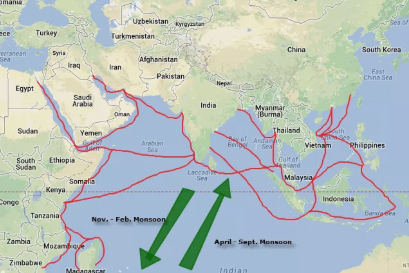
- The Indian Ocean. The compass, the astrolabe, and larger ship designs (Arab dhows, Chinese junks), plus improved commercial practices, expanded the largest sea-based network. Merchants rode the monsoon winds, and the network fostered the growth of states: the Swahili Coast city-states, Gujarat, and the Sultanate of Malacca.
- The trans-Saharan network. The camel saddle and caravan organization made Saharan crossings practical, expanding trade in gold and salt and drawing new peoples into Mali's orbit as the empire expanded. Trading cities like Timbuktu grew rich on this commerce.
In the Americas, the Mexica extracted goods and labor through a tribute system, while the Inca required rotating labor service through the mit'a. Remember the mit'a; the Spanish recycle it in Unit 4.
Unit 3: Empires and the Money to Run Them (1450-1750)
Land-based empires needed revenue, so rulers built systems of tribute collection, tax farming, and innovative tax collection to fund state power and expansion. The four examples to know: Mughal zamindar tax collection, Ottoman tax farming, Mexica tribute lists, and the Ming practice of collecting taxes in hard currency. Armed trade, backed by gunpowder and cannons, underpinned imperial expansion in both hemispheres.
Unit 4: The First Global Economy (1450-1750)

This unit carries the period's defining economic transformations:
- Maritime empires. Portuguese maritime technology produced a global trading-post empire. Spanish sponsorship of Columbus increased European interest in transoceanic trade, and England, France, and the Dutch Republic sought alternative routes to Asia.
- Mercantilism and joint-stock companies. European rulers used mercantilist policies to expand and control their economies and claim overseas territories, hoarding bullion and favoring exports over imports. Joint-stock companies financed exploration and global trade competition. The idea is simple: instead of one investor risking a fortune on a voyage that might sink, many investors pool money, share the risk, and split the profits. The Dutch East India Company is the classic chartered monopoly example, and the British East India Company eventually fielded its own army in South Asia.
- The global silver flow. Silver from Spanish American mines, especially Potosí, was used to purchase Asian goods for Atlantic markets and to satisfy Chinese demand for silver. This is the single best example of a truly global commodity circuit, and the silver influx contributed to inflation in both China and Spain.
- Labor systems. Colonial economies in the Americas depended on agriculture and used existing labor systems, including the Incan mit'a, while introducing chattel slavery, indentured servitude, and the encomienda and hacienda systems. The growth of the plantation economy increased demand for enslaved labor in the Americas, even as enslavement in Africa continued in older forms (incorporation into households, export to Mediterranean and Indian Ocean markets). The result was the triangular trade linking the Americas, Europe, and Africa.

- Continuity matters here. Despite disruption from Portuguese, Spanish, and Dutch merchants, existing Indian Ocean trade networks continued to flourish, run by Swahili Arab, Omani, Gujarati, and Javanese merchants. Regional Afro-Eurasian markets thrived, and peasant and artisan labor intensified to feed export demand: Western European wool and linen, Indian cotton, Chinese silk.
Units 5 and 6: Industrial Capitalism and Its Consequences (1750-1900)
Industrialization is the biggest economic transformation in the course. The enabling factors: improved agricultural productivity, legal protection of private property, access to foreign resources, and accumulation of capital. Steam-powered industrial production raised Europe's and the United States' share of global manufacturing while Middle Eastern and Asian shares declined, including Indian shipbuilding and iron works and textile production in India and Egypt. Industrial methods spread to other parts of Europe, the United States, Russia, and Japan, and some states ran the process themselves: Muhammad Ali's cotton textile industry in Egypt and Meiji Japan are the state-sponsored examples.
The ideology shifted too. Western European countries began abandoning mercantilism and adopting free trade policies, driven by growing acceptance of Adam Smith's laissez-faire capitalism and free markets. Global trade and production drove the proliferation of large-scale transnational businesses relying on new banking and finance practices: the Hong Kong and Shanghai Banking Corporation (HSBC), Unilever operating in British West Africa and the Belgian Congo, plus stock markets and limited-liability corporations. Industrial capitalism raised standards of living for some and made consumer goods more available, affordable, and varied.
But it also generated backlash. Workers organized labor unions to improve working conditions, limit hours, and gain higher wages, and discontent fueled the ideas of Karl Marx, socialism, and communism. That capitalism-versus-socialism tension runs through the rest of the course.
Unit 6 shows what industrial economies did to everyone else:
- Economic imperialism. Industrialized states and their businesses practiced economic imperialism primarily in Asia and Latin America. Britain and France expanded influence in China through the Opium Wars, and the Port of Buenos Aires was built with British firms' support.
- Rigged commodity trades. Trade was organized to advantage European and U.S. merchants: opium produced in the Middle East or South Asia and exported to China, cotton from South Asia and Egypt exported to Britain, palm oil from sub-Saharan Africa, copper extracted in Chile.
- Export economies. The need for factory raw materials and urban food supplies pushed regions into commercial extraction: Egyptian cotton, Amazon and Congo rubber, West African palm oil, Peruvian and Chilean guano, Argentine and Uruguayan meat, African diamonds. Profits went to buying back finished goods.
- Labor migration. Many migrants relocated freely in search of work, but the new global capitalist economy continued to rely on coerced and semicoerced labor, including enslavement, Chinese and Indian indentured servitude, and convict labor. Indentured labor often expanded exactly where Atlantic slavery was abolished, which is a great continuity-and-change point.
Unit 7: War, Depression, and the Interventionist State (c. 1900-1945)
Competition for resources is a named cause of World War I, and the global economic crisis of the Great Depression is a named cause of World War II. The Depression is the pivot: after World War I and the onset of the Great Depression, governments began taking a more active role in economic life. Know the spread of responses: the New Deal in the United States, the fascist corporatist economy in Italy and Germany, popularly backed governments in Brazil and Mexico, and at the extreme, the Soviet Union, where the government controlled the national economy through the Five Year Plans, often with repressive policies and negative repercussions for the population.
Unit 8: Cold War Economies and Decolonization (c. 1945-1990)
The Cold War itself was a power struggle between capitalism and communism across the globe, so economic ideology is baked into the whole unit. In China, after communists came to power, the government controlled the national economy through the Great Leap Forward, again with repressive policies and negative repercussions for the population. Movements to redistribute land and resources developed across Africa, Asia, and Latin America, sometimes advocating communism or socialism: the communist revolution for Vietnamese independence, Mengistu Haile Mariam in Ethiopia, land reform in Kerala and other Indian states, and the White Revolution in Iran.
In newly independent states after World War II, governments often took a strong role in guiding economic life to promote development. The four named leaders are Nasser in Egypt, Indira Gandhi in India, Julius Nyerere in Tanzania, and Sirimavo Bandaranaike in Sri Lanka. The big takeaway: the role of the state in the domestic economy varied widely, and new institutions of global association kept developing throughout the century.
Unit 9: Globalization and Free Markets (late 20th century-present)
In a trend accelerated by the end of the Cold War, many governments encouraged free-market policies and economic liberalization in the late 20th century: the United States under Reagan, Britain under Thatcher, China under Deng Xiaoping, and Chile under Pinochet. Revolutions in information and communications technology produced knowledge economies in some regions (Finland, Japan, the United States) while industrial production and manufacturing increasingly moved to Asia and Latin America (Vietnam and Bangladesh; Mexico and Honduras).
Multinational corporations like Nestlé, Nissan, and Mahindra and Mahindra, plus trade institutions and agreements like the WTO, NAFTA, and ASEAN, reflected the spread of free-market principles worldwide. Not everyone cheered: responses included anti-IMF and anti-World Bank activism, and movements like the World Fair Trade Organization protested the unequal economic and environmental consequences of global integration.
Key Concepts and Vocabulary
Build fluency with these terms and, just as important, know where each one lives in the timeline. The AP World key terms glossary has fuller definitions.
| Term | What it is and where it fits |
|---|---|
| Caravanserai | Inns along the Silk Roads that supported merchant caravans (c. 1200-1450) |
| Bills of exchange / banking houses / paper money | Money-economy innovations that expanded Silk Road trade |
| Serfdom | Coerced agricultural labor in medieval Europe's manorial system |
| Mit'a | Incan rotating labor draft, later adapted by the Spanish for Andean mining |
| Encomienda and hacienda | Spanish colonial labor and land systems in the Americas |
| Chattel slavery | Treating enslaved people as hereditary property; basis of the Atlantic plantation economy |
| Mercantilism | State policy of accumulating wealth through regulated trade and colonies (1450-1750) |
| Joint-stock company | Investor-pooled, often state-chartered monopoly firm financing exploration and trade |
| Global silver flow | Spanish American silver buying Asian goods and feeding Chinese demand |
| Laissez-faire capitalism | Adam Smith's free-market theory that displaced mercantilism (1750-1900) |
| Industrial capitalism | Factory-based market economy; raised living standards for some, fueled inequality |
| Socialism and communism | Marx-era critiques calling for collective control of production |
| Labor unions | Worker organizations seeking better conditions, shorter hours, higher wages |
| Economic imperialism | Business and state domination of foreign economies (Opium Wars, Port of Buenos Aires) |
| Export economy | Region reorganized around extracting raw commodities (guano, rubber, palm oil) |
| Indentured servitude / convict labor | Semicoerced labor migration sustaining the 19th-century global economy |
| Five Year Plans / Great Leap Forward | Soviet and Chinese command-economy programs with repressive results |
| Economic liberalization | Late-20th-century free-market turn under Reagan, Thatcher, Deng, Pinochet |
| Knowledge economy | Information-technology-driven economies (Finland, Japan, U.S.) as manufacturing offshored |
| Multinational corporation | Firms operating across borders (Nestlé, Nissan, HSBC, Unilever) |
How to Use Theme 4 on the Exam
ECN appears across every section of the AP World exam: the 55 multiple-choice questions (40% of your score), the 3 short-answer questions (20%), the DBQ (25%), and the LEQ (15%). MCQs come in stimulus sets of three to four questions, and ECN stimuli frequently include charts and quantitative data (trade statistics, commodity flows) alongside primary and secondary texts. Released sample questions lean on this theme heavily: an 1836 passage on the opium trade is keyed as an early example of economic imperialism and compared to defenses of enslaved labor on sugar plantations, and paired Dow Chemical (1972) and NCR (1989) passages test economic liberalization, the shift of manufacturing to Asia and Latin America, and antiglobalization activism as the response.
For essays, know the chronological windows. DBQ topics come from 1450-2001, which is exactly the ECN sweet spot: the Atlantic system, mercantilism, industrial capitalism, economic imperialism, globalization. LEQ options sit in 1200-1750, 1450-1900, and 1750-2001 windows. SAQ 3 covers 1200-1750 (networks of exchange, silver, labor systems) and SAQ 4 covers 1750-2001 (industrialization onward).
Prompts recycle a few framings, so practice arguing each one:
- Causes and effects of the growth of networks of exchange. Commercial innovations cause trade growth; trade growth causes new trading cities and states.
- Continuities and changes in economic and labor systems. The strongest move: coerced labor never disappears, it changes form. Serfdom and mit'a become encomienda and chattel slavery, which become indentured servitude and convict labor after abolition.
- How rulers employed economic strategies to consolidate power. Zamindars, tax farming, tribute lists, mercantilism, Five Year Plans.
- Continuities and changes in the global economy from 1900 to present. Trace the pendulum: laissez-faire to Depression-era state intervention to command economies and state-guided development to free-market liberalization.
ECN also combines with other themes in essay prompts. A sample LEQ on whether 19th-century reform movements brought political or social change in industrial society blends this theme with governance, social organization, and technology, so don't silo your evidence.
Practice and Next Steps
Test the theme, not just the timeline. Run ECN-heavy stimulus sets in AP World guided practice, then write a continuity-and-change paragraph on labor systems or the role of the state and get it scored in FRQ practice. Since three of the four units from 1900 to the present carry ECN-tagged content, the Period 6 review (1900 to present) pairs well with this page. When you're ready, take a full-length practice exam and watch how often production, exchange, and labor show up. It's a lot.
Frequently Asked Questions
What is Theme 4 (ECN) in AP World History?
Theme 4 (ECN, often written ECON) is Economic Systems: how societies produce, exchange, and consume goods and services. It covers five strands: agricultural and pastoral production, trade and commerce, labor systems, industrialization, and capitalism and socialism. It's one of the six themes explicitly assessed on the AP World exam.
What are the six themes of AP World History?
The six themes are Humans and the Environment (ENV), Cultural Developments and Interactions (CDI), Governance (GOV), Economic Systems (ECN), Social Interactions and Organizations (SOC), and Technology and Innovation (TECH). They run through all nine units as the connective tissue of the course, and essay prompts often combine two or more. Fiveable has a theme review like this Governance guide for each one.
What is the difference between socialism and communism in AP World?
Socialism is the broader set of ideas calling for greater collective or social control over production and distribution to reduce inequality. Communism, as developed by Karl Marx, specifically argues for class struggle leading to a classless society with collective ownership of the means of production. Both emerged in Unit 5 as responses to industrial capitalism, and you see them in practice in the Soviet Five Year Plans and China's Great Leap Forward.
How is the economic systems theme tested on the AP World exam?
ECN appears in all four exam sections: 55 MCQs (40% of your score), 3 SAQs (20%), the DBQ (25%), and the LEQ (15%). DBQ topics come from 1450-2001, which covers mercantilism, industrial capitalism, economic imperialism, and globalization, and ECN multiple-choice stimuli often include charts and trade statistics. You can practice theme-based writing with Fiveable's FRQ practice tool.
Is mercantilism the same as capitalism in AP World?
No, and the difference is a favorite exam point. Mercantilism (1450-1750) was state-controlled trade: governments hoarded bullion, used colonies and chartered monopoly companies, and regulated commerce to build national power. In the 1800s, Western European countries began abandoning mercantilism for free trade as Adam Smith's laissez-faire capitalism gained acceptance, shifting economic power toward private markets, stock exchanges, and transnational businesses like HSBC.
What is an example of economic imperialism in AP World?
The clearest examples are Britain and France expanding influence in China through the Opium Wars and the Port of Buenos Aires being built with British firms' support. Economic imperialism means industrialized states and their businesses dominating economies in Asia and Latin America without necessarily ruling them directly, often through one-sided commodity trades like opium exported to China or Chilean copper extracted for foreign markets.
See Fiveable more often in Google
Mark Fiveable as a preferred source and Google is more likely to show you our guides in Top Stories, with a "preferred" badge in AI Mode and AI Overviews.