AMSCO 2.2 The Mongol Empire and the Modern World Notes

🌍AP World History: Modern Review
AMSCO 2.2 The Mongol Empire and the Modern World Notes
🌍 AP World History: Modern
AMSCO 1.1 Developments in East Asia Notes
AMSCO 1.2 Developments in Dar al-Islam Notes
AMSCO 1.3 Developments in South and Southeast Asia Notes
AMSCO 1.4 Developments in the Americas Notes
AMSCO 1.5 Developments in Africa Notes
AMSCO 1.6 Developments in Europe Notes
AMSCO 1.7 Comparison in the Period from c.1200 to c.1450 Notes
AMSCO 2.1 The Silk Roads Notes
AMSCO 2.2 The Mongol Empire and the Modern World Notes
AMSCO 2.3 Exchange in the Indian Ocean Notes
AMSCO 2.4 Trans-Saharan Trade Routes Notes
AMSCO 2.5 Cultural Consequences of Connectivity Notes
AMSCO 2.6 Environmental Consequences of Connectivity Notes
AMSCO 2.7 Comparison of Economic Exchange Notes
AMSCO 3.1 European, East Asian, and Gunpowder Empires Expand Notes
AMSCO 3.2 Empires: Administrations Notes
AMSCO 3.3 Empires: Belief Systems Notes
AMSCO 3.4 Comparison in Land-Based Empires Notes
AMSCO 4.1 Technological Innovations Notes
AMSCO 4.2 Exploration: Causes and Events Notes
AMSCO 4.3 Columbian Exchange Notes
AMSCO 4.4 Maritime Empires Link Regions Notes
AMSCO 4.5 Maritime Empires Develop Notes
AMSCO 4.6 Internal and External Challenges to State Power Notes
AMSCO 4.7 Changing Social Hierarchies Notes
AMSCO 4.8 Continuity and Change from c.1450 to c.1750 Notes
AMSCO 5.1 The Enlightment Notes
AMSCO 5.2 Nationalism and Revolutions Notes
AMSCO 5.3 Industrial Revolution Begins Notes
AMSCO 5.4 Industrialization Spreads Notes
AMSCO 5.5 Technology in the Industrial Age Notes
AMSCO 5.6 Industrialization: Government's Role Notes
AMSCO 5.7 Economic Developments and Innovations Notes
AMSCO 5.8 Reactions to the Industrial Economy Notes
AMSCO 5.9 Society and the Industrial Age Notes
AMSCO 5.10 Continuity and Change in the Industrial Age Notes
AMSCO 6.1 Rationales for Imperialism Notes
AMSCO 6.2 State Expansion Notes
AMSCO 6.3 Indigenous Responses to State Expansion Notes
AMSCO 6.4 Global Economic Development Notes
AMSCO 6.5 Economic Imperialism Notes
AMSCO 6.6 Causes of Migration in an Interconnected World Notes
AMSCO 6.7 Effects of Migration Notes
AMSCO 6.8 Causation in the Imperial Age Notes
AMSCO 7.1 Shifting Power Notes
AMSCO 7.2 Causes of World War I Notes
AMSCO 7.3 Conducting World War I Notes
AMSCO 7.4 Economy in the Interwar Period Notes
AMSCO 7.5 Unresolved Tensions After World War I Notes
AMSCO 7.6 Causes of World War II Notes
AMSCO 7.7 Conducting World War II Notes
AMSCO 7.8 Mass Atrocities Notes
AMSCO 7.9 Causation in Global Conflict Notes
AMSCO 8.1 Setting the Stage for the Cold War and Decolonization Notes
AMSCO 8.2 The Cold War Notes
AMSCO 8.3 Effects of the Cold War Notes
AMSCO 8.4 Spread of Communism Notes
AMSCO 8.5 Decolonization after 1900 Notes
AMSCO 8.6 Newly Independent States Notes
AMSCO 8.7 Global Resistance to Established Power Structure Notes
AMSCO 8.8 End of the Cold War Notes
AMSCO 8.9 Causation in the Age of the Cold Ward and Decolonization Notes
AMSCO 9.1 Advances in Technology and Exchange Notes
AMSCO 9.2 Technological Advancements and Limitations Notes
AMSCO 9.3 Technology and the Environment Notes
AMSCO 9.4 Economics in the Global Age Notes
AMSCO 9.5 Calls for Reforms and Responses Notes
AMSCO 9.6 Globalized Culture Notes
AMSCO 9.7 Resistance to Globalization Notes
AMSCO 9.8 Institutions Developing in a Globalized World Notes
AMSCO 9.9 Continuity and Change in a Globalized World Notes
Overview
AMSCO Topic 2.2, "The Mongol Empire and the Modern World" (AMSCO p. 85-91), covers how the Mongols built the largest continuous land empire in history during the 13th century and why that empire reshaped trade, technology, and state power across Afro-Eurasia. The chapter follows Genghis Khan's rise, the conquests of his grandsons (Batu, Hulegu, and Kublai Khan), the Pax Mongolica, and the long-term impact of Mongol rule. For AP World, this is the centerpiece of Unit 2's story about how empires facilitated networks of exchange in the period 1200-1450. The Mongols were brutal conquerors, but they also reconnected Eurasia at a level not seen since the Roman and Han Empires.
Key Takeaways
- Temujin united Mongol clans through alliances and conquest, became Genghis Khan in 1206, and expanded his khanate to eastern Persia by 1227.
- Disciplined riders, surprise tactics, and borrowed siege technology helped Mongol armies conquer territory, while soldiers guarded Silk Road trade during the Pax Mongolica.
- Batu's Golden Horde ruled northern Russia through tribute-paying local rulers, while Hulegu destroyed Baghdad and established the Il-khanate.
- Kublai Khan founded the Yuan Dynasty in China, practiced religious tolerance, and encouraged trade that brought prosperity and cultural exchange.
- The Yuan alienated many Chinese by favoring foreigners in government, and Zhu Yuanzhang overthrew the dynasty in 1368 as other Mongol territories also weakened.
- Mongol trade and military networks spread knowledge and technology across Afro-Eurasia, but they also helped transmit the Black Death.
The Mongols and the Rise of Genghis Khan
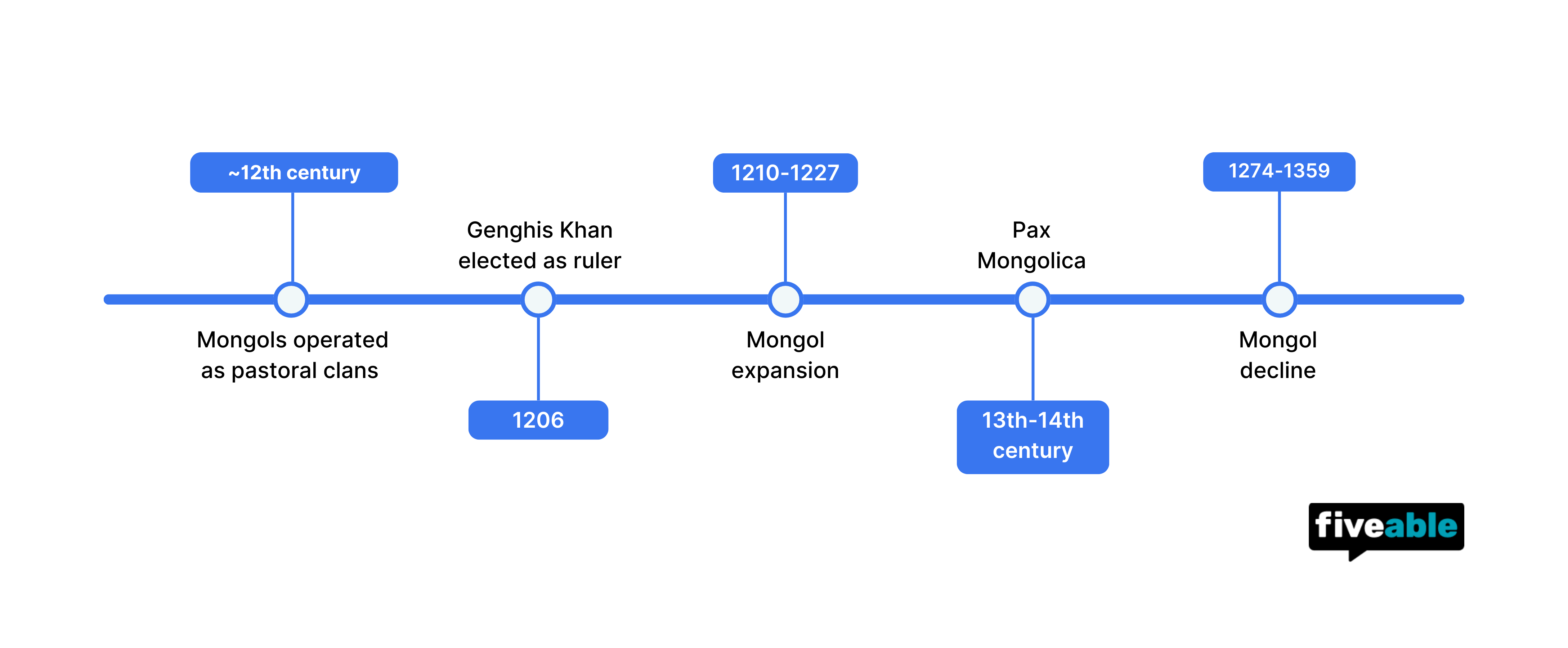
The Mongols started as multiple clans of pastoral nomads north of the Gobi Desert in East Asia. They herded goats and sheep, hunted and foraged, and lived a hard life on the arid steppes that shaped their culture.
- Everyone, male and female, was expected to be a skilled horse rider. Courage in hunting and warfare was the top virtue.
- They were surrounded by rival tribes (Tatars, Naimans, Merkits, and the powerful Jurchen in northern China) and coveted the wealth of peoples closer to the Silk Roads, who had luxury goods like silk clothing and gold jewelry.
Temujin becomes Genghis Khan
Temujin (born 1162) spent decades building tribal alliances and defeating neighboring groups one by one. He married his oldest son to a neighboring khan's daughter, promoted talented non-family members over relatives, and prized personal loyalty above all. He was also ruthless. He killed his own stepbrother.
In 1206, at a meeting of Mongol chieftains called a kuriltai, Temujin was elected khan and took the name Genghis Khan, "ruler of all."
Early conquests
- In 1210 he attacked the Jin Empire (built by the Jurchens), which ruled Manchuria, Inner Mongolia, and northern China from its capital Zhongdu (present-day Beijing).
- Anyone who resisted was brutally killed, sometimes entire civilian populations of towns. Stories of his brutality spread ahead of his armies, and some leaders surrendered before being attacked.
- In 1219 he conquered the Central Asian Kara Khitai Empire and the Islamic Khwarazm Empire.
- By 1227, his khanate (kingdom) stretched from the North China Sea to eastern Persia.
How the Mongols Fought and Governed
The Mongol war machine was disciplined, fast, and adaptable. Their governing style, surprisingly, was the opposite of their battlefield reputation.
Military tactics and technology
- Soldiers were strong riders, expert with the short bow, and highly disciplined under an efficient command structure.
- A messenger force rode for days without stopping, even sleeping on their horses. Genghis Khan also created a pony-express-style relay system, except riders carried oral messages instead of letters.
- Special units mapped terrain in advance so armies knew the ground better than their enemies.
- A favorite trick: send a small force, fake a retreat, lure the enemy into pursuit, then surround them with a larger hidden force.
- Before attacking a settlement, the Mongols asked for surrender. If refused, they killed the aristocrats, recruited skilled workers (craftworkers, miners, the literate), and used everyone else as laborers or front-line fodder.
- They absorbed conquered peoples' technology. Captured Chinese and Persian engineers built improved siege weapons like portable towers and catapults for attacking walled cities.
The Pax Mongolica
The 13th-14th centuries are often called the Pax Mongolica, or Mongolian peace, and it changed the world economy.
- Genghis Khan built his capital at Karakorum and consulted Chinese and Islamic scholars and engineers. He may have built more new bridges than any ruler in history.
- He instituted religious tolerance across the empire, which was highly unusual for the 13th century.
- Mongol soldiers, freed from constant warfare, guarded the Silk Roads, launching the third golden age of Silk Road trade. New trade channels linked Asia, the Middle East, Africa, and Europe. (Pairs directly with AMSCO 2.1 on the Silk Roads.)
- To unify the empire, a captured scribe adapted the Uyghur alphabet to write Mongol. A single empire-wide writing system never fully took hold, but the alphabet is still used in Mongolia today.
The Empire Expands Under the Khanates
Three of Genghis Khan's grandsons set up their own khanates, pushing the empire deeper into Asia and Europe. Each conquest pulled new people into Mongol economies and trade networks. That's exactly the pattern AP World wants you to see: imperial expansion facilitating Afro-Eurasian trade and communication.
Batu and the Golden Horde (Russia)
- In 1236, Batu led 100,000 soldiers into Russia, then a loose network of city-states and principalities. His army became known as the Golden Horde. Kiev was looted and destroyed in 1240.
- In 1241, Batu defeated Polish, German, and French knights under King Henry of Silesia, then Hungarian knights. He was eyeing Italy and Austria when the Great Khan Ogodei died, so Batu went home for the succession and never seriously resumed the western campaign.
- The Mongols ruled northern Russia indirectly through existing Russian rulers, who paid regular tribute. The Mongols simply didn't want to live in the forests.
- Moscow's rulers collected extra tribute, secretly built an army, and assembled an anti-Mongol coalition that defeated the Golden Horde at the Battle of Kulikovo in 1380.
- Long-term effects on Russia: Mongol rule severed Russia's ties with Western Europe for three centuries, pushed Russian princes toward centralized leadership, and helped a distinctly Russian culture develop. Resistance to the Mongols laid the foundation for the modern Russian state.
Hulegu and the Il-khanate (Islamic heartlands)
- In 1258, Hulegu's armies invaded Abbasid territory, destroyed Baghdad, and killed the caliph along with perhaps 200,000 residents.
- The push west stopped in 1260, when the Muslim Mamluks under Baibars allied temporarily with Christian Crusaders in Palestine to defeat the Mongols. Both faiths saw the Mongols as the bigger threat.
- In the Il-khanate, Mongols ruled but Persians served as ministers and local officials, which maximized tax collection.
- Hulegu and most Il-khanate Mongols eventually converted to Islam. Religious tolerance ended after the conversion, and Mongols supported massacres of Jews and Christians.
Kublai Khan and the Yuan Dynasty (China)
- Kublai Khan fought Song China from 1235 to 1271, became Great Khan in 1260, and finally defeated the Chinese in 1271, founding the Yuan Dynasty.
- He governed closer to Chinese tradition than Mongol practice and rebuilt the destroyed capital Zhongdu, renaming it Dadu.
- Like his grandfather, he practiced religious tolerance, winning loyalty from Buddhists and Daoists (out of favor in China at the time) and tolerating Muslims, Jews, and Christians.
- Trade with other countries, including European ones, brought prosperity and cultural exchange to China.
Mongol women
Mongol women lived more independently than women in most societies of the era. They tended flocks, rode horses, and wore the same leather trousers as men. Widows could remarry, and women could initiate divorce.
Why the Mongols Lost Power
Mongol rule in China collapsed because the Yuan alienated the Chinese, and the rest of the empire declined around the same time.
- The Yuan hired foreigners for government jobs instead of native-born Chinese and dismantled the civil service exam system, angering the Confucian scholar-gentry.
- Despite official tolerance, Mongols stayed socially separate and banned non-Mongols from speaking Mongolian.
- Starting in 1274, the Yuan repeatedly failed to conquer Japan, Indochina, Burma, and Java. The defeats convinced the Chinese the Mongols weren't so fearsome anymore.
- In the 1350s, the secret White Lotus Society organized against the Yuan. In 1368, Zhu Yuanzhang, a Buddhist monk from a poor peasant family, led the revolt that overthrew the Yuan and founded the Ming Dynasty (1368-1644).
- Elsewhere, the Golden Horde weakened in civil wars after the 1360s, lost control of Russia by 1480, and broke apart by the early 1500s, while Tamerlane (Timur the Lame) conquered the Central Asian territories around the same time. Russia defeated the remaining descendant khanates by the mid-16th century, except the Crimean Tatars, who held on until the late 18th century.
Long-Term Impact of the Mongol Invasions
The Mongols matter on the AP exam because of what they transferred, not just what they destroyed. This is the chapter's big payoff.
- Scale. They conquered more territory than the Romans and built the largest continuous land empire in history.
- Trade revival. During the Pax Mongolica (c. 1250-c. 1350), the Mongols built roads and guarded trade routes, revitalizing exchange between Asia, the Middle East, Africa, and Europe.
- Technology and cultural transfers. Islamic scientific knowledge reached China. Chinese paper made the Gutenberg printing press revolution possible. Greco-Islamic medical knowledge and the Arabic numbering system traveled to Western Europe. These transfers connect to the cultural diffusion covered in AMSCO 2.5.
- The Black Death. Mongol conquests helped transmit the fleas carrying bubonic plague from southern China to Central Asia, then to Southeast Asia and Europe, following trade and military routes. AMSCO 2.6 picks up this thread.
- Centralized power. The Mongols used a single international law across all conquered territories. After Mongol decline, states across Europe, Asia, and Southeast Asia continued or copied this centralizing model.
- End of medieval warfare. Mongol speed and surprise made armored knights obsolete, and Mongol siege technology ended the era of the walled city in Europe. Some historians credit the Mongols with the cannon, combining Chinese gunpowder, Muslim flamethrowers, and European bell-casting techniques.
Key Terms to Know
| Term | Why it matters |
|---|---|
| Mongols | Pastoral nomadic clans from the steppes north of the Gobi Desert who built history's largest continuous land empire. |
| Khan | The Mongol title for a king or ruler. |
| Kuriltai | The 1206 gathering of Mongol chieftains where Temujin was elected khan. |
| Genghis Khan | Temujin's title, "ruler of all"; he unified the Mongols and conquered from the North China Sea to eastern Persia by 1227. |
| Khanate | A kingdom ruled by a khan; the empire split into khanates run by Genghis's grandsons. |
| Pax Mongolica | The "Mongolian peace" (c. 1250-c. 1350), when guarded trade routes triggered the Silk Roads' third golden age. |
| Batu | Genghis's grandson who led the Golden Horde into Russia and defeated European knights in 1241. |
| Golden Horde | Batu's army and khanate that ruled Russia indirectly through tribute-paying local rulers. |
| Moscow | The city-state that built an anti-Mongol coalition and defeated the Golden Horde at Kulikovo in 1380. |
| Hulegu | Genghis's grandson who destroyed Baghdad in 1258 and ruled the Il-khanate. |
| Il-khanate | Hulegu's Middle Eastern khanate, where Persians staffed government and the Mongols eventually converted to Islam. |
| Kublai Khan | Genghis's grandson who defeated Song China and founded the Yuan Dynasty in 1271. |
| Yuan Dynasty | Mongol-ruled China (1271-1368), known for religious tolerance but resented for sidelining native Chinese. |
| White Lotus Society | Secret society that organized in the 1350s to end Yuan rule. |
| Zhu Yuanzhang | The Buddhist monk from a peasant family who overthrew the Yuan in 1368 and founded the Ming Dynasty (1368-1644). |
| Siege weapons | Portable towers and catapults, built with captured Chinese and Persian engineering expertise, that broke walled cities. |
| Uyghur alphabet | Script adapted to write Mongol; still used in Mongolia today. |
| Bubonic plague | The Black Death, spread along Mongol trade and military routes from southern China to Europe. |
Practice and Next Steps
These notes follow the AMSCO chapter; for the College Board's framing of the same content, review the Topic 2.2 Mongol Empire study guide. Then keep moving through Unit 2 with AMSCO 2.3 on Indian Ocean exchange, or browse all chapters on the AP World AMSCO notes page.
To check yourself, try AP World guided practice questions on Unit 2, drill terms in the key terms glossary, or write a Mongol-themed response with FRQ practice and instant scoring. The Mongols show up constantly in continuity-and-change and causation prompts, so practice explaining both the destruction and the exchange.
Frequently Asked Questions
What does AMSCO Topic 2.2 cover in AP World?
AMSCO 2.2 (p. 85-91) covers the rise of Genghis Khan, the expansion of the Mongol Empire under Batu, Hulegu, and Kublai Khan, the Pax Mongolica, and the empire's decline and long-term impact. It's the core Unit 2 chapter on how empires facilitated trade and cultural transfer across Afro-Eurasia in the period 1200-1450.
What was the Pax Mongolica?
The Pax Mongolica, or "Mongolian peace" (c. 1250-c. 1350), was the period when Mongol armies guarded the Silk Roads and built roads connecting Asia, the Middle East, Africa, and Europe. It launched the third golden age of Silk Road trade and enabled major transfers like Greco-Islamic medical knowledge and the Arabic numbering system reaching Western Europe.
Were the Mongols only destructive, or did they help world trade?
Both, and the AP exam expects you to argue both sides. The Mongols destroyed Baghdad in 1258, wiped out town populations, and helped spread the bubonic plague along trade routes. But they also revitalized interregional trade during the Pax Mongolica, practiced religious tolerance, and transferred technology like paper, gunpowder, and medical knowledge across Eurasia.
What were the three Mongol khanates set up by Genghis Khan's grandsons?
Batu led the Golden Horde, which ruled Russia indirectly through tribute until Moscow's coalition won at Kulikovo in 1380. Hulegu ruled the Il-khanate in the Islamic heartlands after destroying Baghdad in 1258. Kublai Khan defeated Song China and founded the Yuan Dynasty in 1271, which fell to Zhu Yuanzhang's revolt in 1368.
How do the Mongols show up on the AP World exam?
The Mongols are a favorite for continuity-and-change and causation questions: how their expansion facilitated Afro-Eurasian trade, encouraged technological and cultural transfers, and modeled centralized power for later states. Practice building those arguments with Fiveable's FRQ practice with instant scoring.
See Fiveable more often in Google
Mark Fiveable as a preferred source and Google is more likely to show you our guides in Top Stories, with a "preferred" badge in AI Mode and AI Overviews.