AMSCO 3.1 European, East Asian, and Gunpowder Empires Expand Notes

🌍AP World History: Modern Review
AMSCO 3.1 European, East Asian, and Gunpowder Empires Expand Notes
🌍 AP World History: Modern
AMSCO 1.1 Developments in East Asia Notes
AMSCO 1.2 Developments in Dar al-Islam Notes
AMSCO 1.3 Developments in South and Southeast Asia Notes
AMSCO 1.4 Developments in the Americas Notes
AMSCO 1.5 Developments in Africa Notes
AMSCO 1.6 Developments in Europe Notes
AMSCO 1.7 Comparison in the Period from c.1200 to c.1450 Notes
AMSCO 2.1 The Silk Roads Notes
AMSCO 2.2 The Mongol Empire and the Modern World Notes
AMSCO 2.3 Exchange in the Indian Ocean Notes
AMSCO 2.4 Trans-Saharan Trade Routes Notes
AMSCO 2.5 Cultural Consequences of Connectivity Notes
AMSCO 2.6 Environmental Consequences of Connectivity Notes
AMSCO 2.7 Comparison of Economic Exchange Notes
AMSCO 3.1 European, East Asian, and Gunpowder Empires Expand Notes
AMSCO 3.2 Empires: Administrations Notes
AMSCO 3.3 Empires: Belief Systems Notes
AMSCO 3.4 Comparison in Land-Based Empires Notes
AMSCO 4.1 Technological Innovations Notes
AMSCO 4.2 Exploration: Causes and Events Notes
AMSCO 4.3 Columbian Exchange Notes
AMSCO 4.4 Maritime Empires Link Regions Notes
AMSCO 4.5 Maritime Empires Develop Notes
AMSCO 4.6 Internal and External Challenges to State Power Notes
AMSCO 4.7 Changing Social Hierarchies Notes
AMSCO 4.8 Continuity and Change from c.1450 to c.1750 Notes
AMSCO 5.1 The Enlightment Notes
AMSCO 5.2 Nationalism and Revolutions Notes
AMSCO 5.3 Industrial Revolution Begins Notes
AMSCO 5.4 Industrialization Spreads Notes
AMSCO 5.5 Technology in the Industrial Age Notes
AMSCO 5.6 Industrialization: Government's Role Notes
AMSCO 5.7 Economic Developments and Innovations Notes
AMSCO 5.8 Reactions to the Industrial Economy Notes
AMSCO 5.9 Society and the Industrial Age Notes
AMSCO 5.10 Continuity and Change in the Industrial Age Notes
AMSCO 6.1 Rationales for Imperialism Notes
AMSCO 6.2 State Expansion Notes
AMSCO 6.3 Indigenous Responses to State Expansion Notes
AMSCO 6.4 Global Economic Development Notes
AMSCO 6.5 Economic Imperialism Notes
AMSCO 6.6 Causes of Migration in an Interconnected World Notes
AMSCO 6.7 Effects of Migration Notes
AMSCO 6.8 Causation in the Imperial Age Notes
AMSCO 7.1 Shifting Power Notes
AMSCO 7.2 Causes of World War I Notes
AMSCO 7.3 Conducting World War I Notes
AMSCO 7.4 Economy in the Interwar Period Notes
AMSCO 7.5 Unresolved Tensions After World War I Notes
AMSCO 7.6 Causes of World War II Notes
AMSCO 7.7 Conducting World War II Notes
AMSCO 7.8 Mass Atrocities Notes
AMSCO 7.9 Causation in Global Conflict Notes
AMSCO 8.1 Setting the Stage for the Cold War and Decolonization Notes
AMSCO 8.2 The Cold War Notes
AMSCO 8.3 Effects of the Cold War Notes
AMSCO 8.4 Spread of Communism Notes
AMSCO 8.5 Decolonization after 1900 Notes
AMSCO 8.6 Newly Independent States Notes
AMSCO 8.7 Global Resistance to Established Power Structure Notes
AMSCO 8.8 End of the Cold War Notes
AMSCO 8.9 Causation in the Age of the Cold Ward and Decolonization Notes
AMSCO 9.1 Advances in Technology and Exchange Notes
AMSCO 9.2 Technological Advancements and Limitations Notes
AMSCO 9.3 Technology and the Environment Notes
AMSCO 9.4 Economics in the Global Age Notes
AMSCO 9.5 Calls for Reforms and Responses Notes
AMSCO 9.6 Globalized Culture Notes
AMSCO 9.7 Resistance to Globalization Notes
AMSCO 9.8 Institutions Developing in a Globalized World Notes
AMSCO 9.9 Continuity and Change in a Globalized World Notes
Overview
AMSCO Topic 3.1, "European, East Asian, and Gunpowder Empires Expand" (AMSCO p.143-151), covers how land-based empires grew between 1450 and 1750 using gunpowder weapons, armed trade, and strong centralized leadership. The chapter tracks five major threads: Europe's new monarchies, Russia's push east to the Pacific, China under the Ming and Qing, the rise of the three Islamic Gunpowder Empires (Ottoman, Safavid, Mughal), and why those Islamic empires eventually declined while Russia survived. This is the opening chapter of Unit 3, and it sets up everything in Topic 3.1 of the course: empires that expanded over land, not oceans.
The big pattern to remember: gunpowder spread from China along trade routes, and empires that adopted cannons and firearms early (and kept modernizing) expanded fast. Empires that stopped modernizing got left behind.
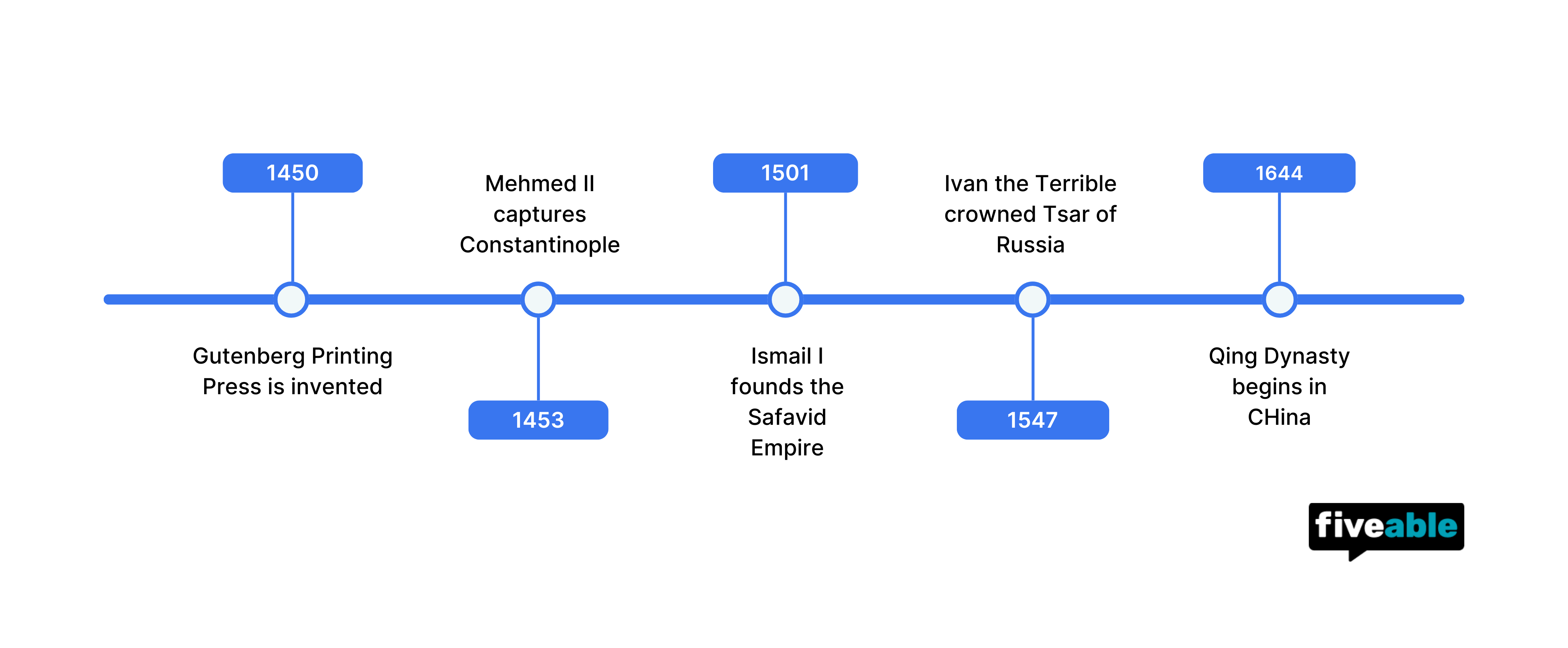
Timeline of pivotal moments shaping empires and cultures from the 15th to 17th century. Image Courtesy of Isaiah Penny
Key Takeaways
- The Tudors, Valois, and Ferdinand and Isabella centralized control over taxes, armies, and religion; their stronger states then launched overseas explorations and colonies.
- Ivan IV pushed Russia east into former Golden Horde lands using gunpowder; later, Russian fur traders and militias reached the Pacific.
- After Mongol victories, Ming rulers restored the Great Wall; Qing emperors Kangxi and Qianlong later expanded China's territory, with Qianlong annexing Xinjiang.
- Mehmed II used Ottoman cannons to break Constantinople's fortifications; Suleiman I's armies later overran Hungary and reached Vienna.
- Ismail made Shi'a Islam central to the Safavid state, fueling conflict with the Sunni Ottomans; Babur founded the Mughal dynasty in India, which grew rich and well governed under Akbar.
- The Ottoman, Safavid, and Mughal empires declined as they failed to modernize their militaries while Western Europe grew stronger; Russia modernized its army and survived.
Europe's New Monarchies
The year 1450 traditionally marks the end of the medieval period and the start of the early modern era. Three things came together in the mid-1400s:
- The end of a wave of plagues
- The conclusion of the Hundred Years' War between France and England
- The invention of the Gutenberg printing press, which boosted literacy
Out of this came the new monarchies of the 1500s: the Tudors in England, the Valois in France, and Ferdinand and Isabella in Spain. These rulers centralized power by controlling taxes, the army, and many aspects of religion. They curbed the private armies of the nobility, grew their bureaucracies, and elevated the middle class at the expense of lords and the churches. These stronger, wealthier states then launched overseas explorations and colonies (the transoceanic side of expansion comes in Unit 4).
One more concept the chapter flags: armed trade. Expanding empires traded with each other, but they kept troops and weapons ready in case a rival challenged their right to trade. That is very different from the free markets of later eras.
Russia Expands East
Russia sat in a pivotal trading position between Europe and Asia, shaped by Mongol influence from the east and Viking invasions and trade from the west. Its capital (Kiev, St. Petersburg, or Moscow, depending on the era) was always in Europe.
Ivan IV ("Ivan the Terrible," ruled 1547-1584) was crowned tsar in 1547 and immediately pushed the border eastward, taking the khanates of Kazan, Astrakhan, and Siberia from descendants of the Golden Horde. This expansion relied increasingly on gunpowder.
- Control of the Volga: To control the fur trade, Ivan IV let the Stroganovs, major Russian landowners, hire Cossacks (fierce peasant warriors) to fight local tribes and the Siberian khan. Winning the Volga River gave Moscow an outlet to the Caspian Sea and direct trade with Persia and the Ottomans, bypassing the Crimean Tartars.
- To the Pacific: After Ivan IV, fur traders and militias kept defeating indigenous tribes across Siberia. Missionaries followed, converting many to Eastern Orthodoxy, though local shamans kept influence. Russians reached the Pacific by 1639, Alaska in 1741, and California's coast by 1814.
Crucially, Russia modernized its army on the model of England, France, and the Netherlands. That's why Russia survived as an independent state while the Islamic Gunpowder Empires fell.
East Asia: Ming and Qing China
The Mongol-founded Yuan Dynasty (1271) was overthrown by the Ming Dynasty in 1368, and Ming rulers stabilized East Asia for nearly 300 years. The Ming expanded into Mongolia and Central Asia but couldn't hold those lands. After Mongol armies defeated Ming forces in the 1440s and even captured the Ming emperor, China restored and expanded the Great Wall to keep out northern invaders.
In 1644, the Manchu from Manchuria seized power and founded the Qing Dynasty, which ruled until 1911. Two emperors matter most here:
- Kangxi (ruled 1661-1722), one of China's longest-reigning emperors, presided over stability and expansion. He sent forces into Taiwan, Mongolia, and Central Asia and imposed a protectorate over Tibet, a policy reflected in China's control of the region today.
- Qianlong (ruled 1736-1796), a poet skilled in art and calligraphy, started his reign with a well-run state and record tax collections. His campaigns west of China annexed Xinjiang, accompanied by mass killings of the local population (the Muslim Uighurs there were never fully incorporated into Chinese culture). He installed the Dalai Lama in Tibet and forced Nepal to submit, but failed campaigns against Burma and Vietnam emptied the treasury.
Conflicts with the West: Needing money, the Qing sold limited trading privileges to Europeans but confined them to Guangzhou (Canton). When Britain asked for more trading rights in 1793, Qianlong wrote King George III that China had no need for British manufactured goods. Late in his reign, the bureaucracy grew corrupt and taxes climbed, sparking the White Lotus Rebellion (1796-1804), a peasant uprising the Qing crushed brutally, killing around 100,000 peasants.
Rise of the Islamic Gunpowder Empires
The Gunpowder Empires were large, multiethnic states in Southwest, Central, and South Asia that relied on firearms to conquer and control territory. Besides Russia, they included three Islamic empires: the Ottoman, Safavid, and Mughal. Their warrior leaders shared key traits:
- Descended from Turkic nomads of Central Asia and spoke a Turkic language
- Took advantage of power vacuums left by the breakup of Mongol khanates
- Relied on gunpowder weapons like artillery and cannons
Their early success combined their own military might with the weakness and corruption of the regimes they replaced, while European nations fought each other instead of uniting against them.
Tamerlane (Timur the Lame), a Mongol-Turkic ruler of the late 14th century, set the stage. From Samarkand he made ruthless conquests in Persia and India; some historians believe his forces massacred about 100,000 Hindus before the gates of Delhi. He embodied the ghazi ideal, a warrior model blending nomadic cooperative values with service as a holy fighter for Islam. Tamerlane built a government dependent on his military and heavy artillery and protected Silk Road land routes, but he left no effective political structure, and war expenses ravaged the economy. His empire fell apart, except the area his descendant Babur used to build the Mughal Dynasty. Still, he championed learning and the arts, a trend the later empires continued.
The Ottoman Empire
The Ottoman Empire was the largest and most enduring Islamic empire of this period, stretching into modern Turkey, the Balkans, North Africa, and Southwest Asia. Founded by the Osman Dynasty in the 1300s, a single dynasty ruled for more than 600 years, until defeat in 1918.
- Mehmed II ("the Conqueror," ruled 1451-1481) besieged Constantinople in 1453. Ottoman cannons, including a 26-foot bronze cannon, crumbled the city's triple fortifications. Renamed Istanbul, the city prospered by controlling the Bosporus Strait, the only waterway linking the Aegean and Black Seas. Mehmed then took lands around the Black Sea and the Balkans, built up the navy against Venice, and forced Venice to pay a yearly tax.
- Suleiman I (ruled 1520-1566) brought the empire to its peak. His armies overran Hungary in 1526 and reached the gates of Vienna by 1529 (both Vienna attempts failed). His navy took Rhodes in 1522 and Tripoli in the 1550s. Ottoman troops pushing so far into Christian Europe terrified Europeans.
The Safavid Empire
The Safavid dynasty grew out of the Safavid order of Sufism in northern Azerbaijan. Ismail, only 14 or 15 years old, conquered most of Persia, pushed into Iraq, and was proclaimed shah in 1501. He made Shi'a Islam the unifying force of the state and denied legitimacy to any Sunni, which fueled constant hostility with the Sunni Ottoman Empire. In 1541 the Ottomans stopped Safavid forces at Tabriz, which became a Sunni-Shi'a border city. The conflict wasn't purely religious: the two empires also fought over overland trade routes, and the Ottomans used trade embargoes against Safavid silk traders.
Shah Abbas I ("Abbas the Great," ruled 1588-1629) led the empire at its height, importing European weaponry and European military advisers. The Safavids had two structural weaknesses: no real navy despite bordering the Arabian Sea, and no natural defenses. Safavid women, while veiled and restricted in movement, had rights under Islamic law to inheritance and, in extreme cases, divorce.
Mughal India
In the 1520s, Babur, a descendant of Tamerlane, conquered northern India during a period of disarray and founded a 300-year dynasty with a central government similar to Suleiman's. His grandson Akbar achieved grand religious and political goals, and under him the Mughal Empire was one of the richest and best-governed states in the world. Overseas trade flourished (mostly handled by Arab traders) in textiles, tropical foods, spices, and precious stones, exchanged for gold and silver. Internal trade ran through merchant castes (jatis), strict social groupings designated at birth that divide Hindu society into Brahmins, Kshatriyas, Vaishyas, and Shudras, with the Dalits outside the system. Mughal wealth left magnificent architectural monuments.
Decline of the Gunpowder Empires
The Ottoman, Safavid, and Mughal Empires declined because they did not modernize their militaries while Western Europe grew stronger economically and militarily, especially at sea. Russia did modernize, so it survived.
- Ottoman decline: In 1571, a mostly Spanish and Venetian force defeated the Ottomans at the naval Battle of Lepanto. Weak sultans followed Suleiman, and "harem politics" (wives and concubines promoting their own sons as heirs) shaped succession, giving some women real behind-the-scenes power. The failed Siege of Vienna in 1683 ended Ottoman domination in Eastern Europe. Greek independence in 1821 and Russian expansion weakened the empire further; it became known as the "Sick Man of Europe."
- Safavid decline: Ineffectual successors to Shah Abbas combined lavish spending with falling revenues. In 1722, oppressed Sunni Pashtuns rebelled and sacked Isfahan; their leader Mahmud declared himself Shah of Persia. Ottomans and Russians grabbed territory, and Nader Shah's Afsharid Dynasty replaced the Safavids in 1736.
- Mughal decline: Aurangzeb (ruled 1658-1707) inherited a corrupt empire that had fallen behind militarily. He tried to bring all of India under Muslim rule and strip away Hindu influences, draining the treasury through southern expansion and provoking rebellions among Sikhs, Hindus, and others with his religious intolerance. Instability after his death let the British and French gain economic power; Britain took political power from the Mughals in the 19th century.
Key Terms to Know
| Term | Why it matters |
|---|---|
| Gunpowder Empires | Large, multiethnic land empires (Ottoman, Safavid, Mughal, plus Russia) that used firearms to conquer and control territory. |
| Gutenberg printing press | Mid-1400s invention that increased literacy and helped mark Europe's shift into the early modern period. |
| Ottoman Empire | The largest and longest-lasting Islamic empire of the era, ruled by one dynasty for over 600 years. |
| Suleiman I | Ottoman ruler at the empire's peak (1520-1566) who overran Hungary and besieged Vienna. |
| Safavid Empire | Persian empire founded by Ismail that made Shi'a Islam its unifying force, fueling rivalry with the Sunni Ottomans. |
| Shah | The Persian title for king or emperor, claimed by Ismail in 1501. |
| Shah Abbas I | "Abbas the Great" (ruled 1588-1629), who led the Safavids at their height using imported European weapons and advisers. |
| Ismail | Teenage Safavid conqueror who took all of Iran and was proclaimed shah in 1501. |
| Mughal Empire | Indian empire founded by Babur in the 1520s; under Akbar it was one of the richest, best-governed states in the world. |
| Akbar | Babur's grandson, whose reign brought Mughal religious and political achievement and flourishing trade. |
| Ghazi ideal | A warrior model blending nomadic values with holy fighting for Islam; the template for Gunpowder Empire warriors. |
| Tamerlane | Mongol-Turkic conqueror whose violent campaigns from Samarkand set the stage for the three Islamic empires. |
| Castes | Strict hereditary social groupings (jatis) that organized Hindu society and structured trade in Mughal India. |
| Ming Dynasty | Chinese dynasty (1368-1644) that overthrew the Mongols, stabilized East Asia, and rebuilt the Great Wall. |
| Manchu | The people from Manchuria who seized power in 1644 and founded the Qing Dynasty. |
| Qing Dynasty | Manchu-led dynasty (1644-1911) that expanded China's borders into Taiwan, Mongolia, Central Asia, and Tibet. |
| Kangxi | Long-reigning Qing emperor (1661-1722) who oversaw stability and major territorial expansion. |
| Ivan IV | "Ivan the Terrible," crowned tsar in 1547, who pushed Russia eastward into former Golden Horde lands. |
Practice and Next Steps
Pair these notes with the 3.1 Expansion of Land-Based Empires study guide for the course-topic view of the same material, then continue to AMSCO 3.2 on how these empires were administered. Since the AP exam loves comparison questions on these empires, AMSCO 3.4 on comparing land-based empires is worth reading early.
To test yourself, run through guided multiple-choice practice, drill definitions in the AP World key terms glossary, or browse the full set of AMSCO chapter notes for the rest of Unit 3.
Frequently Asked Questions
What were the Gunpowder Empires in AP World?
The Gunpowder Empires were large, multiethnic land-based states in Southwest, Central, and South Asia that used firearms and cannons to conquer and control territory between 1450 and 1750. They include the Ottoman, Safavid, and Mughal Empires (all with strong Islamic identities) plus Russia. Their early success came from military might combined with the weakness of the regimes they replaced.
Why did the Ottomans and Safavids fight each other?
Religion was the biggest flashpoint: the Safavids made Shi'a Islam their unifying state force and denied legitimacy to Sunnis, while the Ottomans were a Sunni stronghold. But the rivalry wasn't purely religious. They also fought over control of overland trade routes, and the Ottomans used trade embargoes against Safavid silk traders to pressure their eastern rival.
Why did Russia survive while the Islamic Gunpowder Empires declined?
Russia modernized and reorganized its army on the model of England, France, and the Netherlands, while the Ottoman, Safavid, and Mughal Empires did not keep up with military innovation. As Western Europe grew stronger economically and militarily, especially at sea, the Islamic empires fell behind and eventually declined, but Russia stayed powerful enough to remain an independent nation-state.
What pages does AMSCO Topic 3.1 cover?
AMSCO Topic 3.1, European, East Asian, and Gunpowder Empires Expand, covers pages 143-151. It's the first chapter of Unit 3 and covers Europe's new monarchies, Russia's eastward expansion, Ming and Qing China, and the rise and decline of the Ottoman, Safavid, and Mughal Empires. You can find notes for the rest of the unit on the AMSCO notes page.
How does Topic 3.1 show up on the AP World exam?
Topic 3.1 asks you to explain how and why land-based empires developed and expanded from 1450 to 1750, so expect questions on gunpowder weapons, armed trade, and state rivalries like the Safavid-Mughal conflict. Comparison questions across the Ottoman, Safavid, Mughal, Qing, and Russian empires are common. You can drill this with guided multiple-choice practice.
See Fiveable more often in Google
Mark Fiveable as a preferred source and Google is more likely to show you our guides in Top Stories, with a "preferred" badge in AI Mode and AI Overviews.