AMSCO 4.6 Internal and External Challenges to State Power Notes

🌍AP World History: Modern Review
AMSCO 4.6 Internal and External Challenges to State Power Notes
🌍 AP World History: Modern
AMSCO 1.1 Developments in East Asia Notes
AMSCO 1.2 Developments in Dar al-Islam Notes
AMSCO 1.3 Developments in South and Southeast Asia Notes
AMSCO 1.4 Developments in the Americas Notes
AMSCO 1.5 Developments in Africa Notes
AMSCO 1.6 Developments in Europe Notes
AMSCO 1.7 Comparison in the Period from c.1200 to c.1450 Notes
AMSCO 2.1 The Silk Roads Notes
AMSCO 2.2 The Mongol Empire and the Modern World Notes
AMSCO 2.3 Exchange in the Indian Ocean Notes
AMSCO 2.4 Trans-Saharan Trade Routes Notes
AMSCO 2.5 Cultural Consequences of Connectivity Notes
AMSCO 2.6 Environmental Consequences of Connectivity Notes
AMSCO 2.7 Comparison of Economic Exchange Notes
AMSCO 3.1 European, East Asian, and Gunpowder Empires Expand Notes
AMSCO 3.2 Empires: Administrations Notes
AMSCO 3.3 Empires: Belief Systems Notes
AMSCO 3.4 Comparison in Land-Based Empires Notes
AMSCO 4.1 Technological Innovations Notes
AMSCO 4.2 Exploration: Causes and Events Notes
AMSCO 4.3 Columbian Exchange Notes
AMSCO 4.4 Maritime Empires Link Regions Notes
AMSCO 4.5 Maritime Empires Develop Notes
AMSCO 4.6 Internal and External Challenges to State Power Notes
AMSCO 4.7 Changing Social Hierarchies Notes
AMSCO 4.8 Continuity and Change from c.1450 to c.1750 Notes
AMSCO 5.1 The Enlightment Notes
AMSCO 5.2 Nationalism and Revolutions Notes
AMSCO 5.3 Industrial Revolution Begins Notes
AMSCO 5.4 Industrialization Spreads Notes
AMSCO 5.5 Technology in the Industrial Age Notes
AMSCO 5.6 Industrialization: Government's Role Notes
AMSCO 5.7 Economic Developments and Innovations Notes
AMSCO 5.8 Reactions to the Industrial Economy Notes
AMSCO 5.9 Society and the Industrial Age Notes
AMSCO 5.10 Continuity and Change in the Industrial Age Notes
AMSCO 6.1 Rationales for Imperialism Notes
AMSCO 6.2 State Expansion Notes
AMSCO 6.3 Indigenous Responses to State Expansion Notes
AMSCO 6.4 Global Economic Development Notes
AMSCO 6.5 Economic Imperialism Notes
AMSCO 6.6 Causes of Migration in an Interconnected World Notes
AMSCO 6.7 Effects of Migration Notes
AMSCO 6.8 Causation in the Imperial Age Notes
AMSCO 7.1 Shifting Power Notes
AMSCO 7.2 Causes of World War I Notes
AMSCO 7.3 Conducting World War I Notes
AMSCO 7.4 Economy in the Interwar Period Notes
AMSCO 7.5 Unresolved Tensions After World War I Notes
AMSCO 7.6 Causes of World War II Notes
AMSCO 7.7 Conducting World War II Notes
AMSCO 7.8 Mass Atrocities Notes
AMSCO 7.9 Causation in Global Conflict Notes
AMSCO 8.1 Setting the Stage for the Cold War and Decolonization Notes
AMSCO 8.2 The Cold War Notes
AMSCO 8.3 Effects of the Cold War Notes
AMSCO 8.4 Spread of Communism Notes
AMSCO 8.5 Decolonization after 1900 Notes
AMSCO 8.6 Newly Independent States Notes
AMSCO 8.7 Global Resistance to Established Power Structure Notes
AMSCO 8.8 End of the Cold War Notes
AMSCO 8.9 Causation in the Age of the Cold Ward and Decolonization Notes
AMSCO 9.1 Advances in Technology and Exchange Notes
AMSCO 9.2 Technological Advancements and Limitations Notes
AMSCO 9.3 Technology and the Environment Notes
AMSCO 9.4 Economics in the Global Age Notes
AMSCO 9.5 Calls for Reforms and Responses Notes
AMSCO 9.6 Globalized Culture Notes
AMSCO 9.7 Resistance to Globalization Notes
AMSCO 9.8 Institutions Developing in a Globalized World Notes
AMSCO 9.9 Continuity and Change in a Globalized World Notes
Overview
AMSCO Topic 4.6, Internal and External Challenges to State Power (AMSCO p.243 - p.250), covers how the growth of stronger governments and larger empires between 1450 and 1750 triggered resistance around the world. As states centralized power and expanded overseas, social, political, and economic groups pushed back. Some revolts erupted inside the empires themselves (the Fronde in France, the Pugachev Rebellion in Russia, the Glorious Revolution in England), while others came from indigenous peoples and enslaved Africans resisting colonial control (the Pueblo Revolt, Metacom's War, the Maroon wars). This chapter pairs with the maritime empire growth covered in Topic 4.5: once you know how empires expanded, this topic shows who fought back.
The big pattern to remember: state expansion and centralization led to local resistance, and enslaved people in the Americas challenged authorities through organized resistance.
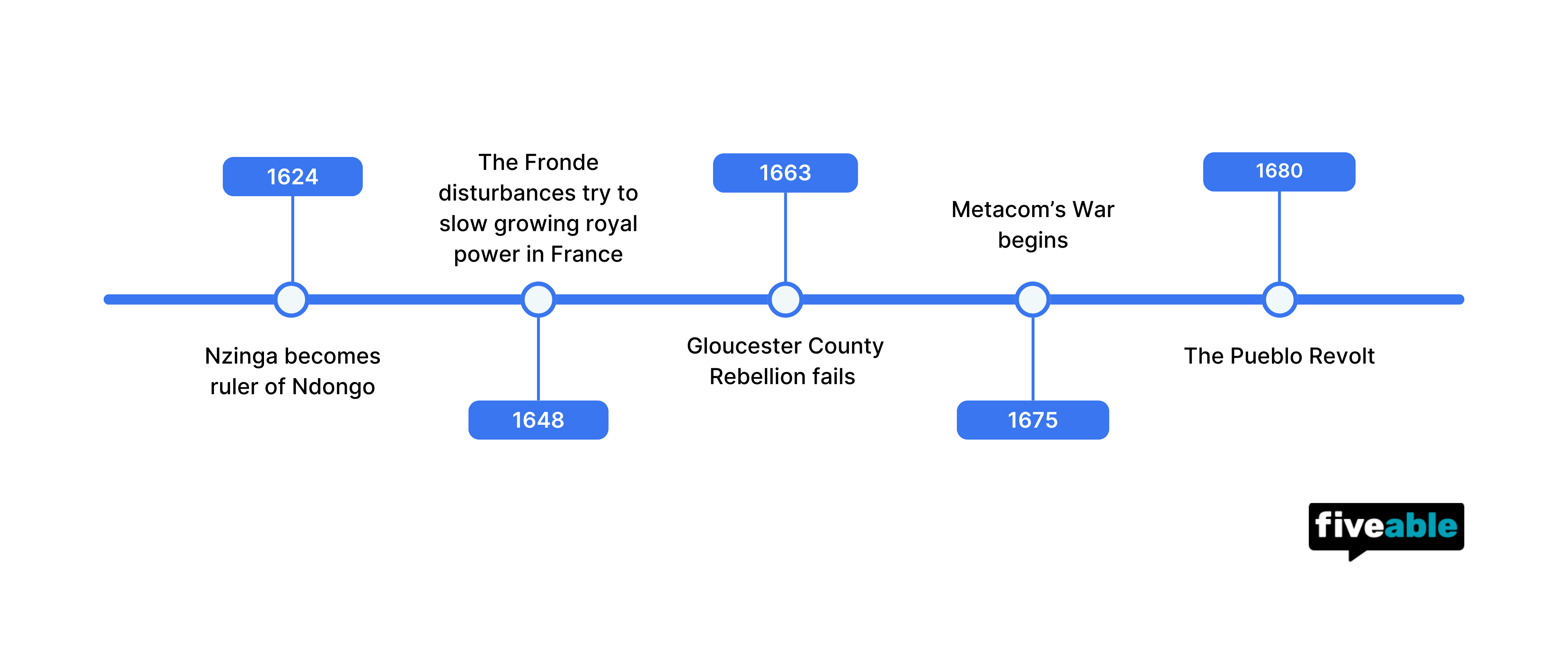
Timeline of conflicts between 1450 and 1750. Image courtesy of Grace.
Key Takeaways
- Ana Nzinga resisted Portuguese slave raids by shifting alliances, taking control of Matamba, and offering freedom there to enslaved Africans.
- Russian serfdom grew harsher as the state expanded, and the defeat of Pugachev's peasant rebellion led Catherine the Great to increase oppression.
- The Hindu Maratha fought Mughal rule and built an empire, while Pueblo and Apache peoples drove out Spanish colonizers who forced religious conversions.
- Higher taxes helped spark the Fronde in France, and the unrest pushed Louis XIV toward absolute rule.
- Maroons in Jamaica fought for freedom, while Metacom's War ended with English colonists subjugating the Wampanoag people.
- In the Glorious Revolution, nobles invited William of Orange to invade England, James II fled, and Parliament gained power.
Ana Nzinga's Resistance to Portugal in Africa
By the 17th century, the Dutch and English had pushed Portugal out of South Asia, so the Portuguese turned to Africa, where they had carried out slave raids since the 15th century. That's where they ran into Ana Nzinga.
- In 1624, Nzinga became ruler of Ndongo in south-central Africa (present-day Angola).
- Ndongo faced two threats at once: Portuguese slave raids and attacks from neighboring African peoples.
- Nzinga first allied with Portugal in exchange for protection and an end to the raids. She was even baptized as Christian, with the Portuguese colonial governor as her godfather.
- When the alliance broke down, she fled west with her people and took over the state of Matamba.
- From Matamba, she incited a rebellion back in Ndongo, allied with the Dutch (Portugal's rival), and offered freedom in Matamba to enslaved Africans.
- She ruled for decades and built Matamba into an economically strong state.
Nzinga is a favorite example on the AP exam because she shows strategic resistance. She used alliances, religion, and rival European powers as tools, not just open warfare.
Serfdom and Peasant Rebellion in Russia
In Russia, the challenge to state power came from inside the empire, not outside it. The root cause was serfdom getting worse while it was fading in Western Europe.
Why Russian serfdom intensified
- Wars in the 14th and 15th centuries weakened the central government and strengthened the nobility.
- First the Mongols, then Russian princes, collected heavy tribute and taxes from peasants. Debt piled up, peasants lost their land, and more were forced into serfdom.
- As demand for grain grew, nobles imposed harsher conditions.
- Serfdom benefited everyone except the serfs. The government got social control, and landowners got free labor.
- A 1649 law legally chained serfs to the lands where they were born. Landlords could buy, sell, and punish them. Compare that to England, where Elizabeth I freed the last remaining serfs in 1574.
- Village communes called mirs controlled even small peasant landholders.
- As Russia expanded west to the Baltic and east to Siberia, serfdom expanded with it.
Cossacks and the Pugachev Rebellion
- The Cossacks were fierce, independent peasant warriors living on the steppes near the Black Sea. Many were runaway serfs influenced by neighboring nomadic descendants of the Mongols.
- They sometimes clashed with the autocratic tsars but could also be hired as mercenaries to defend Russia against Swedish, Tartar, and Ottoman forces. They were key to Russia's expansion to the Urals and into Siberia.
- In 1774, the Cossack Yemelyan Pugachev launched a peasant rebellion against Catherine the Great. His grievance: Catherine had handed nobles power over the serfs on their lands in exchange for political loyalty, leaving peasants with no recourse to the state.
- Pugachev falsely claimed to be Peter III, Catherine's murdered husband, and gathered discontented peasants, various ethnic groups, and fellow Cossacks. At one point his forces controlled the territory between the Volga River and the Urals.
- Within a year, the Russian army captured him and the government executed him.
- The aftermath matters: Catherine responded by increasing oppression of the peasants to keep noble support. Resistance led to more centralized control, not less.
Rebellions Against the Mughals and the Spanish
The Maratha conflict with the Mughals
In the 16th and 17th centuries, the Mughal Empire controlled much of present-day India and Pakistan, centralizing government and spreading Persian culture and Islam. But most of the population stayed Hindu. The Maratha, a Hindu warrior group, fought the Mughals in a series of battles from 1680 to 1707 and created the Hindu Maratha Empire. It lasted until 1818 and effectively ended Mughal rule of India.
The Pueblo Revolt
- In 1680, in what is now New Mexico, the Pueblo and Apache peoples revolted against Spanish colonizers who were forcing religious conversions.
- The indigenous fighters killed about 400 Spaniards, drove the rest out, and destroyed churches.
- The Spanish reconquered the area in 1692.
The Pueblo Revolt is the textbook example of indigenous resistance to forced conversion. Pair it with Metacom's War (below) when an FRQ asks about indigenous responses to colonization.
The Fronde: Civil Unrest in France
The Fronde (1648-1653) was a series of revolts against the French crown during Louis XIV's childhood, and it shaped his entire approach to ruling.
- Louis XIV inherited the throne in 1643 at age four. His mother Anne and chief minister Cardinal Jules Mazarin ruled for him.
- Mazarin pushed higher taxes to pay for recent wars. Nobles and judicial bodies called Parlements refused to pay, so the burden fell on the bourgeoisie.
- In 1648, a Paris mob used children's slings (frondes, which gave the revolt its name) to destroy the property of government officials. The royal family fled the capital.
- With most of the army busy fighting Spain, the government made concessions and reached a shaky peace with the Paris Parlement.
- Mazarin arrested several rebellion leaders in 1650, reigniting the chaos. Fighting between factions continued until the government restored order in 1653.
- The long-term effect: young Louis XIV watched it all and came to distrust the nobility. When Mazarin died in 1661, Louis appointed no chief minister and moved toward absolute rule.
England: Revolts in the Colonies and Revolution at Home
Maroon wars and slave resistance
- England took control of much of Jamaica from Spanish colonists in 1655.
- Maroons were descendants of Africans who had escaped slavery in Jamaica and formed independent settlements. Queen Nanny, who had herself escaped slavery, united the Maroons of the island and was later recognized as a Jamaican national hero.
- Enslaved people fought for freedom in the Maroon wars (1728-1740 and 1795-1796).
- Slave revolts were common across the Americas, especially where enslaved Africans outnumbered free Europeans.
- The Gloucester County Rebellion in Virginia in 1663 was the first recorded slave revolt in what is now the United States. Enslaved Africans and white indentured servants conspired together to demand freedom from the governor, but authorities discovered the plot and arrested them.
Metacom's War (King Philip's War)
- English colonists used underhanded tactics to pressure Native Americans off their land, sparking Metacom's War (1675-1678), the final major effort by indigenous people to drive the British from New England.
- The war spread across New England and destroyed 12 towns.
- Some Native American groups, including the Mohegan and Pequot, sided with the English.
- The war ended with the subjugation of the Wampanoag people to the English colonists, though Native peoples continued living in the region.
The Glorious Revolution
- James II became king in 1685. He was Catholic, and his anti-Protestant measures enraged many English people.
- Nobles invited William of Orange, James's nephew and son-in-law, to invade. He landed in 1688, and James fled to France.
- In 1689, William and Mary II (James's daughter, also Protestant) began their joint rule.
- It was called the Glorious Revolution or Bloodless Revolution because it happened with little violence. It strengthened Parliament, which passed a law forbidding Catholics from ruling England.
This is the one challenge in the chapter where the challengers won and permanently shifted power toward a representative body, a useful contrast with Russia, where rebellion led to harsher control. These power shifts feed directly into the social hierarchy changes in Topic 4.7.
Key Terms to Know
| Term | Why it matters |
|---|---|
| Ana Nzinga | Ruler of Ndongo (from 1624) who resisted Portuguese slave raids through shifting alliances and built Matamba into a strong state. |
| Ndongo | African state in present-day Angola targeted by Portuguese slave raids and ruled by Nzinga. |
| Matamba | The state Nzinga took over after fleeing Ndongo, where she offered freedom to enslaved Africans. |
| Serfdom | Russian labor system that tied peasants to the land; a 1649 law let landlords buy, sell, and punish serfs. |
| Mirs | Russian village communes that controlled even small peasant landholders. |
| Cossacks | Independent warrior peoples of the steppes near the Black Sea, hired as mercenaries and central to Russian expansion into Siberia. |
| Pugachev Rebellion | Yemelyan Pugachev's 1774 peasant uprising against Catherine the Great; its defeat led to harsher peasant oppression. |
| Maratha Empire | Hindu warrior empire that fought the Mughals from 1680 to 1707 and effectively ended Mughal rule of India. |
| Pueblo Revolt | 1680 uprising in present-day New Mexico where Pueblo and Apache peoples drove out Spanish colonizers over forced conversions. |
| Fronde | French revolts (1648-1653) against taxes under Mazarin that pushed Louis XIV toward absolutism. |
| Maroon wars | Conflicts (1728-1740, 1795-1796) in which escaped enslaved people in Jamaica fought for freedom. |
| Queen Nanny | Escaped enslavement and united the Maroons of Jamaica; recognized as a national hero. |
| Gloucester County Rebellion | 1663 Virginia plot by enslaved Africans and white indentured servants, the first recorded slave revolt in what is now the U.S. |
| Metacom's War | Also called King Philip's War (1675-1678); the last major indigenous effort to expel the British from New England. |
| Wampanoag | Native American people subjugated by English colonists at the end of Metacom's War. |
| Glorious Revolution | The mostly bloodless 1688-1689 replacement of Catholic James II with Protestant William and Mary, which strengthened Parliament. |
Practice and Next Steps
Go deeper with the Topic 4.6 course study guide on challenges to state power, or browse all AP World AMSCO notes to keep moving through Unit 4. Next up in the textbook is AMSCO 4.7 Changing Social Hierarchies.
To check yourself, run through guided multiple-choice practice on Unit 4, drill definitions with the AP World key terms glossary, or try FRQ practice with instant scoring using these revolts as evidence for resistance-to-state-power prompts.
Frequently Asked Questions
What is AMSCO Topic 4.6 in AP World about?
AMSCO Topic 4.6 (p.243-250) covers internal and external challenges to state power from 1450 to 1750. As governments centralized and empires expanded, local groups resisted: examples include the Fronde in France, the Pugachev Rebellion in Russia, the Pueblo Revolt, Metacom's War, the Maroon wars, and Ana Nzinga's resistance to Portugal.
Who was Ana Nzinga and why is she important for AP World?
Ana Nzinga became ruler of Ndongo (present-day Angola) in 1624 and resisted Portuguese slave raids. She first allied with Portugal, then fled west and took over Matamba when the alliance broke down, allied with the Dutch, and offered freedom to enslaved Africans. She matters because she's a go-to example of strategic local resistance to European expansion.
What caused the Pugachev Rebellion and what was its effect?
The Cossack Yemelyan Pugachev rebelled against Catherine the Great in 1774 because she gave nobles power over the serfs on their lands in exchange for political loyalty, leaving peasants with no recourse to the state. He claimed to be Peter III and at one point controlled territory between the Volga and the Urals. After his capture and execution, Catherine increased oppression of the peasants to keep noble support.
What's the difference between the Pueblo Revolt and Metacom's War?
Both were indigenous revolts against colonizers, but against different empires for different reasons. The Pueblo Revolt (1680) saw the Pueblo and Apache drive Spanish colonizers out of present-day New Mexico over forced religious conversions, until Spain reconquered the area in 1692. Metacom's War (1675-1678) was the Wampanoag-led effort to drive the British from New England over land seizures, and it ended with English victory.
How does Topic 4.6 show up on the AP World exam?
The exam tests whether you can explain how state expansion and centralization led to resistance from local groups, and how enslaved people organized resistance in the Americas. Revolts like the Fronde, Pugachev Rebellion, Maroon wars, and Pueblo Revolt make strong FRQ evidence. You can practice applying them with Fiveable's FRQ practice with instant scoring.
See Fiveable more often in Google
Mark Fiveable as a preferred source and Google is more likely to show you our guides in Top Stories, with a "preferred" badge in AI Mode and AI Overviews.