AMSCO 6.3 Indigenous Responses to State Expansion Notes

🌍AP World History: Modern Review
AMSCO 6.3 Indigenous Responses to State Expansion Notes
🌍 AP World History: Modern
AMSCO 1.1 Developments in East Asia Notes
AMSCO 1.2 Developments in Dar al-Islam Notes
AMSCO 1.3 Developments in South and Southeast Asia Notes
AMSCO 1.4 Developments in the Americas Notes
AMSCO 1.5 Developments in Africa Notes
AMSCO 1.6 Developments in Europe Notes
AMSCO 1.7 Comparison in the Period from c.1200 to c.1450 Notes
AMSCO 2.1 The Silk Roads Notes
AMSCO 2.2 The Mongol Empire and the Modern World Notes
AMSCO 2.3 Exchange in the Indian Ocean Notes
AMSCO 2.4 Trans-Saharan Trade Routes Notes
AMSCO 2.5 Cultural Consequences of Connectivity Notes
AMSCO 2.6 Environmental Consequences of Connectivity Notes
AMSCO 2.7 Comparison of Economic Exchange Notes
AMSCO 3.1 European, East Asian, and Gunpowder Empires Expand Notes
AMSCO 3.2 Empires: Administrations Notes
AMSCO 3.3 Empires: Belief Systems Notes
AMSCO 3.4 Comparison in Land-Based Empires Notes
AMSCO 4.1 Technological Innovations Notes
AMSCO 4.2 Exploration: Causes and Events Notes
AMSCO 4.3 Columbian Exchange Notes
AMSCO 4.4 Maritime Empires Link Regions Notes
AMSCO 4.5 Maritime Empires Develop Notes
AMSCO 4.6 Internal and External Challenges to State Power Notes
AMSCO 4.7 Changing Social Hierarchies Notes
AMSCO 4.8 Continuity and Change from c.1450 to c.1750 Notes
AMSCO 5.1 The Enlightment Notes
AMSCO 5.2 Nationalism and Revolutions Notes
AMSCO 5.3 Industrial Revolution Begins Notes
AMSCO 5.4 Industrialization Spreads Notes
AMSCO 5.5 Technology in the Industrial Age Notes
AMSCO 5.6 Industrialization: Government's Role Notes
AMSCO 5.7 Economic Developments and Innovations Notes
AMSCO 5.8 Reactions to the Industrial Economy Notes
AMSCO 5.9 Society and the Industrial Age Notes
AMSCO 5.10 Continuity and Change in the Industrial Age Notes
AMSCO 6.1 Rationales for Imperialism Notes
AMSCO 6.2 State Expansion Notes
AMSCO 6.3 Indigenous Responses to State Expansion Notes
AMSCO 6.4 Global Economic Development Notes
AMSCO 6.5 Economic Imperialism Notes
AMSCO 6.6 Causes of Migration in an Interconnected World Notes
AMSCO 6.7 Effects of Migration Notes
AMSCO 6.8 Causation in the Imperial Age Notes
AMSCO 7.1 Shifting Power Notes
AMSCO 7.2 Causes of World War I Notes
AMSCO 7.3 Conducting World War I Notes
AMSCO 7.4 Economy in the Interwar Period Notes
AMSCO 7.5 Unresolved Tensions After World War I Notes
AMSCO 7.6 Causes of World War II Notes
AMSCO 7.7 Conducting World War II Notes
AMSCO 7.8 Mass Atrocities Notes
AMSCO 7.9 Causation in Global Conflict Notes
AMSCO 8.1 Setting the Stage for the Cold War and Decolonization Notes
AMSCO 8.2 The Cold War Notes
AMSCO 8.3 Effects of the Cold War Notes
AMSCO 8.4 Spread of Communism Notes
AMSCO 8.5 Decolonization after 1900 Notes
AMSCO 8.6 Newly Independent States Notes
AMSCO 8.7 Global Resistance to Established Power Structure Notes
AMSCO 8.8 End of the Cold War Notes
AMSCO 8.9 Causation in the Age of the Cold Ward and Decolonization Notes
AMSCO 9.1 Advances in Technology and Exchange Notes
AMSCO 9.2 Technological Advancements and Limitations Notes
AMSCO 9.3 Technology and the Environment Notes
AMSCO 9.4 Economics in the Global Age Notes
AMSCO 9.5 Calls for Reforms and Responses Notes
AMSCO 9.6 Globalized Culture Notes
AMSCO 9.7 Resistance to Globalization Notes
AMSCO 9.8 Institutions Developing in a Globalized World Notes
AMSCO 9.9 Continuity and Change in a Globalized World Notes
Overview
AMSCO Topic 6.3, Indigenous Responses to State Expansion (p. 388-397), covers how peoples across the Americas, Africa, Asia, the Balkans, and Oceania pushed back against imperial expansion between 1750 and 1900. The big pattern: resistance took three main forms, which the AP exam loves to test. People fought back directly within empires (Túpac Amaru II, the 1857 rebellion in India), built new states on imperial peripheries (the Sokoto Caliphate, Balkan nations, the Zulu Kingdom), and launched rebellions fueled by religious ideas (the Ghost Dance, the Xhosa Cattle Killing, the Mahdist Revolt). Ironically, many resistance leaders used the European-style educations imperialism gave them, along with Enlightenment ideas like natural rights, sovereignty, and nationalism, against their colonizers.
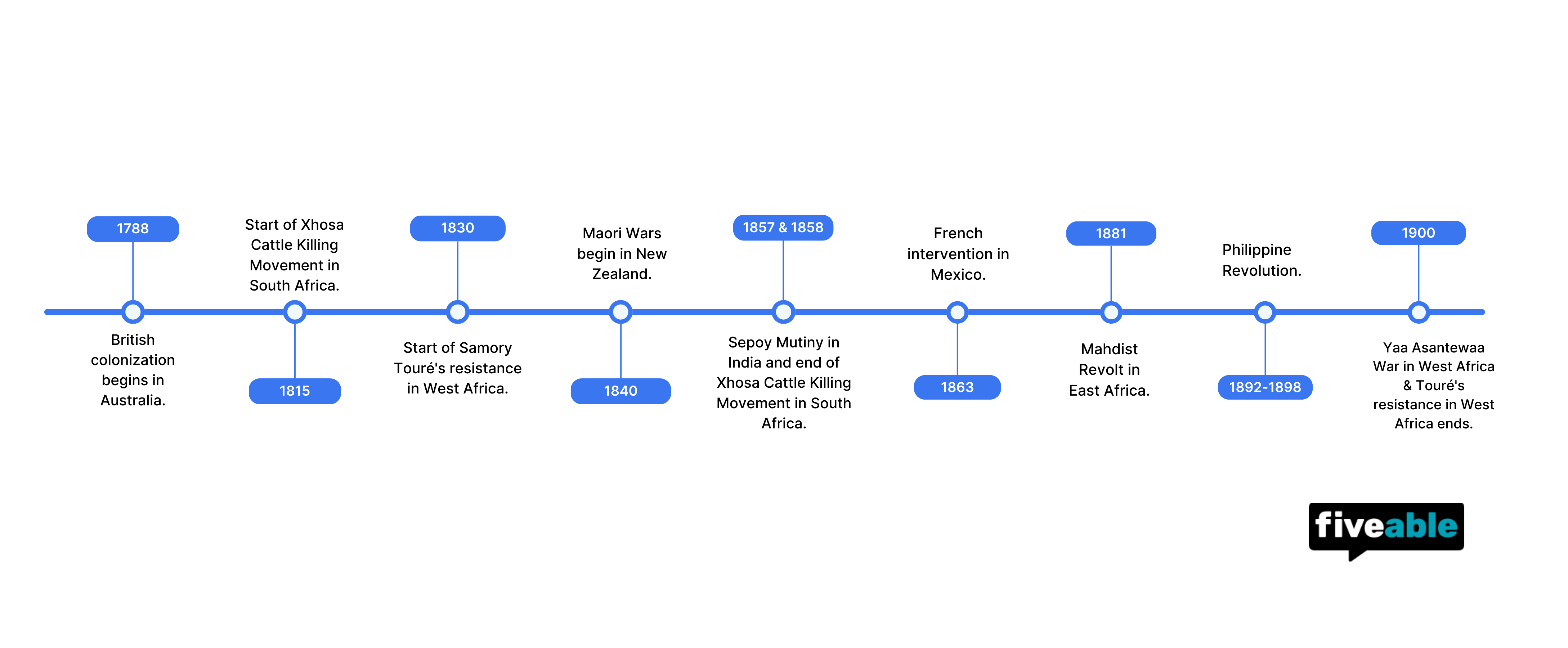
This topic is the "response" half of the imperialism story. Read it alongside AMSCO 6.2 State Expansion notes, which covers the expansion these movements were responding to.
Key Takeaways
- Resistance took three forms: direct revolts, new states on imperial peripheries, and religious rebellions. Many leaders used European-style education and Enlightenment ideas against colonizers.
- Ottoman weakness and ethnic nationalism drove Balkan independence movements; the Treaty of Berlin freed several states but gave Bosnia and Herzegovina to Austria-Hungary.
- Cherokee assimilation did not prevent removal, the Ghost Dance ended at Wounded Knee, and Túpac Amaru II led a revolt against Spanish rule.
- Greased cartridges sparked the 1857 rebellion in India, after which the British Raj replaced Company rule; British-educated Indians later founded the Indian National Congress and called for self-rule.
- Vietnamese resistance continued after Ham Nghi's exile, the Philippines' transfer to U.S. control triggered another war, and the Maori lost most of their land after wars with Britain.
- Usman dan Fodio's Islamic reform movement created the Sokoto Caliphate, Xhosa cattle killing brought famine instead of removing the British, and Yaa Asantewaa's rebellion ended with British control of Asante.
Nationalist Movements in the Balkans
By the early 19th century, the Ottoman Empire was losing its grip on the Balkan Peninsula, and ethnic nationalism (inspired by the French Revolution) drove Balkan peoples to seek independence.
- Serbia won self-rule in 1815 (full independence in 1878) and Greece won independence in 1832, both after long wars.
- Bosnia and Herzegovina, Montenegro, and Bulgaria all rebelled against Ottoman rule. Serbia and Russia joined in during the last major Russo-Turkish War (1877-1878).
- The Treaty of Berlin (1878) freed Bulgaria, Romania, and Montenegro but handed Bosnia and Herzegovina to Austria-Hungary.
- Why it matters long-term: the ethnic tensions here set the stage for World War I.
This is the textbook example of "new states created on the peripheries" of a weakening empire.
Resistance and Rebellion in the Americas
In the Americas, indigenous responses ranged from assimilation to armed revolt to spiritual movements, and almost all of them ran into expansionist settler states.
North America: Proclamation, Cherokee, and the Ghost Dance
- The Proclamation of 1763, issued by Britain after the French and Indian War, reserved land between the Appalachians and the Mississippi for Native Americans. It was the first time a European government recognized indigenous territorial rights, and British colonists hated it. After U.S. independence, settlers overran the Ohio and Illinois river valleys anyway.
- The Cherokee Nation tried assimilation after 1800. They adopted settler-style farming, weaving, and building, created a syllabic alphabet (making nearly the whole tribe literate), published the Cherokee Phoenix (the first Native American newspaper in the U.S.), and wrote a constitution modeled on the U.S. Constitution. None of it protected them. After gold was discovered on Cherokee land in Georgia in 1829, Congress passed the Indian Removal Act of 1830, forcing the Cherokee and other Southeast tribes to relocate to present-day Oklahoma.
- The Ghost Dance began around 1869 with Northern Paiute prophet-dreamers who taught that the dead would return and drive out the whites, restoring Native lands and traditions. The ritual dances and songs spread across the West, reaching the Sioux by 1890. The movement fell at the Wounded Knee Massacre in 1890, which marked the end of the Indian Wars.
Túpac Amaru II's Rebellion in Peru
José Gabriel Condorcanqui was a cacique (hereditary chief) in southern Peru, descended from the last Inca ruler. He took the name Túpac Amaru II and kept his Inca identity despite a formal Jesuit education. In 1780 he arrested and executed a colonial administrator for cruelty, sparking the last general Indian revolt against Spain. The revolt spread through southern Peru into Bolivia and Argentina, and some criollos initially supported it. Captured in March 1781, he was forced to watch his wife and sons executed in Cuzco before being tortured and executed himself. This is the classic "direct resistance" example for this topic.
French Intervention in Mexico
In 1863, Mexican conservatives conspired with Napoleon III of France to overthrow the liberal government of Benito Juárez, a full-blooded Zapotec. Napoleon III installed Archduke Maximilian as emperor of Mexico (crowned June 10, 1864). After three more years of war, Mexicans forced the French out. Maximilian was executed on June 19, 1867, and Juárez resumed the presidency. Resistance here worked.
South Asian Movements: The 1857 Rebellion and the Raj
The Indian Rebellion of 1857 (also called the Sepoy Mutiny) began over rifle cartridges greased with cow and pig fat. Sepoys were Indian soldiers in British employ, mostly Hindus and Muslims, and the cartridges offended both groups, who became convinced the British wanted to convert them to Christianity. The uprising spread through northern Indian cities before the British put it down, killing thousands.
The consequences reshaped India:
- Britain exiled the Mughal emperor and ended the Mughal Empire.
- The British Raj replaced Company rule: from 1858 until independence in 1947, the colonial government took orders directly from London.
- The rebellion marked the emergence of Indian nationalism. In 1885, British-educated Indians founded the Indian National Congress, which started as a forum for grievances but quickly called for self-rule. Because Hindus dominated its first meeting, many Indian Muslims were suspicious of it.
Southeast Asian Resistance: Vietnam and the Philippines
By the 1880s, Siam (Thailand) was the only independent country left in Southeast Asia.
- Vietnam: When 12-year-old Ham Nghi became emperor in 1884, his top advisers were vocal critics of the French. The French raided the royal palace, but the emperor had been hidden. His supporters resisted until his capture and exile to Algeria in 1888, and Phan Dinh Phung carried the resistance to 1895, becoming a hero to later Vietnamese revolutionaries.
- Philippines: José Rizal, educated in Europe, founded the Liga Filipina in 1892. The Liga was actually loyal to Spain, but the Spanish executed Rizal anyway, shocking Filipinos and feeding nationalist ambitions. Revolts around Manila in 1896 launched the Philippine Revolution.
- After the U.S. won the Battle of Manila Bay in the Spanish-American War (1898), Filipino rebels expected independence. Instead, the Treaty of Paris transferred the Philippines from Spain to the United States, triggering the Philippine-American War (1899-1902). About 20,000 Filipino troops and over 200,000 civilians died; of 4,300 American deaths, nearly two-thirds were from disease. The Philippines stayed a U.S. possession until 1946.
The Philippine case is great essay evidence: a colony swapped one imperial ruler for another, and nationalism didn't disappear, it intensified.
Resistance in Australia and New Zealand
- Australia: Aboriginal people have lived in Australia for an estimated 50,000 years, the oldest continuous culture on Earth, with perhaps 1 million people in 500 clans speaking 700 languages at European settlement. When Britain began sending convicts and soldiers to New South Wales in 1788, the colonial government didn't recognize indigenous land ownership, and Aboriginal people weren't considered British subjects, so the law didn't protect them. Thousands were killed defending their territory and resources.
- New Zealand: The Maori arrived from Polynesia in the 14th century. The 1840 Treaty of Waitangi promised British protection of Maori property rights, but settlement patterns alarmed the Maori and the Maori Wars broke out. Britain prevailed by 1846, fighting flared again when troops were sent in 1861 to pressure land sales, and an uneasy peace came in 1872. By 1900 the Maori had lost most of their land.
African Resistance: Sokoto to Yaa Asantewaa
Organized African resistance developed later than Indian resistance because Europeans had been in India longer, and colonial governments in Africa were run largely by European military officials rather than partially by locals. By the end of World War I, Western-educated Africans had built a shared identity called Pan-Africanism.
- Sokoto Caliphate: In 1804, Usman dan Fodio led Muslim intellectuals in a drive to purify Islam among the Hausa, creating a caliphate centered at Sokoto. It became the largest African empire since the 16th century, and it grew its economy through the slave trade just as Britain was trying to end it (the British navy intercepted Sokoto ships and relocated freed people to Sierra Leone). Britain finally absorbed Sokoto into Nigeria in 1903.
- Xhosa Cattle Killing Movement (1856-1857): After Xhosa cattle began sickening and dying, possibly from settler cattle diseases, the Xhosa killed perhaps 400,000 cattle and destroyed crops, believing spirits would then remove the British. The result was famine and thousands of deaths, and the British stayed.
- Anglo-Zulu War (1870s): The well-organized, centralized Zulu Kingdom initially won against the British but was eventually defeated, and Zulu lands became part of British South Africa.
- Samory Touré: A Mande chieftain who built a powerful kingdom in Guinea starting in 1868, he fought French annexation of West Africa beginning in 1883 and again in 1891. The French captured and exiled him in 1898.
- Mahdist Revolt: In 1881, Sudanese cleric Muhammad Ahmad declared himself the Mahdi ("guided one") and turned long-standing resentment of Egyptian rule (sharpened by British arrival in 1873) into a religious army. The Mahdists took the area around Khartoum by 1882 and overran a British-Egyptian force in January 1885, but Ahmad's death that June fractured the movement. Britain returned in 1896 and defeated the Mahdists in September 1898.
- Yaa Asantewaa War (1900): Britain's fifth attempt to subjugate the Asante Empire (in present-day Ghana) began when the British governor demanded the Golden Stool, the Asante symbol of national unity. Warrior queen Yaa Asantewaa led the rebellion, the last African war led by a woman. About 2,000 Asante and 1,000 British died, more than in the first four wars combined. Britain won in September 1900, exiled Yaa Asantewaa, and absorbed Asante into the Gold Coast colony.
Key Terms to Know
| Term | Why it matters |
|---|---|
| Túpac Amaru II | Inca-descended cacique whose 1780 revolt was the last general Indian uprising against Spain; the go-to "direct resistance" example. |
| Ghost Dance | Spiritual movement promising the return of Native lands and traditions; ended at Wounded Knee in 1890, closing the Indian Wars. |
| Indian Removal Act of 1830 | Forced the Cherokee and other Southeast tribes to Oklahoma, proving assimilation didn't protect indigenous land. |
| Cherokee Nation | Adopted a written alphabet, newspaper (Cherokee Phoenix), and constitution; an example of adaptation as a response to expansion. |
| Benito Juárez | Zapotec president of Mexico who outlasted the French intervention and resumed power after Maximilian's execution in 1867. |
| Indian Rebellion of 1857 (Sepoy Mutiny) | Uprising over greased cartridges that ended the Mughal Empire, brought direct British rule, and sparked Indian nationalism. |
| Raj | British colonial government of India (1858-1947) that took orders directly from London. |
| Indian National Congress | Founded 1885 by British-educated Indians; shifted from airing grievances to demanding self-rule. |
| José Rizal | Filipino reformer whose execution by Spain in 1896 helped ignite the Philippine Revolution. |
| Treaty of Paris (1898) | Ended the Spanish-American War by transferring the Philippines to the U.S., triggering the Philippine-American War. |
| Philippine-American War | 1899-1902 conflict in which the U.S. defeated Filipino nationalists; over 200,000 civilians died. |
| Treaty of Waitangi | 1840 treaty promising to protect Maori property rights; Britain's violations fueled the Maori Wars. |
| Sokoto Caliphate | Usman dan Fodio's Islamic state in West Africa, the largest African empire since the 16th century; absorbed into British Nigeria in 1903. |
| Xhosa Cattle Killing Movement | Religiously driven rebellion in southern Africa that caused famine instead of expelling the British. |
| Mahdist Revolt | Muhammad Ahmad's religious-political movement in Sudan that beat British-Egyptian forces in 1885 before falling in 1898. |
| Samory Touré | Mande leader who fought French annexation of West Africa for decades until his capture in 1898. |
| Yaa Asantewaa War | 1900 Asante rebellion over the Golden Stool, the last African war led by a woman. |
| Pan-Africanism | Shared identity and nationalism among Western-educated Africans that emerged by the end of World War I. |
Practice and Next Steps
For the College Board framing of this material, review the Topic 6.3 Indigenous Responses to Imperialism study guide, then continue to AMSCO 6.4 Global Economic Development notes. The full set of chapter summaries lives on the AMSCO notes page.
To check yourself, sort these movements into the three categories (direct resistance, new states, religious rebellions) from memory, then test the material with guided multiple-choice practice. These examples make strong evidence for comparison and causation essays, so try writing with them in FRQ practice with instant scoring.
Frequently Asked Questions
What are the three forms of anti-imperial resistance in AP World Topic 6.3?
Resistance from 1750 to 1900 took three main forms: direct resistance within empires (Túpac Amaru II's rebellion, the 1857 rebellion in India, the Yaa Asantewaa War), the creation of new states on imperial peripheries (Balkan nations, the Sokoto Caliphate, the Cherokee Nation, the Zulu Kingdom), and rebellions influenced by religious ideas (the Ghost Dance, the Xhosa Cattle Killing Movement, the Mahdist wars in Sudan). Sorting examples into these three buckets is the fastest way to study this topic.
Who was Túpac Amaru II and why did he rebel?
Túpac Amaru II (born José Gabriel Condorcanqui around 1740) was a hereditary chief in southern Peru descended from the last Inca ruler. In 1780 he arrested and executed a Spanish colonial administrator for cruelty, sparking the last general Indian revolt against Spain, which spread into Bolivia and Argentina. He was captured in 1781 and executed in Cuzco after watching his wife and sons die.
What caused the Indian Rebellion of 1857 (Sepoy Mutiny)?
The immediate trigger was British rifle cartridges greased with cow and pig fat, which offended both Hindu and Muslim sepoys and convinced them Britain wanted to convert them to Christianity. The British put down the uprising, ended the Mughal Empire, and ruled India directly through the Raj from 1858 to 1947. The rebellion also marked the emergence of Indian nationalism, leading to the Indian National Congress in 1885.
Did the Cherokee assimilation strategy work?
No. The Cherokee adopted settler farming methods, created a written alphabet, published the first Native American newspaper (the Cherokee Phoenix), and wrote a constitution modeled on the U.S. Constitution. But after gold was found on their Georgia land in 1829, the Indian Removal Act of 1830 forced them to relocate to present-day Oklahoma anyway. It's a key example that adaptation didn't protect indigenous peoples from expansionist states.
How do I use Topic 6.3 examples on the AP World exam?
These movements are prime evidence for LEQ and DBQ prompts about reactions to imperialism in the 1750-1900 period. Pairing examples works well, like comparing religiously influenced rebellions (Ghost Dance, Mahdist Revolt, Xhosa Cattle Killing) with secular nationalist movements (Indian National Congress, Philippine Revolution). Try building those paragraphs with Fiveable's FRQ practice with instant scoring.
See Fiveable more often in Google
Mark Fiveable as a preferred source and Google is more likely to show you our guides in Top Stories, with a "preferred" badge in AI Mode and AI Overviews.