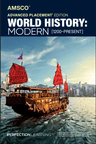
 AP World History AMSCO Guided Notes
AP World History AMSCO Guided Notes74 chapters of study guides with key terms and essential questions
All Chapters
Unit 0 - Prologue: History before 1200 C.E.
Unit 1 - The Global Tapestry from c. 1200 to c. 1450
Unit 2 - Networks of Exchange from c. 1200 to c. 1450
Unit 3 - Land-Based Empires from c. 1450 to c. 1750
Unit 4 - Transoceanic Interconnections from c. 1450 to c. 1750
Unit 5 - Revolutions from c. 1750 to c. 1900
5.1The Enlightenment
5.2Nationalism and Revolutions
5.3Industrial Revolution Begins
5.4Industrialization Spreads
5.5Technology in the Industrial Age
5.6Industrialization: Government's Role
5.7Economic Developments and Innovations
5.8Reactions to the Industrial Economy
5.9Society and the Industrial Age
5.10Continuity and Change in the Industrial Age
Unit 6 - Consequences of Industrialization from c. 1750 to c. 1900
Unit 7 - Global Conflict After 1900
Unit 8 - Cold War and Decolonization After 1900
8.1Setting the Stage for the Cold War and Decolonization
8.2The Cold War
8.3Effects of the Cold War
8.4Spread of Communism after 1900
8.5Decolonization after 1900
8.6Newly Independent States
8.7Global Resistance to Established Power Structures
8.8End of the Cold War
8.9Causation in the Age of the Cold War and Decolonization
Unit 9 - Globalization After 1900
9.1Advances in Technology and Exchange
9.2Technological Advancements and Limitations-Disease
9.3Technology and the Environment
9.4Economics in the Global Age
9.5Calls for Reform and Responses
9.6Globalized Culture
9.7Resistance to Globalization
9.8Institutions Developing in a Globalized World
9.9Continuity and Change in a Globalized World
About AMSCO AP World History: Modern
The AMSCO AP World History: Modern textbook covers global history from c. 1200 to the present, aligning with the College Board's revised course framework. The text examines how societies across Africa, the Americas, Asia, and Europe interacted, traded, and transformed over eight centuries of world history.
World history can feel overwhelming with its global scope, but AMSCO organizes the content around key themes: humans and the environment, cultural developments, governance, economic systems, social interactions, and technology. This thematic approach helps students see patterns and make connections across different regions and time periods.
Our guided notes break down each AMSCO chapter into focused questions that help you identify cross-cultural comparisons and trace developments across regions. Whether you're studying the Mongol Empire, the Columbian Exchange, or decolonization, these notes guide your reading and prepare you for the comparative and contextualization skills tested on the AP exam.
What This AMSCO Covers
- Global coverage from 1200 CE to present
- Organized by 9 units and key themes
- Cross-cultural comparison practice
- Contextualization and argument development
Frequently Asked Questions
What are AMSCO guided notes?
AMSCO guided notes are structured worksheets designed to accompany the AMSCO AP World History textbook. Instead of passive reading, guided notes provide questions and prompts that help you actively engage with each chapter. As you read, you answer questions that focus your attention on key concepts, cause-and-effect relationships, and important details that are likely to appear on the AP exam.
How do I use these guided notes with my AMSCO AP World History textbook?
Open the guided notes alongside your AMSCO textbook. As you read each section, look for answers to the guided questions. Write your responses in the space provided (if you print them) or take notes separately. The questions follow the structure of the AMSCO chapters, so you can work through them section by section. This active reading approach helps you retain information better than highlighting or re-reading alone.
Are these guided notes aligned to the AP AP World History exam?
Yes. The AMSCO textbook itself is written to align with the College Board's AP Course and Exam Description, and our guided notes follow the AMSCO chapter structure. This means the questions focus on the content, skills, and historical thinking processes that the AP exam tests. Using guided notes as part of your study routine helps you prepare for both the multiple-choice and free-response sections of the exam.
Can I print these guided notes?
Yes. Each guided notes page includes print and download options. You can print them with or without answer space depending on how you prefer to take notes. Many students find it helpful to print the notes and fill them in by hand while reading, as handwriting can improve retention. You can also download them as PDFs to annotate digitally.
Where can I find the AP World History AMSCO textbook PDF?
You can sometimes find PDF files for AMSCO textbooks on teacher websites if you search online or on Reddit. The PDF is not publicly available for free. If you purchase the AMSCO textbook through Perfection Learning, you will get an online version of it.
What is the AMSCO textbook and why is it popular?
AMSCO (published by Perfection Learning) is a series of AP exam preparation textbooks known for being concise and accessible. Unlike bulky college-level textbooks, AMSCO books focus specifically on what students need to know for the AP exam. The AP World History AMSCO is written by experienced AP teachers and exam readers, making it practical and exam-focused. Many teachers use it as either their primary text or as a supplement for AP exam review.
How are guided notes different from regular notes?
Regular notes require you to decide what's important while reading, which can be challenging with dense material. Guided notes provide structure by giving you specific questions to answer as you read. This keeps you focused on key concepts rather than getting lost in details. Research shows that guided notes improve comprehension and test performance because they require active processing of information rather than passive copying.