AMSCO 5.2 Nationalism and Revolutions Notes

🌍AP World History: Modern Review
AMSCO 5.2 Nationalism and Revolutions Notes
🌍 AP World History: Modern
AMSCO 1.1 Developments in East Asia Notes
AMSCO 1.2 Developments in Dar al-Islam Notes
AMSCO 1.3 Developments in South and Southeast Asia Notes
AMSCO 1.4 Developments in the Americas Notes
AMSCO 1.5 Developments in Africa Notes
AMSCO 1.6 Developments in Europe Notes
AMSCO 1.7 Comparison in the Period from c.1200 to c.1450 Notes
AMSCO 2.1 The Silk Roads Notes
AMSCO 2.2 The Mongol Empire and the Modern World Notes
AMSCO 2.3 Exchange in the Indian Ocean Notes
AMSCO 2.4 Trans-Saharan Trade Routes Notes
AMSCO 2.5 Cultural Consequences of Connectivity Notes
AMSCO 2.6 Environmental Consequences of Connectivity Notes
AMSCO 2.7 Comparison of Economic Exchange Notes
AMSCO 3.1 European, East Asian, and Gunpowder Empires Expand Notes
AMSCO 3.2 Empires: Administrations Notes
AMSCO 3.3 Empires: Belief Systems Notes
AMSCO 3.4 Comparison in Land-Based Empires Notes
AMSCO 4.1 Technological Innovations Notes
AMSCO 4.2 Exploration: Causes and Events Notes
AMSCO 4.3 Columbian Exchange Notes
AMSCO 4.4 Maritime Empires Link Regions Notes
AMSCO 4.5 Maritime Empires Develop Notes
AMSCO 4.6 Internal and External Challenges to State Power Notes
AMSCO 4.7 Changing Social Hierarchies Notes
AMSCO 4.8 Continuity and Change from c.1450 to c.1750 Notes
AMSCO 5.1 The Enlightment Notes
AMSCO 5.2 Nationalism and Revolutions Notes
AMSCO 5.3 Industrial Revolution Begins Notes
AMSCO 5.4 Industrialization Spreads Notes
AMSCO 5.5 Technology in the Industrial Age Notes
AMSCO 5.6 Industrialization: Government's Role Notes
AMSCO 5.7 Economic Developments and Innovations Notes
AMSCO 5.8 Reactions to the Industrial Economy Notes
AMSCO 5.9 Society and the Industrial Age Notes
AMSCO 5.10 Continuity and Change in the Industrial Age Notes
AMSCO 6.1 Rationales for Imperialism Notes
AMSCO 6.2 State Expansion Notes
AMSCO 6.3 Indigenous Responses to State Expansion Notes
AMSCO 6.4 Global Economic Development Notes
AMSCO 6.5 Economic Imperialism Notes
AMSCO 6.6 Causes of Migration in an Interconnected World Notes
AMSCO 6.7 Effects of Migration Notes
AMSCO 6.8 Causation in the Imperial Age Notes
AMSCO 7.1 Shifting Power Notes
AMSCO 7.2 Causes of World War I Notes
AMSCO 7.3 Conducting World War I Notes
AMSCO 7.4 Economy in the Interwar Period Notes
AMSCO 7.5 Unresolved Tensions After World War I Notes
AMSCO 7.6 Causes of World War II Notes
AMSCO 7.7 Conducting World War II Notes
AMSCO 7.8 Mass Atrocities Notes
AMSCO 7.9 Causation in Global Conflict Notes
AMSCO 8.1 Setting the Stage for the Cold War and Decolonization Notes
AMSCO 8.2 The Cold War Notes
AMSCO 8.3 Effects of the Cold War Notes
AMSCO 8.4 Spread of Communism Notes
AMSCO 8.5 Decolonization after 1900 Notes
AMSCO 8.6 Newly Independent States Notes
AMSCO 8.7 Global Resistance to Established Power Structure Notes
AMSCO 8.8 End of the Cold War Notes
AMSCO 8.9 Causation in the Age of the Cold Ward and Decolonization Notes
AMSCO 9.1 Advances in Technology and Exchange Notes
AMSCO 9.2 Technological Advancements and Limitations Notes
AMSCO 9.3 Technology and the Environment Notes
AMSCO 9.4 Economics in the Global Age Notes
AMSCO 9.5 Calls for Reforms and Responses Notes
AMSCO 9.6 Globalized Culture Notes
AMSCO 9.7 Resistance to Globalization Notes
AMSCO 9.8 Institutions Developing in a Globalized World Notes
AMSCO 9.9 Continuity and Change in a Globalized World Notes
Overview
AMSCO Topic 5.2, Nationalism and Revolutions, covers the wave of revolutions between 1750 and 1900 that toppled monarchies, ended colonial rule across the Americas, and built brand-new nation-states in Europe. The chapter connects Enlightenment ideas (natural rights, popular sovereignty, liberalism) from Topic 5.1 to the American, French, Haitian, and Latin American revolutions, then follows nationalism into Italian and German unification, Balkan independence movements, Ottomanism, the Philippine Propaganda Movement, and the New Zealand Wars. The through-line for the whole chapter is simple: once people started believing governments needed their consent and that nations should match cultural identity, the old political map could not survive.
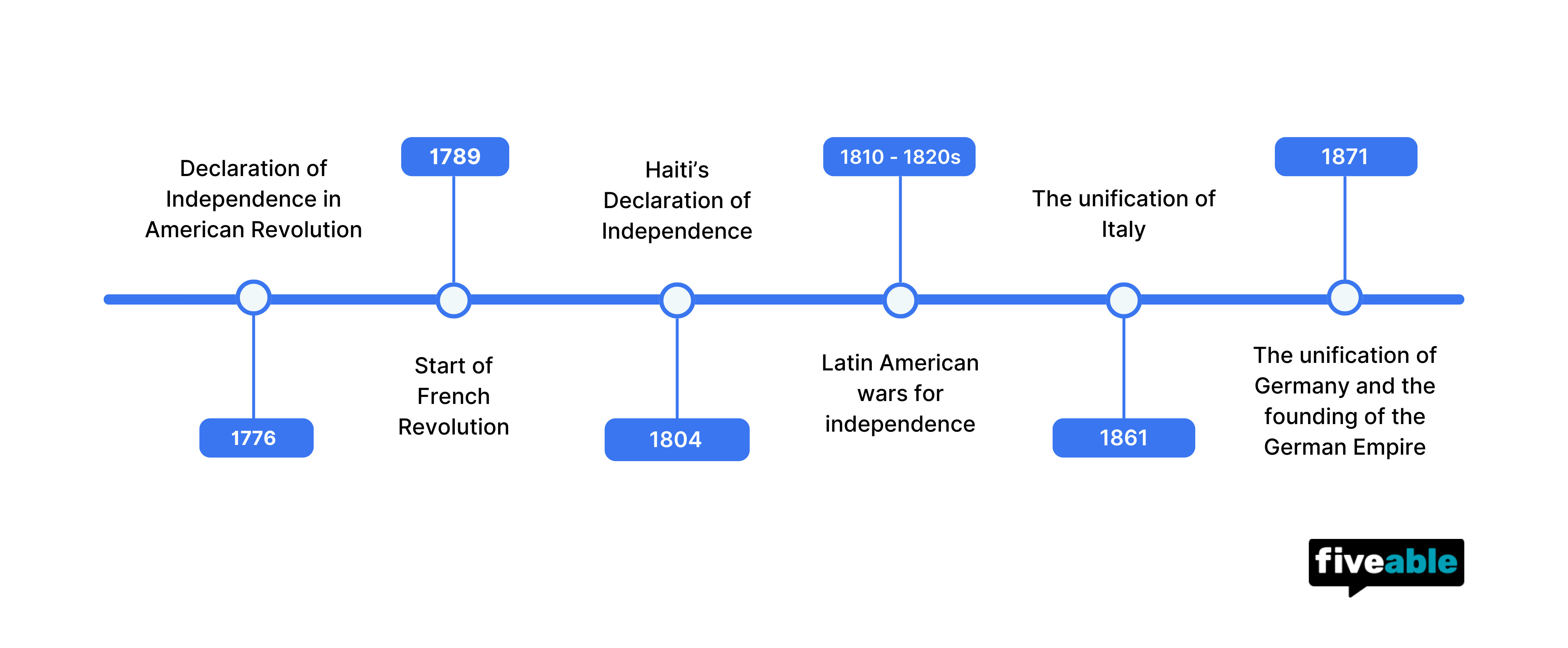
Timeline of revolutions in the 18th and 19th centuries
Image Courtesy of Rashmi Korukonda
Key Takeaways
- The American Declaration of Independence drew on Locke's rights; French debt helped trigger a revolution that abolished feudalism and declared basic human rights.
- Enslaved Africans began Haiti's rebellion, and Toussaint L'Ouverture led its fight against slavery; Jean-Jacques Dessalines declared permanent independence in 1804.
- Creoles such as Simón Bolívar led Latin American independence movements, but new governments stayed conservative, and creoles became the powerful upper class.
- The Filipino Propaganda Movement sought autonomy rather than independence, while José Rizal's execution helped spark resistance to Spain; during the New Zealand Wars, Maori tribes fought together and developed nationalism.
- Cavour allied with Garibaldi's Red Shirts to advance Italian unification; Bismarck engineered three wars to unify Germany and founded the German Empire in 1871.
- Greek independence followed a civil war and outside intervention; Ottomanism tried to unify the empire by minimizing differences but instead increased subject peoples' desire for independence.
The Atlantic Revolutions: America, France, and Haiti
The American, French, and Haitian revolutions all drew on the same Enlightenment toolkit. Each one inspired the next, which is exactly the causation chain AP World loves to ask about.
The American Revolution
- Causes: Enlightenment philosophy, physiocrat free-market ideas opposing English mercantilism, colonial legislatures already acting independently, and the sheer distance between the colonies and London.
- The Declaration of Independence (July 4, 1776) borrowed John Locke's idea of "unalienable rights." Jefferson named them as life, liberty, and the pursuit of happiness.
- The colonists won in 1783 with crucial help from France, Britain's long-time rival. That French spending matters later.
- Why it matters for the whole period: the successful new republic became a model for revolutions that followed.
The French Revolution
- Slogan: liberté, égalité, et fraternité (liberty, equality, fraternity), spread across Europe by the philosophes.
- Economic trigger: France spent more than it took in for years, including the money it sent to help the Americans. To fix the budget, the government called the Estates-General in spring 1789.
- The Estates-General had three estates: clergy, nobility, and commoners. Commoners were 97 percent of French society but got outvoted, so they broke away and formed the National Assembly.
- July 14, 1789: a Paris crowd stormed the Bastille, the prison that symbolized royal and aristocratic abuse. Peasants rose up in the countryside and burned manor houses. The king was forced to accept the National Assembly.
- The most lasting changes came early: abolition of feudalism and the Declaration of the Rights of Man, a statement of basic human rights.
- When Louis XVI and the nobles refused to accept a limited monarchy, radicals like the Jacobins pushed further. The First French Republic was established in 1792, followed by the Reign of Terror, when the government executed thousands of opponents, including the king and queen.
- After years of turmoil, Napoleon Bonaparte became emperor in 1804. His conquests then spread nationalism across Europe, especially in the German states.
The Haitian Revolution
- Setting: France's rich sugar and coffee colony on the western third of Hispaniola (St. Domingue).
- Enslaved Africans began the rebellion, soon joined by Maroons (people who had already escaped slavery). Toussaint L'Ouverture, formerly enslaved and well-read in Enlightenment thought, joined in 1791 and led a general rebellion against slavery.
- L'Ouverture's 1801 constitution granted equality and citizenship to all residents (he also named himself governor for life). Land reform broke up plantations and distributed land to formerly enslaved and free Black people.
- The French betrayed and imprisoned L'Ouverture; he died in France in 1803. His successor Jean-Jacques Dessalines declared permanent independence in 1804.
- Haiti's firsts: first independent country in Latin America, first Black-led country in the Western Hemisphere, and the only country to become permanently independent through a slave uprising.
- Comparison to France: both revolutions grew from Enlightenment natural-rights ideas, but Haiti's was led by people who had no rights at all, making the restraints far more severe.
Creole Revolutions in Latin America
Creoles, people of European ancestry born in the Americas, led the Latin American independence movements. They were educated, wealthy, and resentful that Spain reserved top government jobs for peninsulares (those born in Spain or Portugal).
Why the colonies wanted out
- Creoles owned estates, mines, and businesses but were squeezed by Spanish mercantilism, which forced colonists to trade only with Spain.
- Creoles wanted political power that Spain kept giving to peninsulares.
- Mestizos (mixed European and indigenous ancestry) wanted political power and a share of colonial wealth.
- At the bottom of the social hierarchy were enslaved Africans, the indigenous population, and mulattoes (African and European or indigenous ancestry).
The Bolívar Revolutions
- Simón Bolívar, a wealthy Venezuelan creole born in 1783, pushed Enlightenment ideals and led independence movements in what became Venezuela, Colombia, Ecuador, and Peru.
- He formed Gran Colombia, hoping for a federation like the United States. His "Jamaica Letter" (1815) laid out his goals, defending a people striving "to recover the rights to which the Creator and Nature have entitled them."
- Important nuance: creoles refused support from mestizos, indigenous people, and mulattoes. They had watched the slave uprising in Haiti and the Reign of Terror in France and feared the masses.
Results of the revolutions
- New constitutions legally ended slavery and some social distinctions, but governments stayed conservative and creoles became the new powerful upper class. Peru's first constitution denied the vote to anyone who could not read or write Spanish, shutting out most indigenous people until 1860.
- Long wars produced caudillos, strong local leaders with regional power bases who made and broke national governments and generally ignored rule of law.
- Women gained little. Most could not vote, sign contracts, or get an education until late in the century. The big exception was Manuela Sáenz, who fought alongside Bolívar, rose to the rank of colonel, and earned the nickname "Liberator of the Liberator" for saving his life.
Later challenges to Spain: Puerto Rico and Cuba
Spain held Puerto Rico and Cuba through the 19th century, and both islands saw uprisings starting in 1868. The poet Lola Rodríguez de Tió became famous for her critiques of Spain's exploitative rule. Her revolutionary lyrics to "La Boriqueña" urged Puerto Ricans to "Awake from your sleep, for it's time to fight!" Her writings got her exiled three times (to Venezuela, then Cuba, then New York) before she returned to Cuba in 1899 as a social justice campaigner.
Nationalist Movements Beyond the Atlantic
Revolt in the Philippines
- Spain controlled education in the Philippines through religious authorities, so wealthy young Filipinos (often creoles and mestizos) studied in Madrid and Barcelona, where they absorbed 1880s nationalist and republican ideas.
- These students formed the Propaganda Movement, writing magazines and pamphlets advocating greater autonomy. Notably, it did not call for revolution or independence.
- José Rizal was the most prominent voice. His arrest in 1892 and execution in 1896 shocked Filipinos and sparked the first nationalist movement strong enough to challenge Spain. The Philippine Revolution began in 1896.
The New Zealand Wars
- The Maori, a Polynesian people, had lived in New Zealand since at least the mid-1200s, organized into tribes called iwi.
- After Britain annexed New Zealand in 1840, English control over Maori affairs grew, along with pressure for Maori land.
- The resulting conflicts, the New Zealand Wars, pushed Maori tribes to fight together and develop a sense of Maori nationalism. By 1872, the British had won.
Nationalism and Unification in Europe
Nationalism worked in two directions in Europe. It united fragmented regions into new states (Italy, Germany) and it pulled multiethnic empires apart (Ottoman). People increasingly felt bonded to others who shared their language, history, and customs.
Italian Unification
- Count di Cavour, prime minister of Piedmont-Sardinia, led the drive to unite the Italian Peninsula under the House of Savoy. At the time the peninsula was a patchwork of kingdoms and city-states, and most people spoke regional languages (Cavour himself spoke French better than Italian).
- Cavour practiced realpolitik, the practical politics of reality. In 1858 he maneuvered Napoleon III of France into a war with Austria to weaken Austrian influence in Italy. Napoleon III backed out after two victories, partly fearing the Pope's anger over the Papal States.
- The momentum held anyway: several regions voted by plebiscite (popular referendum) to join Piedmont. Cavour adopted the romantic revolutionary philosophy of Giuseppe Mazzini, who had pushed for Italian resurgence (Risorgimento) for decades, and allied with Giuseppe Garibaldi's Red Shirts fighting in the Kingdom of Naples.
German Unification
- German nationalism strengthened in opposition to Napoleon's occupation of German states. After the Congress of Vienna (1815), revolutions broke out across Europe in 1848, driven by both nationalism and liberalism.
- Prussian leader Otto von Bismarck, another realpolitik practitioner, engineered three wars to unify Germany: with Austria against Denmark (1864), against Austria itself (Seven Weeks' War, 1866), and against France (Franco-Prussian War, 1870). Prussia gained territory each time.
- In 1871 Bismarck founded the German Empire, including Alsace-Lorraine, taken from France.
- Global consequence: by 1871 two new powers, Italy and Germany, entered a Europe of competing alliances. The balance of power held briefly, but extreme nationalism would help cause World War I. Unification didn't fix Italian poverty, especially in the south, driving heavy emigration to the United States and Argentina (whose 1853 constitution encouraged immigration).
Balkan nationalism and Ottomanism
- The Ottoman Empire began its long decline in the 17th century; the failed siege of Vienna in 1683 opened the door for Austria and Russia to roll back Ottoman power in the Balkans.
- Greece, under Ottoman control for over 350 years, saw Enlightenment ideas and European admiration for ancient Greek culture reawaken national pride. A long civil war plus intervention by a British, French, and Russian fleet (which destroyed an Ottoman fleet in 1827) secured Greek independence.
- Serbia, Bulgaria, and Romania followed similar paths: weakening Ottoman control, nationalism built around language, folk traditions, history, and religion, and help from outside powers like Russia or Austria.
- The Ottoman response in the 1870s-1880s was Ottomanism, an attempt to build a modern unified state by minimizing ethnic, linguistic, and religious differences, partly through standardized state schools. It backfired: subject peoples viewed it with suspicion, and it actually intensified their sense of difference and desire for independence.
Key Terms to Know
| Term | Why it matters |
|---|---|
| Declaration of Independence | The 1776 document where Jefferson turned Locke's "unalienable rights" into life, liberty, and the pursuit of happiness, justifying American independence. |
| Philosophes | French Enlightenment writers who spread revolutionary ideals like liberty and equality across Europe. |
| Declaration of the Rights of Man | The French Revolution's statement of basic human rights, one of its most permanent achievements alongside abolishing feudalism. |
| Bastille | The Paris prison stormed on July 14, 1789; it symbolized monarchy's abuses, and the date became French Independence Day. |
| Reign of Terror | The radical Jacobin phase when the French government executed thousands of opponents, including the king and queen. |
| Toussaint L'Ouverture | Formerly enslaved leader of the Haitian Revolution whose constitution granted equality and citizenship and who cemented abolition in Haiti. |
| Maroons | People who had escaped slavery in Haiti and joined the rebellion alongside enslaved Africans. |
| Peninsulares | Colonists born in Spain or Portugal who held the top jobs in Latin America, fueling creole resentment. |
| Mestizos | People of mixed European and indigenous ancestry who wanted political power and a share of colonial wealth. |
| Mulattoes | People of African and European or indigenous ancestry, near the bottom of the colonial social hierarchy. |
| Simón Bolívar | Creole leader who freed Venezuela, Colombia, Ecuador, and Peru and outlined his Enlightenment-based goals in the "Jamaica Letter" (1815). |
| Caudillos | Strong regional leaders who emerged from Latin America's long wars and undermined representative government. |
| Lola Rodríguez de Tió | Puerto Rican poet whose revolutionary writings against Spanish rule got her exiled three times. |
| Propaganda Movement | Filipino students' push for autonomy (not independence) from Spain; Rizal's 1896 execution turned it toward revolution. |
| Realpolitik | Practical power politics used by both Cavour and Bismarck to engineer unification through manipulation and war. |
| Risorgimento | The Italian resurgence movement Mazzini had championed since early in the 19th century. |
| Otto von Bismarck | Prussian leader who used three wars (1864, 1866, 1870) to create the German Empire in 1871. |
| Ottomanism | The Ottoman attempt to unify the empire by downplaying ethnic and religious differences, which ironically intensified separatist nationalism. |
Practice and Next Steps
These AMSCO 5.2 notes pair with Fiveable's course-topic guide on 5.2 Nationalism and Revolutions from 1750-1900, which frames the same content the way the exam tests it. The revolutions in this chapter set the political stage for the economic transformation in AMSCO 5.3 The Industrial Revolution Begins.
To check your understanding, run through guided practice questions on Unit 5, then try writing about revolution causation with FRQ practice and instant scoring. The full set of chapter notes for the unit lives on the AMSCO Notes page.
Frequently Asked Questions
What is AMSCO Topic 5.2 about in AP World?
AMSCO 5.2, Nationalism and Revolutions, covers the Atlantic revolutions (American, French, Haitian, and Latin American) plus nationalist movements like Italian and German unification, Balkan independence, Ottomanism, the Philippine Propaganda Movement, and the New Zealand Wars. The unifying thread is Enlightenment ideas about natural rights and national identity reshaping governments worldwide between 1750 and 1900.
Why was the Haitian Revolution unique compared to other revolutions?
Haiti was the only country to become permanently independent through a slave uprising, the first independent country in Latin America (1804), and the first Black-led country in the Western Hemisphere. Unlike the French Revolution, it was led by people who had no rights at all, with Toussaint L'Ouverture's 1801 constitution granting equality and citizenship to all residents.
Why didn't the creoles include mestizos and indigenous people in their revolutions?
The creoles feared the masses. They had seen the slave uprising in Haiti and the Reign of Terror in France, and they wanted independence from Spain without losing their own social position. That's why post-independence governments stayed conservative, with creoles forming the new upper class and constitutions like Peru's denying most indigenous people the vote.
What is realpolitik and who used it?
Realpolitik means practical power politics, advancing national goals through manipulation and strategic war rather than ideals alone. Count di Cavour used it to unify Italy (maneuvering Napoleon III into war with Austria in 1858), and Otto von Bismarck used it to unify Germany through wars with Denmark (1864), Austria (1866), and France (1870), founding the German Empire in 1871.
How does Topic 5.2 show up on the AP World exam?
Expect causation and comparison questions: causes and effects of the Atlantic revolutions, comparisons between the French and Haitian revolutions, and how Enlightenment documents like the Declaration of Independence and Bolívar's Jamaica Letter influenced resistance to political authority. Revolution causation is a classic LEQ topic, so practice with Fiveable's FRQ tools.
See Fiveable more often in Google
Mark Fiveable as a preferred source and Google is more likely to show you our guides in Top Stories, with a "preferred" badge in AI Mode and AI Overviews.