AMSCO 7.2 Causes of World War I Notes

🌍AP World History: Modern Review
AMSCO 7.2 Causes of World War I Notes
🌍 AP World History: Modern
AMSCO 1.1 Developments in East Asia Notes
AMSCO 1.2 Developments in Dar al-Islam Notes
AMSCO 1.3 Developments in South and Southeast Asia Notes
AMSCO 1.4 Developments in the Americas Notes
AMSCO 1.5 Developments in Africa Notes
AMSCO 1.6 Developments in Europe Notes
AMSCO 1.7 Comparison in the Period from c.1200 to c.1450 Notes
AMSCO 2.1 The Silk Roads Notes
AMSCO 2.2 The Mongol Empire and the Modern World Notes
AMSCO 2.3 Exchange in the Indian Ocean Notes
AMSCO 2.4 Trans-Saharan Trade Routes Notes
AMSCO 2.5 Cultural Consequences of Connectivity Notes
AMSCO 2.6 Environmental Consequences of Connectivity Notes
AMSCO 2.7 Comparison of Economic Exchange Notes
AMSCO 3.1 European, East Asian, and Gunpowder Empires Expand Notes
AMSCO 3.2 Empires: Administrations Notes
AMSCO 3.3 Empires: Belief Systems Notes
AMSCO 3.4 Comparison in Land-Based Empires Notes
AMSCO 4.1 Technological Innovations Notes
AMSCO 4.2 Exploration: Causes and Events Notes
AMSCO 4.3 Columbian Exchange Notes
AMSCO 4.4 Maritime Empires Link Regions Notes
AMSCO 4.5 Maritime Empires Develop Notes
AMSCO 4.6 Internal and External Challenges to State Power Notes
AMSCO 4.7 Changing Social Hierarchies Notes
AMSCO 4.8 Continuity and Change from c.1450 to c.1750 Notes
AMSCO 5.1 The Enlightment Notes
AMSCO 5.2 Nationalism and Revolutions Notes
AMSCO 5.3 Industrial Revolution Begins Notes
AMSCO 5.4 Industrialization Spreads Notes
AMSCO 5.5 Technology in the Industrial Age Notes
AMSCO 5.6 Industrialization: Government's Role Notes
AMSCO 5.7 Economic Developments and Innovations Notes
AMSCO 5.8 Reactions to the Industrial Economy Notes
AMSCO 5.9 Society and the Industrial Age Notes
AMSCO 5.10 Continuity and Change in the Industrial Age Notes
AMSCO 6.1 Rationales for Imperialism Notes
AMSCO 6.2 State Expansion Notes
AMSCO 6.3 Indigenous Responses to State Expansion Notes
AMSCO 6.4 Global Economic Development Notes
AMSCO 6.5 Economic Imperialism Notes
AMSCO 6.6 Causes of Migration in an Interconnected World Notes
AMSCO 6.7 Effects of Migration Notes
AMSCO 6.8 Causation in the Imperial Age Notes
AMSCO 7.1 Shifting Power Notes
AMSCO 7.2 Causes of World War I Notes
AMSCO 7.3 Conducting World War I Notes
AMSCO 7.4 Economy in the Interwar Period Notes
AMSCO 7.5 Unresolved Tensions After World War I Notes
AMSCO 7.6 Causes of World War II Notes
AMSCO 7.7 Conducting World War II Notes
AMSCO 7.8 Mass Atrocities Notes
AMSCO 7.9 Causation in Global Conflict Notes
AMSCO 8.1 Setting the Stage for the Cold War and Decolonization Notes
AMSCO 8.2 The Cold War Notes
AMSCO 8.3 Effects of the Cold War Notes
AMSCO 8.4 Spread of Communism Notes
AMSCO 8.5 Decolonization after 1900 Notes
AMSCO 8.6 Newly Independent States Notes
AMSCO 8.7 Global Resistance to Established Power Structure Notes
AMSCO 8.8 End of the Cold War Notes
AMSCO 8.9 Causation in the Age of the Cold Ward and Decolonization Notes
AMSCO 9.1 Advances in Technology and Exchange Notes
AMSCO 9.2 Technological Advancements and Limitations Notes
AMSCO 9.3 Technology and the Environment Notes
AMSCO 9.4 Economics in the Global Age Notes
AMSCO 9.5 Calls for Reforms and Responses Notes
AMSCO 9.6 Globalized Culture Notes
AMSCO 9.7 Resistance to Globalization Notes
AMSCO 9.8 Institutions Developing in a Globalized World Notes
AMSCO 9.9 Continuity and Change in a Globalized World Notes
Overview
AMSCO Topic 7.2, "Causes of World War I," covers why a regional assassination in the Balkans exploded into the first truly global war (1914-1918). The chapter (AMSCO p. 461-465) splits the causes into one immediate trigger, the assassination of Archduke Franz Ferdinand by Gavrilo Princip in June 1914, and four long-term tensions you can remember with the acronym MAIN: Militarism, Alliances, Imperialism, and Nationalism. This topic sits at the heart of Unit 7 (Global Conflict, 1900-present) and builds directly on the shifting power dynamics from Topic 7.1.
The big idea: the assassination was the spark, but Europe was already soaked in gasoline. Decades of arms races, secret defense pacts, colonial rivalry, and nationalist movements meant a "damned foolish thing in the Balkans" (as German Chancellor Otto von Bismarck predicted back in 1888) could pull every major power into war.
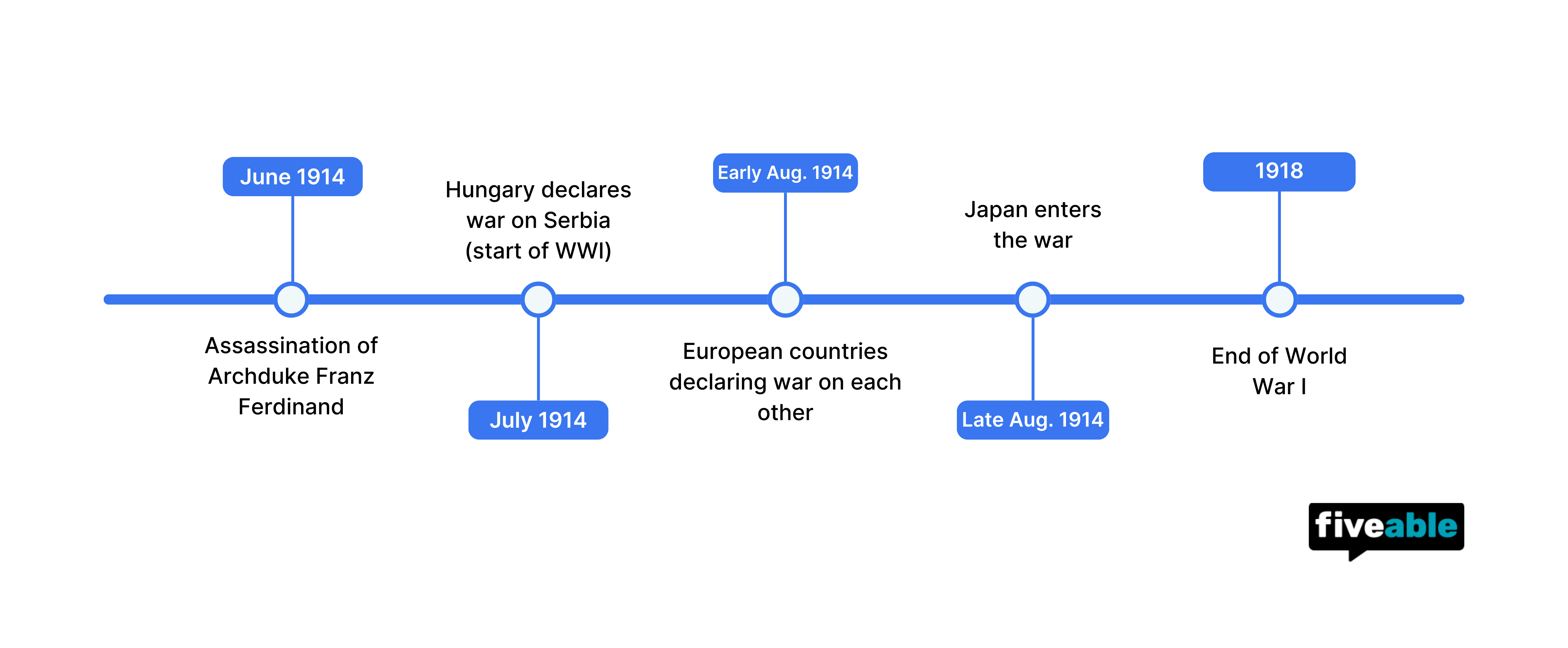
Timeline of the beginning of World War I. Image courtesy of Vibhi.
Key Takeaways
- Black Hand member Gavrilo Princip assassinated Franz Ferdinand and Sophie, and the conflict spread from the Balkans to other powers by August 1914.
- Militarism pushed European powers to build up armies and navies, while industrial production of weapons raised the stakes of war.
- Secret alliances meant countries were expected to defend one another, drawing Russia and Germany into the conflict between Serbia and Austria-Hungary.
- Competition for colonies and resources kept European powers at odds, while nationalist movements challenged Austro-Hungarian and Ottoman rule.
- The war weakened Western European powers and fueled colonial demands for self-rule; Germany's anger over the peace terms helped authoritarian regimes rise.
The Immediate Cause: Assassination of Archduke Franz Ferdinand
The immediate cause of World War I was the assassination of Archduke Franz Ferdinand, heir to the Austro-Hungarian throne, and his wife Sophie on June 28, 1914. The assassin, Gavrilo Princip, was a Serbian member of the Black Hand, a nationalist organization devoted to ending Austro-Hungarian presence in the Balkans. To Serbian nationalists, the Black Hand fought for liberation. To Austria-Hungary, it was a terrorist group. Serbian nationalists were specifically protesting Austria-Hungary's control over Bosnia-Herzegovina.
The chain reaction, summer 1914
Watch how fast the alliance system turned one assassination into a world war:
- Austria-Hungary sent Serbia an ultimatum demanding an end to all anti-Austrian agitation. Serbia rejected it.
- July 28, 1914: Austria-Hungary declared war on Serbia, counting on its stronger ally Germany for firepower.
- Serbia, populated by ethnic Slavs, looked to fellow Slavic countries, especially Russia, for protection.
- August 1: Germany declared war on Russia.
- August 3: Germany declared war on France.
- August 4: Britain declared war on Germany.
- August 6: Austria declared war on Russia.
- By the end of August 1914, Japan entered the conflict, turning a relatively minor Balkan incident into a true world war.
This sequence is FRQ gold. If you're asked to explain how regional conflict escalated globally, this is your evidence.
Long-Term Causes: MAIN
Princip's bullets were not the sole cause. Tensions had been simmering in Europe for decades, and the AMSCO chapter organizes them with the acronym MAIN.
Militarism
Militarism is aggressive military preparedness, a culture that celebrates war and the armed forces. European powers proved their strength by pouring money into armies and navies. Great Britain and Germany in particular spent heavily, recruiting young men and building ships and other military hardware. The Industrial Revolution made it possible to mass-produce weapons and supplies, which raised the stakes of any conflict.
Militarism also shaped public attitudes. War looked like a festive competition, more game than tragedy. British soldier Bill Haine recalled, "Everybody said, 'It'll be over by Christmas.'" Spoiler: it lasted four years.
Alliances
European nations formed secret alliances, agreements to protect and defend one another when attacked. If one member was attacked, the others were expected to jump in. That's exactly why Russia and Germany piled into a quarrel between Serbia and Austria-Hungary.
The two big rival blocs before the war:
- Triple Entente: Britain, France, and Russia. All three saw Germany as a rival, for different reasons. France was bitter about losing the Franco-Prussian War (1870-1871) and losing Alsace-Lorraine, a major industrial region rich in iron ore, to Germany. Both Britain and France competed with Germany for colonies in Africa.
- Triple Alliance: Germany, Austria-Hungary, and Italy.
Once the war began, the names changed:
- The Triple Entente became the Allies, eventually joined by Italy, Japan, China, the United States, and others. By war's end there were 27 Allies and "Associated Powers."
- The Triple Alliance became the Central Powers when the Ottoman Empire and Bulgaria joined. Italy stayed neutral until 1915, then switched sides and joined the Allies.
Quick reference for who lined up where:
| Side | Countries |
|---|---|
| Allied Powers | France, Great Britain, Russia, Italy, Portugal, Romania, Serbia, Greece |
| Central Powers | Germany, Austria-Hungary, Ottoman Empire, Bulgaria |
| Neutral States | Spain, Norway, Sweden, Denmark, Netherlands, Switzerland, Albania |
Imperialism
The alliance system grew out of imperial rivalry. Owning overseas colonies was one of the most important ways European nations asserted power and generated wealth. During the late 19th century, Western European countries scrambled for any available land in Africa to add to colonies they already held in Asia, the Americas, and the Pacific. Once nearly all of Africa was claimed, European powers started fighting each other over colonies. Competition for resources and territory kept the rivals on edge long before 1914.
Nationalism
Nationalism starts as pride in one's national identity, but in multinational empires it became explosive. The Ottoman Empire and Austro-Hungarian Empire each ruled many ethnic groups with their own nationalist movements. Serbs like Princip wanted to throw off Austro-Hungarian domination. Arabs were tired of Ottoman restrictions.
Both groups sought self-determination, the idea that people sharing the same ethnicity, language, culture, and political ideals should be united and have the right to form an independent nation-state. Militant Serb and Arab nationalists fought for the Allies, which extended the boundaries of the Great War even further.
Consequences of the Great War
World War I reshaped the entire 20th century. The AMSCO chapter argues that virtually every major event of the rest of the century was a direct or indirect result of the war. Know these outcomes:
- Four monarchies fell: Russia, Austria-Hungary, Germany, and the Ottoman Empire.
- Maps were redrawn in Europe and the Middle East as the Austro-Hungarian and Ottoman empires disintegrated. Germany lost all its overseas colonies to Allied nations, and former Ottoman provinces (Iraq, Palestine, Syria, Lebanon) came under British and French control.
- Colonialism began to crumble. The war weakened Western European powers, fueling nationalism and demands for self-rule in their Asian and African colonies.
- New technologies made it the deadliest, most destructive war in human history up to that point. No previous war had involved as many nations or killed as many soldiers and civilians.
- Economic and social upheaval followed: the rise of communism and fascism, colonial revolts, genocide, and a massive shift of power from Europe to the United States.
- The peace treaty set up World War II. Germany was forced to take full blame for the war (even though Austria-Hungary started it) and to pay reparations, impossibly large payments to its opponents. German fury over these terms helped authoritarian regimes rise. The treaties signed at the war's end helped set the stage for World War II.
The irony the chapter highlights: Europeans entered the 20th century expecting peace guaranteed by alliances, prosperity from colonial empires, and continued progress. The war that was supposed to make the world safe for democracy instead produced authoritarian regimes and an even bigger war.
Key Terms to Know
| Term | Why it matters |
|---|---|
| Great War | The original name for World War I (1914-1918), reflecting its unprecedented scale, not anything positive about it. |
| Archduke Franz Ferdinand | Heir to the Austro-Hungarian throne whose assassination on June 28, 1914 was the immediate cause of the war. |
| Gavrilo Princip | Serbian nationalist and Black Hand member who assassinated Franz Ferdinand and his wife Sophie. |
| Black Hand | Serbian nationalist organization devoted to ending Austro-Hungarian presence in the Balkans; Austria-Hungary considered it a terrorist group. |
| Militarism | Aggressive military preparedness that celebrates war; drove the British-German arms race. |
| Secret alliances | Hidden mutual-defense agreements that obligated nations to fight when an ally was attacked, turning a local conflict global. |
| Triple Entente | Prewar alliance of Britain, France, and Russia, united by rivalry with Germany. |
| Triple Alliance | Prewar alliance of Germany, Austria-Hungary, and Italy (Italy later stayed neutral, then joined the Allies in 1915). |
| Allies | The wartime name for the Triple Entente side, eventually 27 nations including Italy, Japan, China, and the United States. |
| Central Powers | The wartime name for Germany and Austria-Hungary after the Ottoman Empire and Bulgaria joined them. |
| Imperialism | Competition for overseas colonies and resources that made European powers bitter rivals. |
| Nationalism | Pride in national identity; destabilized multinational empires like Austria-Hungary and the Ottomans. |
| Self-determination | The idea that people sharing ethnicity, language, culture, and political ideals have the right to their own independent nation-state. |
| Alsace-Lorraine | Iron-rich industrial region France lost to Germany in the Franco-Prussian War (1870-1871), fueling French resentment. |
| Reparations | Impossibly large payments forced on Germany after the war, a key grievance that helped lead to World War II. |
Practice and Next Steps
Pair these AMSCO notes with the Topic 7.2 Causes of World War I study guide for the College Board's framing of the same material, then continue to AMSCO 7.3 Conducting World War I to see how the war was actually fought. You can find every chapter summary on the AP World AMSCO notes page.
To check your understanding:
- Run through AP World guided practice questions on Unit 7 to test the MAIN causes and the 1914 chain of events.
- Try a causation prompt with FRQ practice and instant scoring. World War I's causes and consequences are a classic LEQ setup.
- Skim the AP World key terms glossary if any vocabulary above still feels shaky.
Frequently Asked Questions
What does MAIN stand for in the causes of World War I?
MAIN stands for Militarism, Alliances, Imperialism, and Nationalism, the four long-term causes of World War I. Militarism was the arms buildup (especially Britain and Germany), alliances were secret defense pacts that pulled nations into the conflict, imperialism was the competition for colonies and resources, and nationalism fueled movements like Serbian resistance to Austria-Hungary.
What was the immediate cause of World War I?
The immediate cause was the assassination of Archduke Franz Ferdinand, heir to the Austro-Hungarian throne, and his wife Sophie on June 28, 1914. The assassin, Gavrilo Princip, was a Serbian member of the Black Hand, a nationalist group that wanted Austria-Hungary out of the Balkans. Austria-Hungary declared war on Serbia on July 28, 1914, and the alliance system pulled in Germany, Russia, France, and Britain within days.
What's the difference between the Triple Entente and the Triple Alliance?
The Triple Entente was Britain, France, and Russia, while the Triple Alliance was Germany, Austria-Hungary, and Italy. Once the war started, the Entente side became known as the Allies (eventually 27 nations) and the Alliance side became the Central Powers after the Ottoman Empire and Bulgaria joined. Italy actually stayed neutral until 1915, then switched and joined the Allies.
Did the assassination of Franz Ferdinand really cause World War I?
Not by itself. The assassination was the spark, but decades of militarism, secret alliances, imperial rivalry, and nationalism had already primed Europe for war. Bismarck predicted as early as 1888 that the next great European war would come out of 'some damned foolish thing in the Balkans.' Without those long-term tensions, the assassination would have stayed a regional incident instead of a global war.
How does Topic 7.2 show up on the AP World exam?
World War I's causes are a classic causation prompt, perfect for an LEQ or SAQ asking you to explain how regional conflicts escalated into global war. Strong answers connect the MAIN long-term causes to the 1914 chain reaction (assassination, ultimatum, declarations of war) and mention consequences like fallen empires and the harsh peace terms. You can practice this with Fiveable's FRQ practice tool.
See Fiveable more often in Google
Mark Fiveable as a preferred source and Google is more likely to show you our guides in Top Stories, with a "preferred" badge in AI Mode and AI Overviews.