AMSCO 9.4 Economics in the Global Age Notes

🌍AP World History: Modern Review
AMSCO 9.4 Economics in the Global Age Notes
🌍 AP World History: Modern
AMSCO 1.1 Developments in East Asia Notes
AMSCO 1.2 Developments in Dar al-Islam Notes
AMSCO 1.3 Developments in South and Southeast Asia Notes
AMSCO 1.4 Developments in the Americas Notes
AMSCO 1.5 Developments in Africa Notes
AMSCO 1.6 Developments in Europe Notes
AMSCO 1.7 Comparison in the Period from c.1200 to c.1450 Notes
AMSCO 2.1 The Silk Roads Notes
AMSCO 2.2 The Mongol Empire and the Modern World Notes
AMSCO 2.3 Exchange in the Indian Ocean Notes
AMSCO 2.4 Trans-Saharan Trade Routes Notes
AMSCO 2.5 Cultural Consequences of Connectivity Notes
AMSCO 2.6 Environmental Consequences of Connectivity Notes
AMSCO 2.7 Comparison of Economic Exchange Notes
AMSCO 3.1 European, East Asian, and Gunpowder Empires Expand Notes
AMSCO 3.2 Empires: Administrations Notes
AMSCO 3.3 Empires: Belief Systems Notes
AMSCO 3.4 Comparison in Land-Based Empires Notes
AMSCO 4.1 Technological Innovations Notes
AMSCO 4.2 Exploration: Causes and Events Notes
AMSCO 4.3 Columbian Exchange Notes
AMSCO 4.4 Maritime Empires Link Regions Notes
AMSCO 4.5 Maritime Empires Develop Notes
AMSCO 4.6 Internal and External Challenges to State Power Notes
AMSCO 4.7 Changing Social Hierarchies Notes
AMSCO 4.8 Continuity and Change from c.1450 to c.1750 Notes
AMSCO 5.1 The Enlightment Notes
AMSCO 5.2 Nationalism and Revolutions Notes
AMSCO 5.3 Industrial Revolution Begins Notes
AMSCO 5.4 Industrialization Spreads Notes
AMSCO 5.5 Technology in the Industrial Age Notes
AMSCO 5.6 Industrialization: Government's Role Notes
AMSCO 5.7 Economic Developments and Innovations Notes
AMSCO 5.8 Reactions to the Industrial Economy Notes
AMSCO 5.9 Society and the Industrial Age Notes
AMSCO 5.10 Continuity and Change in the Industrial Age Notes
AMSCO 6.1 Rationales for Imperialism Notes
AMSCO 6.2 State Expansion Notes
AMSCO 6.3 Indigenous Responses to State Expansion Notes
AMSCO 6.4 Global Economic Development Notes
AMSCO 6.5 Economic Imperialism Notes
AMSCO 6.6 Causes of Migration in an Interconnected World Notes
AMSCO 6.7 Effects of Migration Notes
AMSCO 6.8 Causation in the Imperial Age Notes
AMSCO 7.1 Shifting Power Notes
AMSCO 7.2 Causes of World War I Notes
AMSCO 7.3 Conducting World War I Notes
AMSCO 7.4 Economy in the Interwar Period Notes
AMSCO 7.5 Unresolved Tensions After World War I Notes
AMSCO 7.6 Causes of World War II Notes
AMSCO 7.7 Conducting World War II Notes
AMSCO 7.8 Mass Atrocities Notes
AMSCO 7.9 Causation in Global Conflict Notes
AMSCO 8.1 Setting the Stage for the Cold War and Decolonization Notes
AMSCO 8.2 The Cold War Notes
AMSCO 8.3 Effects of the Cold War Notes
AMSCO 8.4 Spread of Communism Notes
AMSCO 8.5 Decolonization after 1900 Notes
AMSCO 8.6 Newly Independent States Notes
AMSCO 8.7 Global Resistance to Established Power Structure Notes
AMSCO 8.8 End of the Cold War Notes
AMSCO 8.9 Causation in the Age of the Cold Ward and Decolonization Notes
AMSCO 9.1 Advances in Technology and Exchange Notes
AMSCO 9.2 Technological Advancements and Limitations Notes
AMSCO 9.3 Technology and the Environment Notes
AMSCO 9.4 Economics in the Global Age Notes
AMSCO 9.5 Calls for Reforms and Responses Notes
AMSCO 9.6 Globalized Culture Notes
AMSCO 9.7 Resistance to Globalization Notes
AMSCO 9.8 Institutions Developing in a Globalized World Notes
AMSCO 9.9 Continuity and Change in a Globalized World Notes
Overview
AMSCO Topic 9.4, "Economics in the Global Age" (AMSCO p. 657 - p. 663), covers how the global economy changed and stayed the same from 1900 to the present, the heart of Unit 9's globalization story. The big changes: governments embraced free-market policies and economic liberalization after the Cold War, and revolutions in information technology created knowledge economies in places like Finland, Japan, and the United States. The big continuity: manufacturing still drives the global economy, it just moved to Asia and Latin America. This chapter is your one-stop source for examples like Reagan, Thatcher, Deng Xiaoping, Pinochet, NAFTA, the WTO, and multinational corporations.
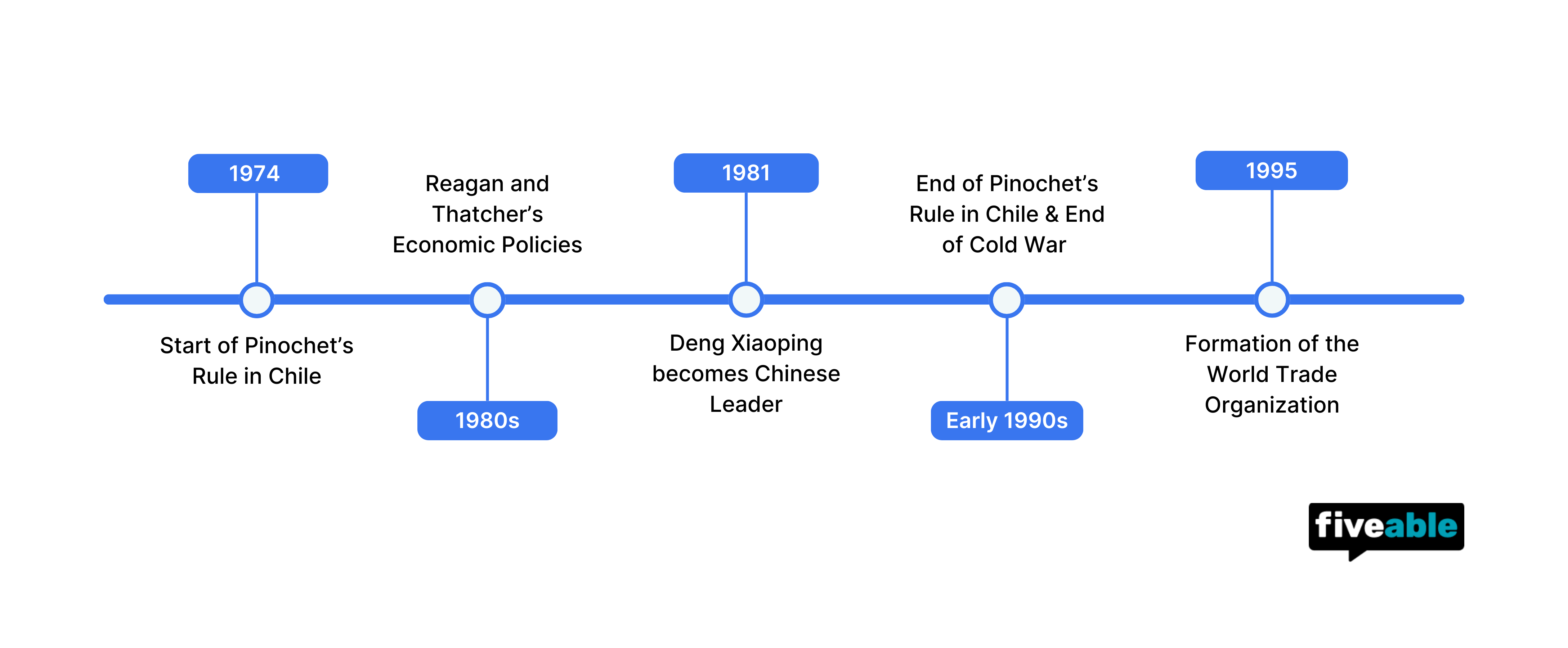
Timeline of Economic and Political Transformations Post-Cold War. Image Courtesy of Isaiah Penny
Key Takeaways
- Reagan and Thatcher pushed free markets, while Pinochet imposed privatization in Chile through a dictatorship that used repression.
- Deng Xiaoping opened China's economy to private business and foreign factories, but the Communist Party kept political control and violently suppressed the Tiananmen Square protests.
- Finland built technology industries after an economic crisis, while Japan shifted toward a knowledge economy after building its manufacturing strength; the Asian Tigers copied Japan's export-driven model.
- Manufacturing remained central but shifted toward lower-wage countries in Asia and Latin America; NAFTA encouraged maquiladoras in Mexico, while garment workers in Vietnam and Bangladesh protested wages and conditions.
- GATT lowered trade barriers, and the WTO took over its operations in 1995, though critics challenged the WTO's secrecy and corporate influence.
- Multinational corporations combine knowledge-economy workers at home with low-wage manufacturing abroad, drawing criticism over worker exploitation and tax avoidance.
Acceleration of Free-Market Economies
Globalization means interaction among peoples, governments, and companies worldwide. It's not new (think Indian Ocean trade), but the term usually refers to the increased integration of the global economy since the 1970s. When the Cold War ended, former Eastern Bloc nations could suddenly trade with capitalist democracies, and nonaligned countries like India relaxed trade restrictions in the 1990s. Opening up a country's economy this way is called economic liberalization.
- Ronald Reagan (US) and Margaret Thatcher (Britain) pushed free markets, which are economic systems based on supply and demand with minimal government control. Their playbook: cut taxes, cut regulations, cut government assistance to the poor.
- Corporations used this shift to move jobs to countries with lower wages, lower taxes, and fewer regulations.
- Critics charged that globalization led to labor exploitation and environmental damage. Wealth grew for many; hardship grew for others.
Economic Liberalization in Chile
Free-market reform in Chile came through a dictatorship, not a democracy.
- In 1973, Augusto Pinochet took power in a U.S.-backed coup against the democratically elected socialist government of Salvador Allende. He ruled from 1974 to 1990, when citizens ousted him over his violent tactics. Indicted for kidnapping, torture, money laundering, and murder, he died in 2006 before conviction.
- Economists called the Chicago Boys (they studied under free-market economist Milton Friedman at the University of Chicago) designed Chile's reforms: privatizing state-run businesses and taming serious inflation.
- The reforms were unpopular because they ignored poverty, and Pinochet used repression to enact them. Later democratic governments took a balanced approach, pairing free-trade growth with government programs that significantly reduced poverty.
Chinese Economic Reforms Under Deng Xiaoping
Deng Xiaoping became China's leader in 1981 and pulled the Communist Party away from its commitment to economic equality toward economic growth. His slogan: "Let some people get rich first." The government opened up the economy while keeping overall control:
- Replaced communes with peasant-leased plots where peasants grew and sold their own crops, producing agricultural surpluses instead of famines
- Allowed factories to make more consumer products
- Encouraged foreign companies to build factories in special economic zones, drawn by low wages and lax environmental laws
- Reopened the Shanghai stock market and allowed some private business ownership
Economic reform did not mean political reform. When students led a large, peaceful demonstration in Tiananmen Square in Beijing in 1989 demanding freedom of speech and an end to the Communist Party's political monopoly, the government sent in soldiers with guns and tanks, killing hundreds. That's the pattern to remember: China liberalized its economy without liberalizing its politics.
New Knowledge Economies
A knowledge economy creates, distributes, and uses knowledge and information instead of relying on factories and farms. Designers, engineers, and teachers all work in the knowledge economy. In the US, the clearest example is Silicon Valley in California. Governments building knowledge economies pour resources into research, education, innovation, and technological infrastructure.
Finland
Finland is the textbook case of a country reinventing its economy.
- Agrarian in the 1950s, Finland industrialized after World War II.
- When the Soviet Union collapsed, Finland lost a main customer for manufactured goods and hit an economic crisis.
- In the 1990s, it entered the global marketplace, encouraged competition, and created the Science and Technology Policy Council to steer growth through technology and innovation.
- Finland led in mobile phone development, then built software companies. These industries needed highly educated workers, while hardware production was outsourced to lower-wage countries.
Japan and the Asian Tigers
After World War II, Japan used policies similar to 18th-century mercantilism: increase exports, decrease imports.
- To boost exports, the government coordinated finance and labor policies with large corporations and subsidized them to keep costs low.
- To discourage imports, it used high tariffs and trade restrictions.
- It emphasized rigorous education to produce productive workers.
Aided by big investments from the US and others, Japan became a manufacturing powerhouse, but at a cost. Low-wage workers often couldn't afford the goods they made (Japanese cars cost more in Japan than in the US). Over time, unions won higher wages and international pressure loosened trade restrictions. Japan diversified into a knowledge economy and a center of banking, finance, and IT. Even though growth slowed after the 1980s, Japan was still the world's third-largest economy in 2014, behind only the US and China.
Four states known as the Asian Tigers (Hong Kong, Singapore, South Korea, and Taiwan) copied Japan's model: government-business partnerships, high exports, intense education, and a low-wage workforce. The success of the Asian Tigers and China lifted hundreds of millions of people out of poverty.
Continuity: Manufacturing Shifts to Asia and Latin America
Here's the continuity-and-change answer in one line: manufacturing still anchors the global economy, but it moved from the US and Europe to Asia and Latin America. As knowledge economies grew in some regions, industrial production there declined, and factories relocated to where labor was cheaper.
Vietnam and Bangladesh
- Importers who once bought from China found even lower labor costs in Vietnam and Bangladesh.
- Both became known for clothing exports. Garment compounds the size of small villages, often funded by foreign investors, produce the clothes sold in developed countries.
- Clothing accounts for 80 percent of Bangladesh's exports. Vietnam's largest export is phones, worth about $45 billion in 2017, with apparel and electronic goods each bringing in $25.9 billion.
- Workers in both countries have gone on strike over low wages and poor conditions. Pay rose slightly, but not enough to keep up with the cost of living.
Mexico and Honduras
- In 1994, the US, Canada, and Mexico negotiated NAFTA (the North American Free Trade Agreement). It encouraged US and Canadian industries to build maquiladoras, factories in Mexico that used low-wage Mexican labor to assemble raw materials into tariff-free goods for export.
- Many maquiladoras hired large numbers of young women and exposed them to harsh working conditions. US labor unions complained NAFTA exported thousands of US jobs to Mexico, where wages, benefits, safety standards, and environmental rules were weaker.
- Honduras, the second-largest textile exporter in the Americas, has tried to upgrade its manufacturing with sustainability (recycling or treating waste) and fair labor practices like housing and education plans for workers. Much of the investment in Honduras, Vietnam, and Bangladesh comes from South Korean and Taiwanese businesses.
Transnational Free-Trade Organizations
International institutions made the post-WWII trade boom possible by tearing down trade barriers.
- Regional organizations: the European Economic Community, Mercosur (South America), and the Association of Southeast Asian Nations (ASEAN).
- GATT (General Agreement on Tariffs and Trade): an international accord that lifted restrictive trade barriers. Protective tariffs (taxes on foreign imports) averaged 40 percent worldwide before GATT; by the 1990s the average had sunk below 5 percent. That eased goods across borders, lowered consumer prices, and helped rebuild war-ravaged Europe.
- In 1995, the World Trade Organization (WTO) took over GATT's operations and made rules governing more than 90 percent of international trade. The WTO became controversial: meetings closed to the public, board members representing mostly corporate interests, and rules that favored trade over moral concerns. A member nation that refused to buy sweatshop-made clothing could face WTO trade sanctions.
Multinational Corporations
A multinational corporation is legally incorporated in one country but makes or sells goods or services in others. The earliest examples were Commercial Revolution joint-stock companies like the British East India Company and Dutch East India Company, and multinationals were how imperialist nations extracted colonial wealth. Today's multinationals get the best of both worlds: knowledge-economy workers (software designers, engineers) at home and low-wage manufacturing workers abroad, plus a global market to sell in.
- India: after opening its markets in the early 1990s, India's highly educated, English-speaking workforce made it a software and IT powerhouse. Microsoft and Google invested heavily, and corporate wealth built a thriving middle-class consumer culture. By 2014, India's middle class was estimated to be the world's largest at more than 350 million people.
- Mahindra & Mahindra: headquartered in Mumbai, it makes cars, farm equipment, military vehicles, and electrical energy, with operations in South Korea, China, Australia, the US, South Africa, and elsewhere. It has won awards for socially responsible practices.
- Nestlé: the Swiss-based multinational, the world's largest food company, has faced criticism for buying cocoa from suppliers using child labor and farming protected lands, and for treating drinking water as a product rather than a human right, even as it funds sustainable agriculture research.
The general critique of multinationals: weak national identity (so no home-country ethical standards), worker exploitation, and structuring operations to avoid taxes.
Key Terms to Know
| Term | Why it matters |
|---|---|
| Economic liberalization | Opening a country's economy by cutting state intervention, the defining trend after the Cold War. |
| Free markets | Economic systems run by supply and demand with minimal government control, championed by Reagan and Thatcher. |
| Ronald Reagan | US president who pushed tax cuts, deregulation, and reduced government assistance to spur growth. |
| Margaret Thatcher | British prime minister who pursued the same free-market agenda in Great Britain. |
| Augusto Pinochet | Chilean dictator (1974-1990) whose regime imposed free-market reforms designed by the Chicago Boys. |
| Deng Xiaoping | Chinese leader from 1981 who opened China's economy ("Let some people get rich first") while keeping party control. |
| Tiananmen Square | 1989 Beijing protest demanding political reform; the government's crackdown killed hundreds. |
| Knowledge economy | An economy built on creating and using information, like Finland, Japan, and Silicon Valley. |
| Asian Tigers | Hong Kong, Singapore, South Korea, and Taiwan, which prospered by copying Japan's export-driven model. |
| NAFTA | The 1994 US-Canada-Mexico trade agreement that spurred maquiladora growth and US job-loss debates. |
| Maquiladora | A Mexican factory that assembles imported materials into tariff-free goods for export using low-wage labor. |
| GATT | The international accord that cut average tariffs from 40 percent to under 5 percent by the 1990s. |
| Protective tariffs | Taxes on foreign imports that GATT and the WTO worked to lower or eliminate. |
| World Trade Organization (WTO) | Took over GATT in 1995 and governs more than 90 percent of international trade; controversial for secrecy and corporate influence. |
| ASEAN | The Association of Southeast Asian Nations, a regional trade organization in Southeast Asia. |
| Mercosur | South America's regional trade organization. |
| Multinational corporation | A company incorporated in one country that operates in others, like Mahindra & Mahindra and Nestlé. |
Practice and Next Steps
Pair these notes with the Fiveable 9.4 Economics in the Global Age study guide for the course-topic version of this material, then continue to AMSCO 9.5 Calls for Reforms and Responses to see how people pushed back on the problems globalization created. The full chapter lineup lives on the AMSCO notes page.
To check yourself, drill Unit 9 questions with guided MCQ practice, look up any fuzzy vocab in the key terms glossary, and try writing about economic continuity and change with FRQ practice and instant scoring. The continuity-and-change framing of this topic (manufacturing persists, but its location shifts) is exactly the kind of reasoning the long essay question rewards.
Frequently Asked Questions
What is AMSCO Topic 9.4 Economics in the Global Age about?
AMSCO Topic 9.4 (p. 657-663) covers how the global economy changed and stayed the same from 1900 to the present. The major changes were the spread of free-market policies and economic liberalization after the Cold War plus the rise of knowledge economies, while the major continuity was manufacturing's central role, which shifted to Asia and Latin America.
What is economic liberalization in AP World History?
Economic liberalization is the opening up of a country's economy by reducing government control, such as privatizing state-run businesses and lowering trade barriers. Key AP World examples are Chile under Pinochet, China under Deng Xiaoping, India in the 1990s, and the broader free-market push by Reagan and Thatcher in the 1980s.
How did China's economy change under Deng Xiaoping?
Deng Xiaoping, who became China's leader in 1981, replaced communes with peasant-leased plots, allowed more consumer goods production, created special economic zones for foreign companies, reopened the Shanghai stock market, and permitted some private business ownership. The key twist: China liberalized its economy without political reform, shown by the violent 1989 crackdown on Tiananmen Square protesters.
What is the difference between GATT and the WTO?
GATT was an international accord that lifted trade barriers after World War II, dropping average world tariffs from 40 percent to below 5 percent by the 1990s. The World Trade Organization (WTO) took over GATT's operations in 1995 and made rules governing more than 90 percent of international trade, becoming controversial for its closed meetings and corporate-leaning rules.
How does Topic 9.4 show up on the AP World exam?
Topic 9.4 is a classic continuity-and-change setup: manufacturing remained central to the global economy (continuity) but moved from the US and Europe to Asia and Latin America (change), while free-market policies and knowledge economies spread. That framing works well for LEQ and DBQ reasoning, so practice it with FRQ practice and instant scoring.
See Fiveable more often in Google
Mark Fiveable as a preferred source and Google is more likely to show you our guides in Top Stories, with a "preferred" badge in AI Mode and AI Overviews.