AMSCO 8.6 Newly Independent States Notes

🌍AP World History: Modern Review
AMSCO 8.6 Newly Independent States Notes
🌍 AP World History: Modern
AMSCO 1.1 Developments in East Asia Notes
AMSCO 1.2 Developments in Dar al-Islam Notes
AMSCO 1.3 Developments in South and Southeast Asia Notes
AMSCO 1.4 Developments in the Americas Notes
AMSCO 1.5 Developments in Africa Notes
AMSCO 1.6 Developments in Europe Notes
AMSCO 1.7 Comparison in the Period from c.1200 to c.1450 Notes
AMSCO 2.1 The Silk Roads Notes
AMSCO 2.2 The Mongol Empire and the Modern World Notes
AMSCO 2.3 Exchange in the Indian Ocean Notes
AMSCO 2.4 Trans-Saharan Trade Routes Notes
AMSCO 2.5 Cultural Consequences of Connectivity Notes
AMSCO 2.6 Environmental Consequences of Connectivity Notes
AMSCO 2.7 Comparison of Economic Exchange Notes
AMSCO 3.1 European, East Asian, and Gunpowder Empires Expand Notes
AMSCO 3.2 Empires: Administrations Notes
AMSCO 3.3 Empires: Belief Systems Notes
AMSCO 3.4 Comparison in Land-Based Empires Notes
AMSCO 4.1 Technological Innovations Notes
AMSCO 4.2 Exploration: Causes and Events Notes
AMSCO 4.3 Columbian Exchange Notes
AMSCO 4.4 Maritime Empires Link Regions Notes
AMSCO 4.5 Maritime Empires Develop Notes
AMSCO 4.6 Internal and External Challenges to State Power Notes
AMSCO 4.7 Changing Social Hierarchies Notes
AMSCO 4.8 Continuity and Change from c.1450 to c.1750 Notes
AMSCO 5.1 The Enlightment Notes
AMSCO 5.2 Nationalism and Revolutions Notes
AMSCO 5.3 Industrial Revolution Begins Notes
AMSCO 5.4 Industrialization Spreads Notes
AMSCO 5.5 Technology in the Industrial Age Notes
AMSCO 5.6 Industrialization: Government's Role Notes
AMSCO 5.7 Economic Developments and Innovations Notes
AMSCO 5.8 Reactions to the Industrial Economy Notes
AMSCO 5.9 Society and the Industrial Age Notes
AMSCO 5.10 Continuity and Change in the Industrial Age Notes
AMSCO 6.1 Rationales for Imperialism Notes
AMSCO 6.2 State Expansion Notes
AMSCO 6.3 Indigenous Responses to State Expansion Notes
AMSCO 6.4 Global Economic Development Notes
AMSCO 6.5 Economic Imperialism Notes
AMSCO 6.6 Causes of Migration in an Interconnected World Notes
AMSCO 6.7 Effects of Migration Notes
AMSCO 6.8 Causation in the Imperial Age Notes
AMSCO 7.1 Shifting Power Notes
AMSCO 7.2 Causes of World War I Notes
AMSCO 7.3 Conducting World War I Notes
AMSCO 7.4 Economy in the Interwar Period Notes
AMSCO 7.5 Unresolved Tensions After World War I Notes
AMSCO 7.6 Causes of World War II Notes
AMSCO 7.7 Conducting World War II Notes
AMSCO 7.8 Mass Atrocities Notes
AMSCO 7.9 Causation in Global Conflict Notes
AMSCO 8.1 Setting the Stage for the Cold War and Decolonization Notes
AMSCO 8.2 The Cold War Notes
AMSCO 8.3 Effects of the Cold War Notes
AMSCO 8.4 Spread of Communism Notes
AMSCO 8.5 Decolonization after 1900 Notes
AMSCO 8.6 Newly Independent States Notes
AMSCO 8.7 Global Resistance to Established Power Structure Notes
AMSCO 8.8 End of the Cold War Notes
AMSCO 8.9 Causation in the Age of the Cold Ward and Decolonization Notes
AMSCO 9.1 Advances in Technology and Exchange Notes
AMSCO 9.2 Technological Advancements and Limitations Notes
AMSCO 9.3 Technology and the Environment Notes
AMSCO 9.4 Economics in the Global Age Notes
AMSCO 9.5 Calls for Reforms and Responses Notes
AMSCO 9.6 Globalized Culture Notes
AMSCO 9.7 Resistance to Globalization Notes
AMSCO 9.8 Institutions Developing in a Globalized World Notes
AMSCO 9.9 Continuity and Change in a Globalized World Notes
Overview
AMSCO Topic 8.6, "Newly Independent States" (AMSCO p. 589 - p. 594), covers what happened after colonial powers left: new states were created, borders were redrawn, and those borders often triggered conflict, displacement, and mass migration. Between 1945 and 2000, the number of independent states in the world more than doubled, from roughly 75 to around 190. The chapter walks through the founding of Israel and its wars with Arab neighbors, Cambodia's independence and the Khmer Rouge, the Partition of India and Pakistan, women leaders in South Asia, Julius Nyerere's modernization of Tanzania, and migration from new nations to the old imperial capitals. It sits squarely in Unit 8 (Cold War and Decolonization) and pairs directly with AMSCO 8.5 Decolonization after 1900, which covers how independence happened. Topic 8.6 covers what came next.
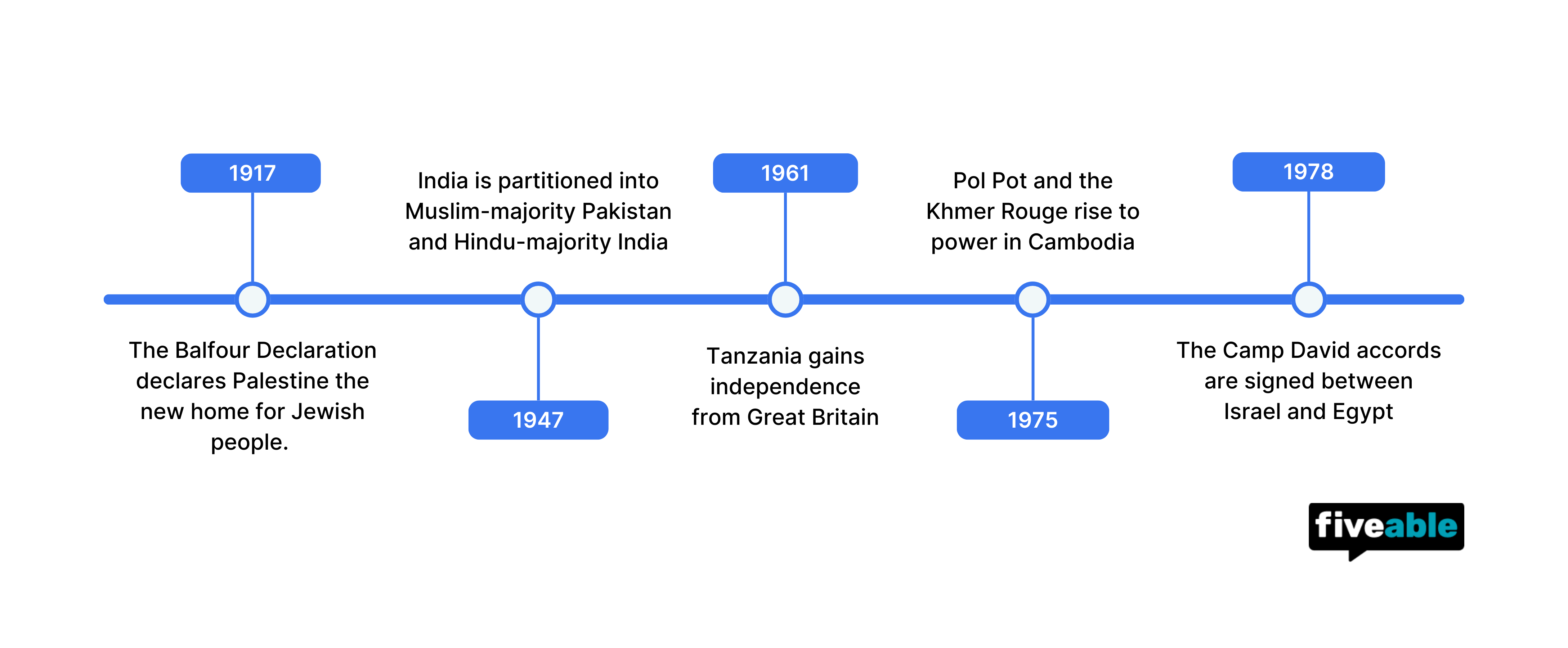
Timeline of developments in newly independent states. Image courtesy of Lauren Hamlette.
The big patterns to remember: redrawn borders caused conflict and displacement (India/Pakistan, Israel/Palestine), new governments took a strong hand in guiding their economies (Nasser, Indira Gandhi, Nyerere, Bandaranaike), and former colonial subjects migrated to the metropoles, keeping cultural and economic ties alive.
Key Takeaways
- Israel was founded after the UN divided Palestine in 1948, fought wars with Arab neighbors, and signed a 1979 peace treaty with Egypt that Palestinians and several Arab states rejected.
- Cambodia gained independence in 1953, but Khmer Rouge rule and famine killed more than two million people; a 1991 peace agreement later allowed UN-monitored elections.
- The 1947 Partition created mostly Hindu India and mostly Muslim Pakistan, displaced at least 10 million people, and left Kashmir claimed by both countries.
- Sirimavo Bandaranaike became the world's first female prime minister, Indira Gandhi declared a national emergency amid economic problems, and Benazir Bhutto became the first elected female leader of a majority Muslim country.
- Julius Nyerere's ujamaa program promoted collective farming, literacy campaigns, and free education in Tanzania, but he could not pull the country out of poverty.
- Migration from newly independent countries to former colonial powers' cities, including London and Paris, kept economic and cultural ties alive after empires ended.
Israel's Founding and Foreign Relations
Israel was created in 1948 after the UN partitioned Palestine into Jewish and Arab sections, and war with its Arab neighbors began immediately.
The Zionist Movement
- The Zionist movement began in the 1890s as a reaction to the Dreyfus Affair, an antisemitic scandal in France.
- Theodore Herzl, a Hungarian Jewish journalist, argued the affair proved that Jews would never be safe or treated equally through assimilation into European society. At the First Zionist Congress in 1897, he called for a separate Jewish state.
- Zionists wanted that state in Palestine, where their ancestors had lived. At the time, Palestine was part of the Ottoman Empire and most of its inhabitants were Muslim Arabs.
Britain's Conflicting Promises
- The Balfour Declaration (1917) said Britain favored a "national home" for the Jewish people in Palestine, while also promising not to prejudice the rights of non-Jewish communities there.
- Meanwhile, British officer T. E. Lawrence ("Lawrence of Arabia") promised certain Arabs an independent state, hoping they would rise up against the Ottomans during World War I. Arabs did not trust the British.
- After WWI, Britain received a mandate over former Ottoman lands, and Zionist immigration to Palestine increased. Arabs protested the loss of land and their traditional Islamic way of life.
- The Holocaust, which killed six million Jews, drove more Jewish immigration and built worldwide sympathy. Britain, stuck between the two sides, handed the question to the United Nations.
- In 1948, after the UN divided Palestine, the Jewish section declared itself the new country of Israel.
Four Wars
- 1948: Arab forces from Syria, Jordan (then Transjordan), Lebanon, and Iraq invaded Israel, which had U.S. support. Israel won, and an armed truce followed. About 400,000 Palestinians became refugees living in camps near the Israeli border.
- 1956: Israel, backed by France and Britain, invaded Egypt's Sinai Peninsula, partly to liberate the Suez Canal after Egypt nationalized it under Gamal Abdel Nasser's economic programs. International protests forced a withdrawal.
- Six-Day War (1967): Israel fought on three fronts at once and gained the Gaza Strip from Egypt, the West Bank and East Jerusalem from Jordan, and the Golan Heights from Syria.
- Yom Kippur War (1973): Israel repelled a surprise invasion by Egypt and Syria.
Peace With Egypt, Ongoing Conflict With Palestinians
- The Camp David Accords, mediated by U.S. President Jimmy Carter, produced a 1979 peace treaty between Israel's Menachem Begin and Egypt's Anwar Sadat after 30 years of conflict.
- The Palestinians and several Arab states rejected it. The Palestinian Liberation Organization (PLO), led by Yasser Arafat, wanted occupied lands returned and an independent Palestine.
- In the 21st century, Palestinians split into two factions: Fatah controlled the West Bank and Hamas controlled Gaza.
- Israeli border controls (effectively economic sanctions) restricted daily life for hundreds of thousands of Palestinians, and new Israeli settlements on occupied land deepened the anger. Between 2000 and 2014, over 7,000 Palestinians and over 1,000 Israelis were killed. U.S. support for Israel kept many Middle Eastern countries hostile to the United States.
Cambodia: Independence, the Khmer Rouge, and Recovery
Cambodia gained independence from France in 1953, but its attempt to stay non-aligned during the Cold War failed when it was drawn into the Vietnam War.
- After the Vietnam War, the Khmer Rouge, a communist guerrilla organization led by Pol Pot, overthrew Cambodia's right-wing government.
- The Khmer Rouge imposed a ruthless form of communism modeled on China's Cultural Revolution, targeting intellectuals and dissenters. The slaughter and famine took more than two million lives, about one-quarter of Cambodia's population. Mass graves from the "killing fields" were still being discovered decades later.
- In December 1978, Vietnamese troops invaded to support Pol Pot's opponents, took control of the government, and helped stabilize the country while hundreds of thousands of refugees fled. Vietnam fully withdrew in 1989.
- A 1991 peace agreement allowed UN-monitored free elections. Prince Norodom Sihanouk became a constitutional monarch, and Cambodia developed a multiparty democratic government with elements of a market economy.
The Partition of India and Pakistan
In 1947, the British divided colonial India into two independent countries: a mostly Hindu India and a mostly Muslim Pakistan. India's population was about 10 times larger, and women had the vote in both countries from the start.
- Partition was chaotic and violent along religious lines. At least 10 million people moved: Hindus and Sikhs fled Pakistan for India, and Muslims fled India for Pakistan. Between 500,000 and one million people died.
- The two countries developed differently. India became the world's largest democracy, while Pakistan alternated between elected leaders and authoritarian military rulers. Moderates in both countries faced powerful conservative religious movements that opposed compromise. Pakistan later split again, creating Bangladesh.
Kashmir
- Kashmir, a mountainous border region, became the flashpoint. At partition, most of its people were Muslim but its leader was Hindu, so both Pakistan and India claimed it.
- The rivalry repeatedly broke into armed conflict, and the stakes rose dramatically once both countries developed nuclear weapons.
- Eventually India controlled about 45 percent of the region, Pakistan about 35 percent, and China about 20 percent.
Women Gain Power in South Asia
Several newly independent South Asian countries elected women as heads of state, often daughters or widows of previous leaders. Each one also illustrates the chapter's economic theme: governments taking a strong role in guiding development.
Sirimavo Bandaranaike (Sri Lanka)
- Became the world's first female prime minister in 1960 in Ceylon (later Sri Lanka), running after her husband was assassinated in office in 1959.
- She continued his socialist economic policies, was voted out in 1965 over a sagging economy, then returned in 1970 with more radical policies: land reforms, restrictions on free enterprise, and a new constitution renaming the country Sri Lanka. Voted out again in 1977.
- Her daughter Chandrika became Sri Lanka's first female president in 1994 and appointed her mother prime minister again.
Indira Gandhi (India)
- Became India's leader in 1966, two years after the death of her father, first prime minister Jawaharlal Nehru. (No relation to Mohandas Gandhi.)
- Initially underestimated, she proved effective, strengthening India's economy and winning a war with Pakistan with Soviet military support.
- Facing high inflation and growing poverty, she declared a national emergency in 1975 and jailed opposition leaders. Her 20-point economic program reduced inflation, reformed corrupt laws, and increased national production, but some policies were unpopular.
- She lost the 1977 election, returned as prime minister in 1980, and was assassinated in 1984.
Benazir Bhutto (Pakistan)
- Elected prime minister in 1988, the first elected female leader of a majority Muslim country. Her father had also been prime minister.
- She struggled to improve Pakistan's economy and reduce poverty while corruption charges followed her and her husband. She served two nonconsecutive terms, went into exile from 1999 to 2007, and was assassinated shortly after returning to Pakistan.
Tanzania Modernizes Under Nyerere
Tanganyika gained independence from Britain in 1961 and later became the United Republic of Tanzania. First president Julius Nyerere is the chapter's clearest example of a government deliberately guiding economic life.
- His African socialist program, summarized in the Arusha Declaration of 1967, was an egalitarian approach built on cooperative agriculture.
- Literacy campaigns, free education, and collective farming were key parts of what Nyerere called ujamaa, Swahili for "familyhood."
- He also pushed Tanzania toward economic independence and away from foreign aid.
- Economic hardships and conflicts with Uganda under Idi Amin challenged his leadership. Though personally popular, Nyerere could not pull Tanzania out of poverty. He resigned in 1985 but remained an important social leader until his death in 1999.
Migration to the Metropoles
People from newly independent countries often moved to the former colonial power's major cities, keeping economic and cultural ties strong even after empires dissolved.
- A metropole is a large city of a former colonial ruler. London is the classic example: large numbers of refugees and immigrants from Pakistan, India, and Bangladesh moved there after World War II and later conflicts.
- Similarly, Vietnamese, Algerians, and West Africans migrated to Paris and other French cities, and Filipinos migrated to the United States.
- Many migrants found work in the medical field; others worked on railroads, in foundries, and in airports.
- This is the continuity to remember for essays: empires ended politically, but the colony-metropole connection survived through migration.
Key Terms to Know
| Term | Why it matters |
|---|---|
| Zionist movement | Movement begun by Theodore Herzl in the 1890s, after the Dreyfus Affair, calling for a separate Jewish state where Jews could escape persecution. |
| Balfour Declaration | Britain's 1917 statement favoring a Jewish "national home" in Palestine while promising to protect non-Jewish communities' rights, a contradiction that fueled decades of conflict. |
| Six-Day War | The 1967 war in which Israel fought on three fronts and gained Gaza, the West Bank, East Jerusalem, and the Golan Heights. |
| Yom Kippur War | The 1973 war in which Israel repelled a surprise invasion by Egypt and Syria. |
| Camp David Accords | The Carter-mediated peace agreement between Israel's Begin and Egypt's Sadat, leading to a 1979 treaty that Palestinians and several Arab states rejected. |
| Palestinian Liberation Organization (PLO) | Yasser Arafat's organization demanding the return of occupied lands and an independent Palestinian nation. |
| Fatah | Palestinian faction that controlled the West Bank after Palestinians split into two factions in the 21st century. |
| Hamas | Palestinian faction that controlled Gaza after the split. |
| Khmer Rouge | Pol Pot's communist guerrilla organization in Cambodia whose brutal rule and resulting famine killed more than two million people, about a quarter of the population. |
| Kashmir | Mountainous border region claimed by both India and Pakistan, a recurring flashpoint made more dangerous once both countries had nuclear weapons. |
| Partition of India | The 1947 British division of colonial India into Hindu-majority India and Muslim-majority Pakistan, displacing at least 10 million people and killing 500,000 to one million. |
| Sirimavo Bandaranaike | Sri Lankan leader who became the world's first female prime minister in 1960 and pursued socialist economic policies. |
| Indira Gandhi | India's prime minister (Nehru's daughter) whose 20-point economic program strengthened the economy before her 1984 assassination. |
| Benazir Bhutto | First elected female leader of a majority Muslim country, prime minister of Pakistan starting in 1988, assassinated in 2007. |
| Julius Nyerere | Tanzania's first president, whose Arusha Declaration of 1967 laid out African socialist policies based on cooperative agriculture. |
| Ujamaa | Swahili for "familyhood," Nyerere's framework of collective farming, free education, and literacy campaigns. |
| Metropole | A major city of a former colonial power (like London or Paris) that drew migrants from newly independent countries, sustaining colonial-era ties. |
Practice and Next Steps
For the College Board's framing of this topic, read the 8.6 Newly Independent States After 1900 study guide, which lines these examples up with the skills the exam tests. Then continue the AMSCO sequence with 8.7 Global Resistance to Established Power Structures, or review the full chapter list on the AMSCO notes hub.
To check your understanding, run Unit 8 questions in guided practice, drill definitions with the AP World key terms glossary, and try a decolonization-era prompt with FRQ practice and instant scoring.
Frequently Asked Questions
What is AMSCO Topic 8.6 Newly Independent States about?
Topic 8.6 (AMSCO p. 589-594) covers the new states created after decolonization: the founding of Israel in 1948 and its wars, Cambodia's independence and the Khmer Rouge, the 1947 Partition of India and Pakistan, women leaders in South Asia, Nyerere's Tanzania, and migration to former colonial metropoles. The core themes are border conflicts from redrawn boundaries, governments guiding economic development, and continuing colony-metropole ties through migration.
Why did the Partition of India cause so much violence?
The 1947 British division of colonial India into Hindu-majority India and Muslim-majority Pakistan was chaotic and split along religious lines. At least 10 million people moved (Hindus and Sikhs fled Pakistan for India, Muslims fled India for Pakistan), and between 500,000 and one million people died. The border region of Kashmir, claimed by both countries, became a lasting flashpoint, especially once both developed nuclear weapons.
What was the Khmer Rouge and what did it do in Cambodia?
The Khmer Rouge was a communist guerrilla organization led by Pol Pot that took over Cambodia after the Vietnam War. It imposed a ruthless form of communism modeled on China's Cultural Revolution, targeting intellectuals and dissenters. The slaughter and famine killed more than two million people, about one-quarter of Cambodia's population, until Vietnamese troops invaded in 1977 and removed Pol Pot from power.
Did the Camp David Accords end the Israeli-Palestinian conflict?
No. The Camp David Accords, mediated by U.S. President Jimmy Carter, produced a 1979 peace treaty between Israel and Egypt specifically, ending 30 years of war between those two countries. The Palestinians and several Arab states rejected it, and the PLO under Yasser Arafat kept demanding occupied lands and an independent Palestine. Violence continued, with over 7,000 Palestinians and over 1,000 Israelis killed between 2000 and 2014.
How does Topic 8.6 show up on the AP World exam?
Topic 8.6 examples are common evidence for Unit 8 essays and multiple choice on territorial and economic change after decolonization. Strong go-to examples include Israel and Partition for border conflict and displacement, Indira Gandhi, Nyerere, and Bandaranaike for governments guiding economic life, and South Asians moving to Britain for migration to metropoles. Practice applying them with Fiveable's guided practice questions.
Who was the world's first female prime minister?
Sirimavo Bandaranaike became the world's first female prime minister in 1960 in Ceylon, later renamed Sri Lanka. She ran after her husband was assassinated in office in 1959 and pursued socialist economic policies, including land reforms and a new constitution. Indira Gandhi in India and Benazir Bhutto in Pakistan followed as other South Asian women leaders covered in this chapter.
See Fiveable more often in Google
Mark Fiveable as a preferred source and Google is more likely to show you our guides in Top Stories, with a "preferred" badge in AI Mode and AI Overviews.