AMSCO 7.8 Mass Atrocities Notes

🌍AP World History: Modern Review
AMSCO 7.8 Mass Atrocities Notes
🌍 AP World History: Modern
AMSCO 1.1 Developments in East Asia Notes
AMSCO 1.2 Developments in Dar al-Islam Notes
AMSCO 1.3 Developments in South and Southeast Asia Notes
AMSCO 1.4 Developments in the Americas Notes
AMSCO 1.5 Developments in Africa Notes
AMSCO 1.6 Developments in Europe Notes
AMSCO 1.7 Comparison in the Period from c.1200 to c.1450 Notes
AMSCO 2.1 The Silk Roads Notes
AMSCO 2.2 The Mongol Empire and the Modern World Notes
AMSCO 2.3 Exchange in the Indian Ocean Notes
AMSCO 2.4 Trans-Saharan Trade Routes Notes
AMSCO 2.5 Cultural Consequences of Connectivity Notes
AMSCO 2.6 Environmental Consequences of Connectivity Notes
AMSCO 2.7 Comparison of Economic Exchange Notes
AMSCO 3.1 European, East Asian, and Gunpowder Empires Expand Notes
AMSCO 3.2 Empires: Administrations Notes
AMSCO 3.3 Empires: Belief Systems Notes
AMSCO 3.4 Comparison in Land-Based Empires Notes
AMSCO 4.1 Technological Innovations Notes
AMSCO 4.2 Exploration: Causes and Events Notes
AMSCO 4.3 Columbian Exchange Notes
AMSCO 4.4 Maritime Empires Link Regions Notes
AMSCO 4.5 Maritime Empires Develop Notes
AMSCO 4.6 Internal and External Challenges to State Power Notes
AMSCO 4.7 Changing Social Hierarchies Notes
AMSCO 4.8 Continuity and Change from c.1450 to c.1750 Notes
AMSCO 5.1 The Enlightment Notes
AMSCO 5.2 Nationalism and Revolutions Notes
AMSCO 5.3 Industrial Revolution Begins Notes
AMSCO 5.4 Industrialization Spreads Notes
AMSCO 5.5 Technology in the Industrial Age Notes
AMSCO 5.6 Industrialization: Government's Role Notes
AMSCO 5.7 Economic Developments and Innovations Notes
AMSCO 5.8 Reactions to the Industrial Economy Notes
AMSCO 5.9 Society and the Industrial Age Notes
AMSCO 5.10 Continuity and Change in the Industrial Age Notes
AMSCO 6.1 Rationales for Imperialism Notes
AMSCO 6.2 State Expansion Notes
AMSCO 6.3 Indigenous Responses to State Expansion Notes
AMSCO 6.4 Global Economic Development Notes
AMSCO 6.5 Economic Imperialism Notes
AMSCO 6.6 Causes of Migration in an Interconnected World Notes
AMSCO 6.7 Effects of Migration Notes
AMSCO 6.8 Causation in the Imperial Age Notes
AMSCO 7.1 Shifting Power Notes
AMSCO 7.2 Causes of World War I Notes
AMSCO 7.3 Conducting World War I Notes
AMSCO 7.4 Economy in the Interwar Period Notes
AMSCO 7.5 Unresolved Tensions After World War I Notes
AMSCO 7.6 Causes of World War II Notes
AMSCO 7.7 Conducting World War II Notes
AMSCO 7.8 Mass Atrocities Notes
AMSCO 7.9 Causation in Global Conflict Notes
AMSCO 8.1 Setting the Stage for the Cold War and Decolonization Notes
AMSCO 8.2 The Cold War Notes
AMSCO 8.3 Effects of the Cold War Notes
AMSCO 8.4 Spread of Communism Notes
AMSCO 8.5 Decolonization after 1900 Notes
AMSCO 8.6 Newly Independent States Notes
AMSCO 8.7 Global Resistance to Established Power Structure Notes
AMSCO 8.8 End of the Cold War Notes
AMSCO 8.9 Causation in the Age of the Cold Ward and Decolonization Notes
AMSCO 9.1 Advances in Technology and Exchange Notes
AMSCO 9.2 Technological Advancements and Limitations Notes
AMSCO 9.3 Technology and the Environment Notes
AMSCO 9.4 Economics in the Global Age Notes
AMSCO 9.5 Calls for Reforms and Responses Notes
AMSCO 9.6 Globalized Culture Notes
AMSCO 9.7 Resistance to Globalization Notes
AMSCO 9.8 Institutions Developing in a Globalized World Notes
AMSCO 9.9 Continuity and Change in a Globalized World Notes
Overview
AMSCO Topic 7.8, Mass Atrocities (AMSCO p.521 - p.530), covers the genocides, ethnic violence, and mass civilian deaths that marked the period from 1900 to the present, from the Armenian Genocide through the Holocaust to Rwanda, Bosnia, and Darfur. The chapter's big argument for AP World Unit 7: when extremist groups gained power during an era of total war, they attempted to destroy specific populations, and the international community repeatedly failed to stop them. The chapter also folds in the human cost of the world wars themselves, the 1918-1919 influenza pandemic, and the Soviet famine in Ukraine.
The chapter opens with a chilling Hitler quote from August 1939: "Who, after all, speaks today of the annihilation of the Armenians?" The point: when the world ignores one genocide, it emboldens the next.
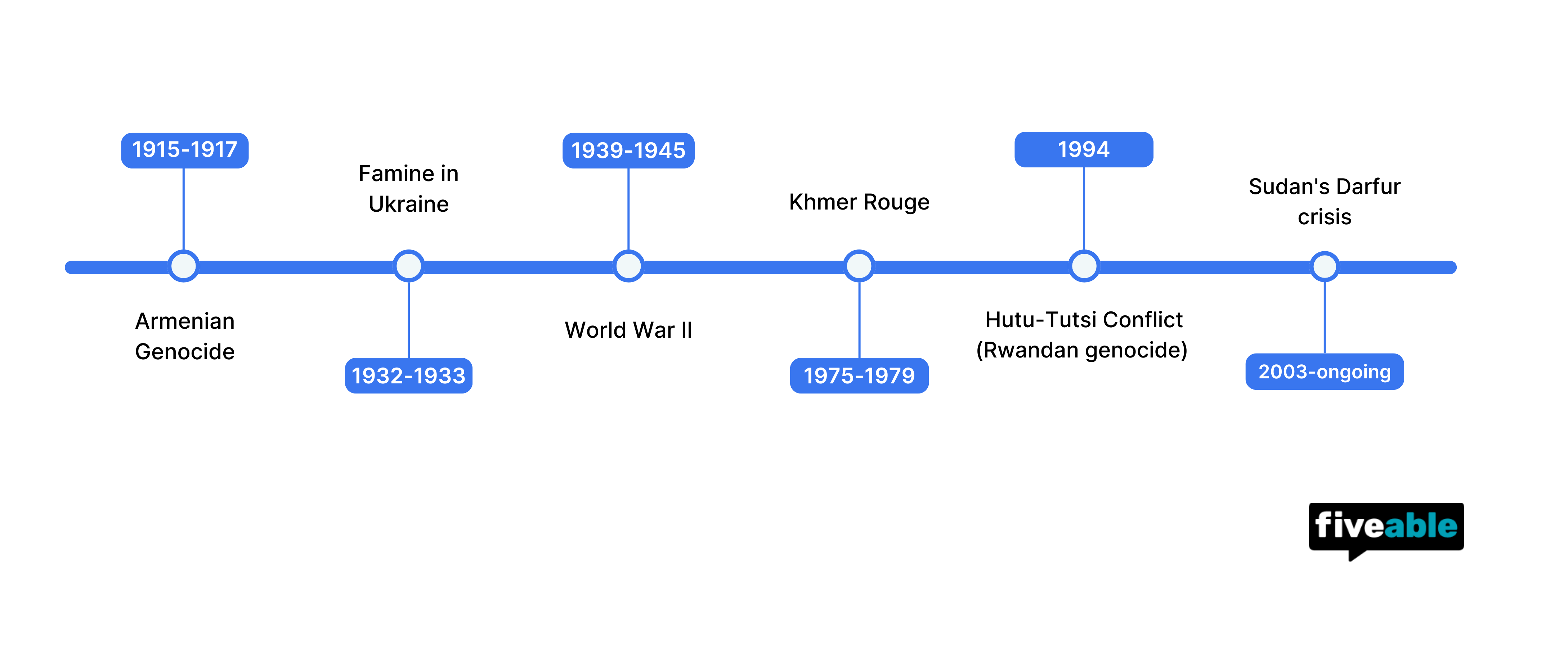
Timeline of 20th-century mass atrocities, from the Armenian Genocide to ongoing Darfur atrocities. Image Courtesy of Abdullah
Key Takeaways
- World War I killed millions of soldiers and civilians, while the Ottoman government deported Armenians to camps where many died or were executed.
- Returning soldiers helped spread the 1918 influenza pandemic, and the war's psychological shock gave rise to the term Lost Generation.
- Stalin's collectivization caused man-made famines in 1932 and 1933, with Ukraine hit hardest as the government seized harvests to support industry.
- World War II killed an estimated 40 million to 50 million people; Nazi persecution of Jews escalated under the Final Solution into mass murder in the Holocaust.
- Japanese wartime policies killed millions and forced conquered peoples into labor, while Allied firebombing and atomic bombs brought heavy civilian casualties.
- After the Holocaust, Serb forces ethnically cleansed Muslims in Bosnia and Kosovo, mostly Tutsis were killed in Rwanda, and Sudanese forces and Janjaweed killed people in Darfur.
Atrocities in Europe and the Middle East: WWI and the Armenian Genocide
World War I made civilians legitimate targets for the first time in a modern war, and the deadliest result was the Armenian Genocide in the Ottoman Empire. The war ended with Germany's surrender on November 11, 1918 (Armistice Day), after the U.S. entered in 1917 and tipped the balance toward the Allies.
The human cost of WWI:
- 8 to 9 million soldiers dead, more than 21 million wounded
- Civilian deaths estimated between 6 million and 13 million
- In France, Germany, Russia, and Austria-Hungary, fewer than half of the young men who fought returned physically unharmed
- Germany lost the most soldiers (1.8 million dead), followed by Russia (1.7 million) and France (1.4 million)
The Armenian Genocide (1915-1917)
This is called the 20th century's first genocide, meaning the attempted killing of a group of people based on race, religion, or ethnicity. Key facts:
- The Ottoman Empire was ruled by the "Young Turks," a clique alarmed by the empire's continuing decline.
- The Ottoman government accused the Christian Armenian minority of cooperating with Russia, an Ottoman enemy in WWI.
- Between 1915 and 1917, the government deported Armenians from their homes into camps in Syria and present-day Iraq. Many died of starvation, disease, or exposure. Turkish troops executed others.
- Death toll estimates range from 600,000 to 1.5 million Armenians.
- Armenians call it genocide. The Turkish government has said the deaths resulted from wartime actions, ethnic conflict, and disease, not genocide. This denial debate still matters today.
Hitler later pointed to the world's silence on Armenia as evidence the Nazis had little to fear when carrying out the Holocaust. For the buildup to that war, review the AMSCO 7.6 Causes of World War II notes.
Pandemic Disease and the Lost Generation
The 1918 influenza epidemic became a global pandemic because millions of soldiers returning home at war's end carried the virus with them. A pandemic is a disease prevalent over a large area or the entire world.
- By 1919, the flu had killed about 20 million people in Europe, the United States, and elsewhere.
- India alone may have lost 7 million people.
- The pandemic showed that improved transportation was creating a global culture with global challenges, and it was unclear whether nations could mount effective international responses.
The war also left an intangible casualty: a lost sense of security and hopefulness. The term Lost Generation originally described American expatriate writers in Paris after the war, then broadened to describe everyone suffering from the shock of the bloodiest war in history up to that point.
Famine in Ukraine
Stalin's collectivization of agriculture caused man-made famines in the Soviet Union in 1932 and 1933, killing an estimated 7 million to 10 million peasants, with Ukraine hit hardest. This is what the exam's illustrative examples call the Holodomor.
- Peasants resisted collectivization by hiding or destroying crops and killing livestock rather than handing them to the state.
- The famines came from human action, not weather or crop failure. Ukraine was one of the Soviet Union's most fertile farming regions.
- The government seized much of the harvest to feed industrial workers or supply industry. Peasants starved while industry grew.
That trade-off is the AP-level takeaway: a state deliberately let millions die to fund industrialization.
Casualties of World War II
World War II killed an estimated 40 million to 50 million people, and civilian deaths likely exceeded military deaths. Roughly half the dead were Soviet citizens, with millions more from Germany, Poland, China, and Japan. The U.S. lost about 290,000 soldiers with more than 600,000 wounded. For the war itself, see the AMSCO 7.7 Conducting World War II notes.
The Nazis and the Holocaust
The Nazi killing of six million Jews in the Holocaust is the central example of an extremist regime attempting to destroy a specific population.
- The Nuremberg Laws of 1935 banned Jews from certain professions and schools. Jews were forced into city sections called ghettos.
- Germany forcibly removed Slavic peoples (including one million Poles) and Roma from their homes. Heinrich Himmler, leader of the SS, oversaw these policies.
- More than 7 million residents of conquered territories were forced into labor camps or jobs supporting the German war effort. Political opponents, people with disabilities, and gay people were also sent to the camps.
- In 1942, persecution turned to mass murder under the "Final Solution," the SS-led plan to kill all Jews in Europe. Killing units first shot Jews into mass graves, then the SS shipped Jews to death camps like Auschwitz and Treblinka in Poland and Dachau in Germany, where they were gassed.
- The Nazis killed about six million Jews plus another five million people from other persecuted groups and Soviet prisoners of war.
- A shocking feature: the Nazis used modern technology (trains, poison gas, cremation ovens) to make genocide more efficient and deadly.
The Japanese
Japan did not carry out a dedicated genocide policy paralleling the Holocaust, but its wartime policies killed millions.
- In 1937, during the Second Sino-Japanese War, Japanese soldiers killed at least 100,000 Chinese soldiers and civilians in the Rape of Nanking.
- Under "Asia for Asiatics," Japan forced conquered peoples into military service, public works, and farm labor to ease food shortages in Japan.
- The Japanese army forced women in Korea, China, and other occupied countries to become "comfort women," prostitutes for Japanese soldiers.
- More than a million civilians died in Vietnam alone. Perhaps an equal number of Allied POWs and local workers died doing forced labor.
The Allies
Allied air warfare brought deadly combat directly to civilians.
- Firebombing of German cities killed about 50,000 in Hamburg (1943) and roughly 25,000 in Dresden (1945), where 15 square miles of the historic city center were destroyed. The U.S. also firebombed Tokyo.
- The atomic bombings of Hiroshima and Nagasaki produced high casualties and lasting fear about future nuclear war.
- Delivering nuclear weapons required new technology: long-range planes that could carry heavy loads, plus aircraft carriers that extended airpower's reach worldwide.
Genocide and Human Rights After the Holocaust
The world said "never again" after the Holocaust, but genocides kept happening, and international responses ranged from insufficient to callous. The chapter also notes Cambodia, where dictator Pol Pot tried to "purify" society along racial, social, and political lines, killing 1.6 to 1.8 million Cambodians in the late 1970s.
Bosnia (1990s)
- Yugoslavia, created after WWI, held Eastern Orthodox Serbians, Catholic Croats and Slovenes, and Muslims in Bosnia and Kosovo. Communist dictator Josip Broz Tito suppressed separatism until his death in 1980.
- After the Soviet Union collapsed, Yugoslavia broke apart. Serbian nationalists led by Slobodan Milošević pushed for ethnic purity.
- Serb forces committed ethnic cleansing against Muslims from Bosnia and Kosovo, killing or driving out people outside the main ethnic group, and raped untold numbers of Muslim women.
- More than 300,000 people died during Yugoslavia's balkanization (disintegration into separate states).
Rwanda (1994)
- Belgian colonizers had favored the minority Tutsis over the majority Hutus. After independence in 1962, the Hutu-controlled government discriminated against Tutsis, and tens of thousands of Tutsis fled and formed a rebel army.
- Power-sharing negotiations in 1993 collapsed when Rwanda's Hutu president died in a 1994 plane crash, supposedly shot down by rebels.
- Over roughly three months, between 500,000 and 1 million civilians (mostly Tutsis, plus moderate Hutus) were killed.
- UN peacekeepers were told not to use force and were too few to protect Rwandans. The U.S. and other countries evacuated their own personnel but no Rwandans. The genocide exposed the UN's failure of leadership in protecting human rights.
Sudan (Darfur, 2003-present)
- In Darfur, western Sudan, non-Arab rebel groups took up arms against the Arab Muslim-controlled government.
- The government unleashed the Janjaweed ("evil men on horseback"), Arab militants who, with Sudanese forces, destroyed hundreds of villages and killed more than 200,000 people, mostly non-Arab Muslim Africans.
- More than one million people were displaced, creating a refugee crisis that spilled into neighboring Chad.
- The International Criminal Court charged Sudan's President Omar al-Bashir with war crimes, but the genocide continued.
The pattern across all three: ethnic or political extremism in power, mass killing of a targeted group, and an international community that failed to act in time.
Key Terms to Know
| Term | Why it matters |
|---|---|
| Genocide | The attempted killing of a group based on race, religion, or ethnicity; the chapter's central concept. |
| Armenian Genocide | Ottoman deportation and killing of 600,000 to 1.5 million Armenians (1915-1917), called the 20th century's first genocide. |
| Armistice Day | November 11, 1918, when Germany surrendered and World War I ended. |
| Lost Generation | Term for those psychologically scarred by WWI, originally American expatriate writers in Paris. |
| Pandemic | A disease prevalent over a large area or the world; the 1918-1919 flu killed 20 million people. |
| Holodomor | Man-made famine in Soviet Ukraine (1932-1933) caused by Stalin's collectivization; 7 to 10 million dead. |
| Nuremberg Laws | 1935 Nazi laws banning Jews from certain professions and schools, an early step toward the Holocaust. |
| Ghettos | City sections where Nazis forced Jews to live before deportation to camps. |
| Final Solution | The Nazis' 1942 plan, led by the SS, to murder all Jews in Europe. |
| Holocaust | Nazi genocide of about six million Jews, plus five million others from persecuted groups and Soviet POWs. |
| Heinrich Himmler | SS leader who oversaw Nazi removal, labor, and extermination policies. |
| Asia for Asiatics | Japan's program forcing conquered peoples into labor and military service; millions died under it. |
| Firebombing | Allied air tactic that killed about 50,000 in Hamburg and roughly 25,000 in Dresden; also used on Tokyo. |
| Ethnic cleansing | Killing or expelling people outside the dominant ethnic group, as Serb forces did to Bosnian and Kosovar Muslims. |
| Balkanization | The disintegration of a state into separate states, named for Yugoslavia's breakup; over 300,000 died. |
| Hutus and Tutsis | Rwanda's majority and minority groups; colonial-era favoritism fueled the 1994 genocide of 500,000 to 1 million people. |
| Janjaweed | Arab militants ("evil men on horseback") the Sudanese government unleashed on Darfur, killing more than 200,000. |
| International Criminal Court | Court that charged Sudan's Omar al-Bashir with war crimes, though the Darfur genocide continued. |
Practice and Next Steps
Pair these notes with the Fiveable course guide for Topic 7.8 Mass Atrocities After 1900, which frames the same content the way the exam tests it. Then close out the unit with the AMSCO 7.9 Causation in Global Conflict notes, where you'll connect these atrocities to the era's larger causes and effects.
To check yourself:
- Quiz on this topic with guided practice questions
- Drill vocab in the AP World key terms glossary
- Try writing a comparison paragraph (Holocaust vs. Rwanda or Darfur is a classic prompt) and score it with FRQ practice
Browse the full set of AMSCO chapter notes for every Unit 7 topic.
Frequently Asked Questions
What does AMSCO Topic 7.8 Mass Atrocities cover?
AMSCO 7.8 (p.521-530) covers genocides and mass civilian deaths from 1900 to the present: the Armenian Genocide, WWI casualties, the 1918 flu pandemic, the Ukrainian famine (Holodomor), the Holocaust and other WWII atrocities, and post-WWII genocides in Cambodia, Bosnia, Rwanda, and Darfur. The unifying thread is that extremist groups in power attempted to destroy specific populations.
Why is the Armenian Genocide called the first genocide of the 20th century?
Between 1915 and 1917, the Ottoman government deported its Christian Armenian minority into camps in Syria and present-day Iraq, where 600,000 to 1.5 million died from starvation, disease, exposure, and executions. It was a systematic attempt to destroy a group based on ethnicity and religion, which fits the definition of genocide. Hitler later cited the world's silence on Armenia as a reason the Nazis could carry out the Holocaust without fear.
What is the difference between genocide and ethnic cleansing?
Genocide is the attempted killing of a group of people based on race, religion, or ethnicity, like the Holocaust or Rwanda. Ethnic cleansing means killing or driving out people who are not part of the dominant ethnic group, the term used for Serb actions against Bosnian and Kosovar Muslims in the 1990s. They overlap heavily, but ethnic cleansing emphasizes removal from a territory while genocide emphasizes destruction of the group itself.
What was the Holodomor and why does AP World test it?
The Holodomor was the man-made famine in Soviet Ukraine in 1932-1933, caused by Stalin's collectivization of agriculture. An estimated 7 to 10 million peasants died while the government seized crops to feed industrial workers. It's a key AP World example of mass death caused by state policy rather than war, weather, or crop failure.
How might Topic 7.8 show up on the AP World exam?
You should be able to explain the causes and consequences of mass atrocities from 1900 to the present, with the Holocaust as the central example and the Armenian Genocide, Cambodia under the Khmer Rouge, Rwanda, and the Holodomor as supporting evidence. Comparison prompts (like the Holocaust vs. Rwanda or Darfur) are common, so practice with FRQ scoring to build that skill.
See Fiveable more often in Google
Mark Fiveable as a preferred source and Google is more likely to show you our guides in Top Stories, with a "preferred" badge in AI Mode and AI Overviews.