AMSCO 6.6 Causes of Migration in an Interconnected World Notes

🌍AP World History: Modern Review
AMSCO 6.6 Causes of Migration in an Interconnected World Notes
🌍 AP World History: Modern
AMSCO 1.1 Developments in East Asia Notes
AMSCO 1.2 Developments in Dar al-Islam Notes
AMSCO 1.3 Developments in South and Southeast Asia Notes
AMSCO 1.4 Developments in the Americas Notes
AMSCO 1.5 Developments in Africa Notes
AMSCO 1.6 Developments in Europe Notes
AMSCO 1.7 Comparison in the Period from c.1200 to c.1450 Notes
AMSCO 2.1 The Silk Roads Notes
AMSCO 2.2 The Mongol Empire and the Modern World Notes
AMSCO 2.3 Exchange in the Indian Ocean Notes
AMSCO 2.4 Trans-Saharan Trade Routes Notes
AMSCO 2.5 Cultural Consequences of Connectivity Notes
AMSCO 2.6 Environmental Consequences of Connectivity Notes
AMSCO 2.7 Comparison of Economic Exchange Notes
AMSCO 3.1 European, East Asian, and Gunpowder Empires Expand Notes
AMSCO 3.2 Empires: Administrations Notes
AMSCO 3.3 Empires: Belief Systems Notes
AMSCO 3.4 Comparison in Land-Based Empires Notes
AMSCO 4.1 Technological Innovations Notes
AMSCO 4.2 Exploration: Causes and Events Notes
AMSCO 4.3 Columbian Exchange Notes
AMSCO 4.4 Maritime Empires Link Regions Notes
AMSCO 4.5 Maritime Empires Develop Notes
AMSCO 4.6 Internal and External Challenges to State Power Notes
AMSCO 4.7 Changing Social Hierarchies Notes
AMSCO 4.8 Continuity and Change from c.1450 to c.1750 Notes
AMSCO 5.1 The Enlightment Notes
AMSCO 5.2 Nationalism and Revolutions Notes
AMSCO 5.3 Industrial Revolution Begins Notes
AMSCO 5.4 Industrialization Spreads Notes
AMSCO 5.5 Technology in the Industrial Age Notes
AMSCO 5.6 Industrialization: Government's Role Notes
AMSCO 5.7 Economic Developments and Innovations Notes
AMSCO 5.8 Reactions to the Industrial Economy Notes
AMSCO 5.9 Society and the Industrial Age Notes
AMSCO 5.10 Continuity and Change in the Industrial Age Notes
AMSCO 6.1 Rationales for Imperialism Notes
AMSCO 6.2 State Expansion Notes
AMSCO 6.3 Indigenous Responses to State Expansion Notes
AMSCO 6.4 Global Economic Development Notes
AMSCO 6.5 Economic Imperialism Notes
AMSCO 6.6 Causes of Migration in an Interconnected World Notes
AMSCO 6.7 Effects of Migration Notes
AMSCO 6.8 Causation in the Imperial Age Notes
AMSCO 7.1 Shifting Power Notes
AMSCO 7.2 Causes of World War I Notes
AMSCO 7.3 Conducting World War I Notes
AMSCO 7.4 Economy in the Interwar Period Notes
AMSCO 7.5 Unresolved Tensions After World War I Notes
AMSCO 7.6 Causes of World War II Notes
AMSCO 7.7 Conducting World War II Notes
AMSCO 7.8 Mass Atrocities Notes
AMSCO 7.9 Causation in Global Conflict Notes
AMSCO 8.1 Setting the Stage for the Cold War and Decolonization Notes
AMSCO 8.2 The Cold War Notes
AMSCO 8.3 Effects of the Cold War Notes
AMSCO 8.4 Spread of Communism Notes
AMSCO 8.5 Decolonization after 1900 Notes
AMSCO 8.6 Newly Independent States Notes
AMSCO 8.7 Global Resistance to Established Power Structure Notes
AMSCO 8.8 End of the Cold War Notes
AMSCO 8.9 Causation in the Age of the Cold Ward and Decolonization Notes
AMSCO 9.1 Advances in Technology and Exchange Notes
AMSCO 9.2 Technological Advancements and Limitations Notes
AMSCO 9.3 Technology and the Environment Notes
AMSCO 9.4 Economics in the Global Age Notes
AMSCO 9.5 Calls for Reforms and Responses Notes
AMSCO 9.6 Globalized Culture Notes
AMSCO 9.7 Resistance to Globalization Notes
AMSCO 9.8 Institutions Developing in a Globalized World Notes
AMSCO 9.9 Continuity and Change in a Globalized World Notes
Overview
AMSCO Topic 6.6, Causes of Migration in an Interconnected World (p.417-425), explains why millions of people moved between 1750 and 1900: economic imperialism created huge demand for cheap labor, new transportation made long-distance moves possible, and poverty, famine, and political pressure pushed people out of their homelands. Some migrants chose to move (Irish to the United States, Italians to Argentina). Others were coerced or semi-coerced through slavery, indentured servitude, contract labor, and convict transportation. The chapter opens with an 1850 letter from an Irish settler in Wisconsin urging friends to "quit Ireland", a reminder that desperation, not adventure, drove most of these moves.
The chapter builds directly on the labor demands you saw in AMSCO 6.5 Economic Imperialism and sets up 6.7 Effects of Migration.
Key Takeaways
- As slavery declined, plantation owners still needed workers, so imperial powers recruited Indian and Chinese indentured and contract laborers, often under coercive or exploitative conditions.
- Britain sent convicts to labor in Australia, while France operated penal colonies in Africa, New Caledonia, and French Guiana.
- Indians moved overseas for indentured plantation work, while gold rushes, population growth, and the Taiping Rebellion contributed to Chinese migration.
- The Great Famine drove as many as 3 million Irish people to emigrate, while unsustainable farming pushed Italians abroad and money sent home encouraged more migration.
- Many British migrants settled permanently in colonies such as Canada and Australia; British engineers also worked in South Asia and Africa, while business migrants built banks and railroads in Argentina.
- Japan's Colonization Society sent contract workers to Peru, while better transportation let some migrants return home and industrial growth drew more migrants to cities.
Migration through Labor Systems
As slavery declined in the 19th century, demand for plantation labor did not. Imperial powers replaced enslaved labor with new coerced and semi-coerced systems and recruited workers across the globe:
- Indian laborers went to British colonies in the Caribbean, South Africa, East Africa, and Fiji
- Chinese laborers went to California and British Malaya to build railroads and work as farmhands, gardeners, and domestics
- Japanese laborers went to Hawaii, Peru, and Cuba to work on sugar plantations
Slavery's decline
Most countries in the Americas abolished the African slave trade in the early 19th century. Without a fresh supply of enslaved people, slavery itself declined, except in the United States, the only place where the enslaved population grew after the trade ended. The last abolitions in the Americas were the United States (1865), Cuba (1886), and Brazil (1888). Slavery within Africa continued well into the 20th century despite prohibitions.
Indentured servitude
Indentured servants worked for a set number of years before becoming free. Most became indentured to pay for transportation out of a desperately poor community; others were paying off debt. Many planned to earn money and go home, but lots of them stayed. That's how indentured labor reshaped demographics: Mauritius, Fiji, and Trinidad all gained strong Indian cultural influences this way.
Asian contract laborers
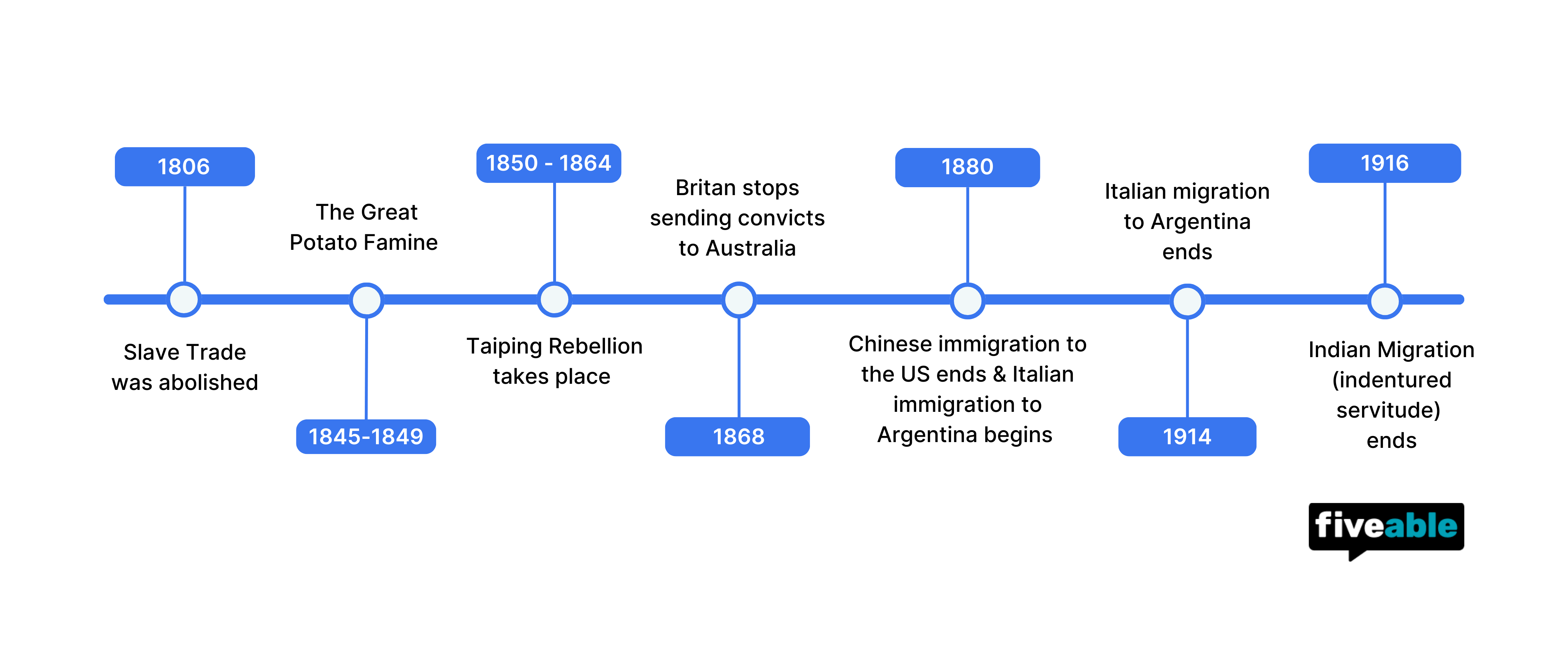
Chinese and Indian contract workers were an early substitute for the slave trade, and many were forced or tricked into servitude. Britain first tried it in 1806, importing 200 Chinese workers to Trinidad. Between 1847 and 1874, the British, French, Dutch, and Spanish imported between 250,000 and 500,000 Chinese workers to colonies in Southeast Asia, Africa, and the Caribbean. About 125,000 went to Cuba alone, where 80 percent worked sugar plantations.
These workers weren't legally property, but they were exploited at subsistence wages, and the press attacked the system as a new form of slavery. The backlash worked: Britain stopped its trade in 1855, the U.S. Congress banned it in 1862, Portugal ended it in 1874, and an 1877 China-Spain treaty terminated the contracts of Chinese workers still in Cuba.
British and French penal colonies
After losing its Georgia penal colony in the American Revolution, Britain established one in Australia in the late 1700s. Convicts from England, Scotland, Ireland, and colonies like India did hard labor for free settlers or worked on government projects such as roads and railways. Actual imprisonment was rare, and most convicts earned freedom after a set term of service. Many stayed in Australia anyway, because some were barred from returning and passage home was expensive. Britain ended convict transportation by 1850, partly because a stay in Australia no longer seemed like much of a punishment. The 1851 gold discovery then drew free settlers, including about 50,000 Chinese migrants, and Australia became one of Britain's most successful settler colonies.
France ran penal colonies in Africa, New Caledonia (1864-1897, for convicts and political prisoners), and French Guiana, where Devil's Island became notorious for underfed prisoners and brutal hard labor. France stopped transporting convicts in 1938, but Devil's Island held prisoners until 1953.
Migration in the Face of Challenges (Diasporas)
A diaspora is a mass emigration from a country or region, often stretched over many years. The African slave trade caused one of history's biggest diasporas, an involuntary movement of millions between the 16th and 19th centuries. Most other diasporas were driven by poverty, political conditions, or famine.
India
Poverty was the main push factor. In 1833 the British began sending Indians to Mauritius as indentured laborers to replace enslaved workers on sugar plantations. By 1878, Indians worked plantations in British Guiana, Dutch Guiana (Surinam), Natal, Fiji, and British and French Caribbean islands. Most signed five-year contracts; many renewed, and some stayed permanently by taking land or a lump sum instead of return passage. Over 1.5 million Indians were shipped to colonies in Asia, Africa, the Caribbean, and Oceania before Britain abolished the indenture system in 1916. Between 1880 and 1938, two recruitment systems operated in Southeast Asia. The kangani system in Ceylon and Malaya used foremen who recruited from their own extended families. The maistry system in Burma used supervisors in a rigid hierarchy and sent workers to highly exploitative plantation jobs.
China
The Chinese diaspora took off in the mid-19th century with the gold rushes in California, South Australia, and western Canada, though most Chinese migrants weren't miners. Chinese workers were instrumental in building the U.S. Transcontinental Railroad despite facing intense prejudice. Many left as indentured laborers; the vast majority were men who intended to return home. Push factors included a population explosion in coastal cities starting in the late 18th century, easier exit after the first Opium War, and the poverty and chaos of the Taiping Rebellion (1850-1864). After mid-century, most Chinese emigrants headed to the Americas, Europe, Australia, or New Zealand.
Ireland
Irish emigration had political, religious, and economic causes. Britain abolished the Irish Parliament in 1801 when Ireland joined the United Kingdom, and Roman Catholics and Protestant dissenters faced religious discrimination. Tenant farmer evictions rose after the 1846 repeal of the Corn Laws. Then the Great Famine (1845-1849) destroyed the potato crop for four years, and as many as 3 million people emigrated, most to the United States, plus England, Scotland, Canada, and Australia. The exodus didn't stop with the famine: as many people left in the first four years afterward as during its height. The Irish built canals and railroads in Britain and the U.S., 300,000 free Irish plus 45,000 convicts went to Australia, and about 45,000 went to Argentina (though more than half moved on to the United States).
Italy
Italian emigration's first wave ran from unification in 1861 to 1900, when more than 7 million people left. Over half went to other European countries; most of the rest went to North and South America, Australia, and New Zealand. Poverty was the main driver. Farmland subdivided over generations made farming unsustainable, and some fled organized crime in the south or left for political reasons. Emigrants sent money home, which encouraged even more emigration. This is classic chain migration.
Migration to Settler Colonies
British citizens who moved abroad permanently mostly went to settler colonies: Canada, South Africa, Australia, or New Zealand. Those who went to India, Malaya, or Kenya usually didn't plan to stay; they served as army officers, Colonial Service officials, or plantation and business managers.
Technical experts
British engineers and geologists migrated to South Asia and Africa in such numbers that they formed their own kind of diaspora, spreading Western science and technology and collaborating with engineers from colonial lands on public works and private industrial projects. Example: Andrew Geddes Bain emigrated to Cape Town in 1816, built eight major roads and passes, produced the first comprehensive geological map of South Africa in 1852, and reported on Namaqualand's copper mines in 1854.
Argentina
Argentina was part of Britain's "informal" empire, and Britain actually invested more there than in India, the "Jewel in the Crown." British settlers in Argentina weren't escaping poverty; they were businessmen, traders, bankers, and engineers who founded banks, built railroads, developed agricultural export trade, and imported luxuries for Argentina's growing middle class.
Japan
Japan was closed to the world before 1868. By 1893 the government wanted an overseas empire and created the Colonization Society to export Japan's surplus population and commercial goods. An 1892 attempt at an agricultural settler colony in Mexico failed, but the Society sent 790 Japanese to Peru for contract work in 1899. Meanwhile, young Japanese men went to study in U.S. West Coast cities like San Francisco, Portland, and Seattle. Anti-Japanese sentiment grew, leading to the 1907 Gentlemen's Agreement: the U.S. would not restrict Japanese immigration, and Japan would not allow further emigration to the U.S. It was informal, never ratified, and ended by the Immigration Act of 1924.
Migration, Transportation, and Urbanization
Better transportation technology meant migration was no longer always a one-way trip. Some workers could return home, periodically or permanently. An 1885 agreement between Japan and Hawaii let Japanese laborers work sugar plantations on three-year contracts; about 29,000 went over the next nine years, with thousands more taking similar contracts in Australia, New Caledonia, and Fiji. Italian industrial workers had similar arrangements in Argentina, though many settled there permanently (Mendoza even built a monument to Italian immigrants in the Plaza Italia).
Because industry concentrated in cities, both internal and external migrants increasingly settled in urban areas. That pattern fueled the massive global urbanization of the 19th century.
Key Terms to Know
| Term | Why it matters |
|---|---|
| Slavery | Coerced labor system that declined in the 19th century after the slave trade was abolished, but lasted until 1865 in the U.S., 1886 in Cuba, and 1888 in Brazil. |
| Indentured servants | Workers bound for a set number of years, usually to pay for passage or debt, who reshaped the demographics of places like Mauritius, Fiji, and Trinidad. |
| Contract laborers | Chinese and Indian workers, often forced or tricked into service, who replaced enslaved labor on plantations and were criticized as a new form of slavery. |
| Penal colony | A settlement where convicts were sent to labor; Britain used Australia and France used New Caledonia and French Guiana (including Devil's Island). |
| Convicts | People sentenced for crimes and transported to penal colonies, where most did labor for settlers or the government and earned freedom after a set term. |
| Diaspora | A mass emigration from a country or region over many years; the African slave trade caused one of the largest in history. |
| Emigrate | To leave your own country to settle in another, the core action behind every diaspora in this chapter. |
| Great Famine (1845-1849) | Irish potato blight that destroyed the crop for four years and pushed as many as 3 million people to emigrate, mostly to the United States. |
| Taiping Rebellion (1850-1864) | Massive civil war in Qing China whose poverty and disorder drove large-scale Chinese emigration. |
| Kangani system | Labor recruitment in Ceylon and Malaya where foremen recruited workers from their own extended families (1880-1938). |
| Maistry system | Hierarchical, highly exploitative labor recruitment in Burma that sent workers to Southeast Asian plantations. |
| Colonial Service | The body of British government officials who administered Britain's overseas possessions. |
| Colonization Society | Japanese government organization (1893) created to export Japan's surplus population and goods, sending 790 workers to Peru in 1899. |
| Gentlemen's Agreement (1907) | Informal U.S.-Japan deal restricting Japanese emigration; never ratified and ended by the Immigration Act of 1924. |
| Settler colony | A colony where migrants moved permanently, like Canada, Australia, New Zealand, and South Africa, rather than serving temporary tours. |
Practice and Next Steps
Connect these notes to the course framework with the 6.6 Causes of Migration from 1750 to 1900 study guide, which frames the same material around environmental and economic push-pull factors. Then continue to AMSCO 6.7 Effects of Migration to see what happened once these migrants arrived, and find every chapter on the AMSCO Notes hub.
To check yourself, run Unit 6 questions in guided practice and review migration vocabulary in the AP World key terms glossary. For essay prep, the FRQ practice tool with instant scoring is a good place to try a comparison or causation prompt on 1750-1900 migration.
Frequently Asked Questions
What does AMSCO Topic 6.6 cover in AP World?
AMSCO 6.6 (p.417-425) covers why people migrated between 1750 and 1900: coerced labor systems like slavery, indentured servitude, Asian contract labor, and penal colonies, plus voluntary diasporas from Ireland, Italy, China, and India driven by poverty, famine, and political pressure. It also covers how new transportation let some migrants return home and fueled 19th-century urbanization.
What replaced slavery as a labor source in the 19th century?
Indentured servitude, Asian contract labor, and convict labor. Between 1847 and 1874, European powers imported 250,000 to 500,000 Chinese contract workers to their colonies, and over 1.5 million Indians were shipped abroad as indentured laborers before Britain abolished the indenture system in 1916. Critics at the time called contract labor a new form of slavery.
What is a diaspora, and which ones does AP World Unit 6 focus on?
A diaspora is a mass emigration from a country or region that can stretch over many years. Unit 6 focuses on the Indian, Chinese, Irish, and Italian diasporas, plus the African slave trade as one of history's largest involuntary diasporas. Poverty, famine, and political conditions were the main causes of the voluntary ones.
Was most migration between 1750 and 1900 voluntary or coerced?
Both, and the AP exam expects you to distinguish them. Many people freely relocated for work, like Irish migrants to the U.S. or Italians to Argentina, but the global capitalist economy still relied heavily on coerced and semi-coerced migration, including enslavement, Chinese and Indian indentured servitude, and convict labor in British and French penal colonies. Even 'voluntary' contract workers were often forced or tricked into service.
How does Topic 6.6 show up on the AP World exam?
Topic 6.6 supports causation questions about why migration patterns developed from 1750 to 1900, especially economic factors (labor demand, poverty) and environmental factors (famine, demographic pressure). It pairs naturally with Topic 6.7 on migration's effects, so practice connecting causes to outcomes. You can drill this with Unit 6 guided practice questions.
See Fiveable more often in Google
Mark Fiveable as a preferred source and Google is more likely to show you our guides in Top Stories, with a "preferred" badge in AI Mode and AI Overviews.