AMSCO 9.1 Advances in Technology and Exchange Notes

🌍AP World History: Modern Review
AMSCO 9.1 Advances in Technology and Exchange Notes
🌍 AP World History: Modern
AMSCO 1.1 Developments in East Asia Notes
AMSCO 1.2 Developments in Dar al-Islam Notes
AMSCO 1.3 Developments in South and Southeast Asia Notes
AMSCO 1.4 Developments in the Americas Notes
AMSCO 1.5 Developments in Africa Notes
AMSCO 1.6 Developments in Europe Notes
AMSCO 1.7 Comparison in the Period from c.1200 to c.1450 Notes
AMSCO 2.1 The Silk Roads Notes
AMSCO 2.2 The Mongol Empire and the Modern World Notes
AMSCO 2.3 Exchange in the Indian Ocean Notes
AMSCO 2.4 Trans-Saharan Trade Routes Notes
AMSCO 2.5 Cultural Consequences of Connectivity Notes
AMSCO 2.6 Environmental Consequences of Connectivity Notes
AMSCO 2.7 Comparison of Economic Exchange Notes
AMSCO 3.1 European, East Asian, and Gunpowder Empires Expand Notes
AMSCO 3.2 Empires: Administrations Notes
AMSCO 3.3 Empires: Belief Systems Notes
AMSCO 3.4 Comparison in Land-Based Empires Notes
AMSCO 4.1 Technological Innovations Notes
AMSCO 4.2 Exploration: Causes and Events Notes
AMSCO 4.3 Columbian Exchange Notes
AMSCO 4.4 Maritime Empires Link Regions Notes
AMSCO 4.5 Maritime Empires Develop Notes
AMSCO 4.6 Internal and External Challenges to State Power Notes
AMSCO 4.7 Changing Social Hierarchies Notes
AMSCO 4.8 Continuity and Change from c.1450 to c.1750 Notes
AMSCO 5.1 The Enlightment Notes
AMSCO 5.2 Nationalism and Revolutions Notes
AMSCO 5.3 Industrial Revolution Begins Notes
AMSCO 5.4 Industrialization Spreads Notes
AMSCO 5.5 Technology in the Industrial Age Notes
AMSCO 5.6 Industrialization: Government's Role Notes
AMSCO 5.7 Economic Developments and Innovations Notes
AMSCO 5.8 Reactions to the Industrial Economy Notes
AMSCO 5.9 Society and the Industrial Age Notes
AMSCO 5.10 Continuity and Change in the Industrial Age Notes
AMSCO 6.1 Rationales for Imperialism Notes
AMSCO 6.2 State Expansion Notes
AMSCO 6.3 Indigenous Responses to State Expansion Notes
AMSCO 6.4 Global Economic Development Notes
AMSCO 6.5 Economic Imperialism Notes
AMSCO 6.6 Causes of Migration in an Interconnected World Notes
AMSCO 6.7 Effects of Migration Notes
AMSCO 6.8 Causation in the Imperial Age Notes
AMSCO 7.1 Shifting Power Notes
AMSCO 7.2 Causes of World War I Notes
AMSCO 7.3 Conducting World War I Notes
AMSCO 7.4 Economy in the Interwar Period Notes
AMSCO 7.5 Unresolved Tensions After World War I Notes
AMSCO 7.6 Causes of World War II Notes
AMSCO 7.7 Conducting World War II Notes
AMSCO 7.8 Mass Atrocities Notes
AMSCO 7.9 Causation in Global Conflict Notes
AMSCO 8.1 Setting the Stage for the Cold War and Decolonization Notes
AMSCO 8.2 The Cold War Notes
AMSCO 8.3 Effects of the Cold War Notes
AMSCO 8.4 Spread of Communism Notes
AMSCO 8.5 Decolonization after 1900 Notes
AMSCO 8.6 Newly Independent States Notes
AMSCO 8.7 Global Resistance to Established Power Structure Notes
AMSCO 8.8 End of the Cold War Notes
AMSCO 8.9 Causation in the Age of the Cold Ward and Decolonization Notes
AMSCO 9.1 Advances in Technology and Exchange Notes
AMSCO 9.2 Technological Advancements and Limitations Notes
AMSCO 9.3 Technology and the Environment Notes
AMSCO 9.4 Economics in the Global Age Notes
AMSCO 9.5 Calls for Reforms and Responses Notes
AMSCO 9.6 Globalized Culture Notes
AMSCO 9.7 Resistance to Globalization Notes
AMSCO 9.8 Institutions Developing in a Globalized World Notes
AMSCO 9.9 Continuity and Change in a Globalized World Notes
Overview
AMSCO Topic 9.1, Advances in Technology and Exchange (p.633-637), covers how new technologies transformed the world from 1900 to the present, kicking off Unit 9 on globalization. The chapter traces four big threads: communication and transportation breakthroughs (radio, the internet, air travel, shipping containers), the Green Revolution in agriculture, new energy technologies (petroleum and nuclear power), and medical innovations (antibiotics, birth control, and vaccines). The unifying idea is that technology shrank geographic distance, raised productivity, and helped humans survive longer, which set up the interconnected world the rest of Unit 9 examines.
The chapter opens with a quote from writer Joseph Krutch that captures the theme in one line: "Technology made large populations possible; large populations now make technology indispensable."
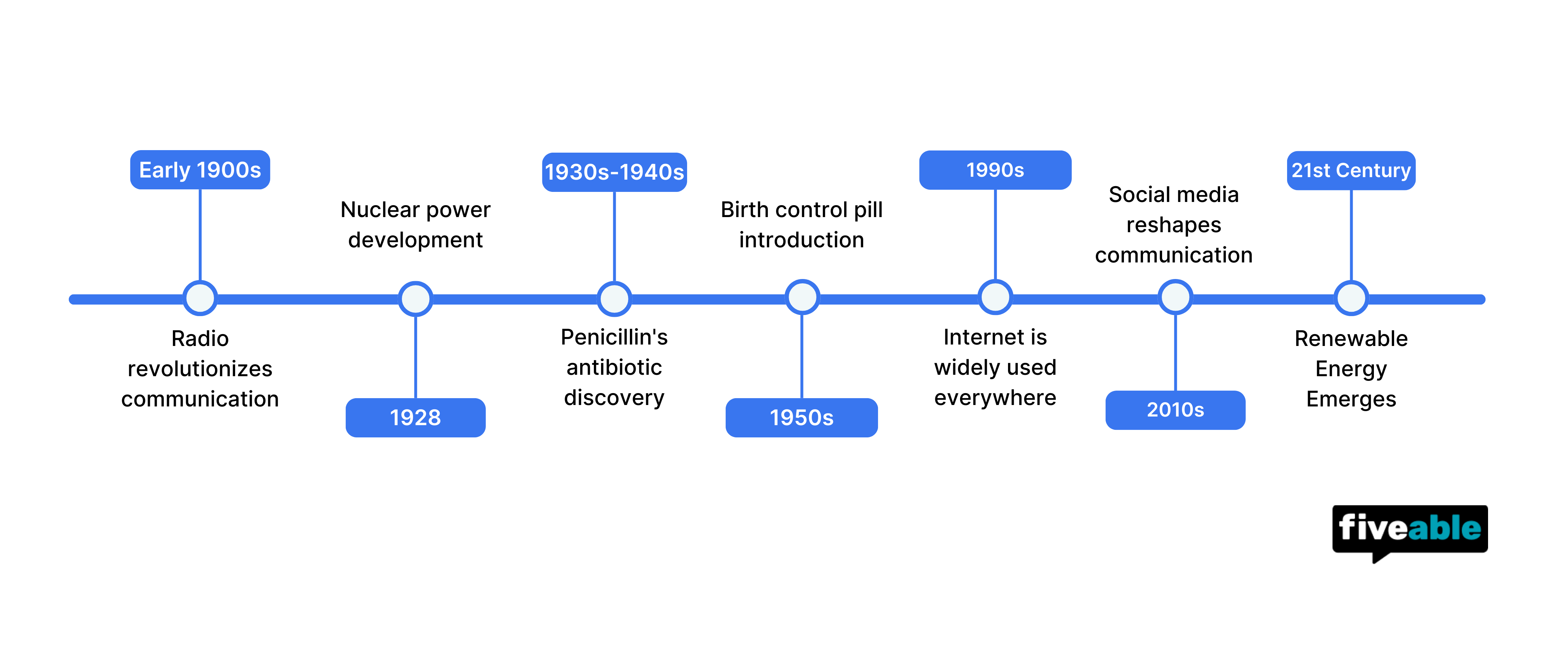
Timeline of Technological and Medical Advancements (1900-2019). Image Courtesy of Riya
Key Takeaways
- Radio, the internet, and social media spread information across distances, while air travel and standardized shipping containers moved people and goods faster and more cheaply.
- The Green Revolution raised crop yields through new grain varieties and farming methods, but many small farmers could not afford the new chemicals, and heavy chemical use damaged the environment.
- Petroleum, natural gas, and nuclear power increased energy production, but fossil fuels cause pollution and greenhouse gases, while nuclear power carries risks from radiation leaks and waste storage.
- Fleming's discovery of penicillin led to antibiotics that saved lives, though overuse can allow antibiotic-resistant strains to evolve.
- The birth control pill gave women greater control over fertility, and fertility rates declined in much of the world.
- Wider vaccine distribution made polio and measles rare and eradicated smallpox by the 1980s.
Communication and Transportation
New communication and transportation technologies reduced the problem of geographic distance. People, goods, and information could move farther and faster than ever before.
From radio to social media
- Starting in the early 1900s, radio brought news, music, and cultural events to a wide range of people. Decades before the internet, it was already connecting the world.
- The internet was first developed for the U.S. Defense Department during the Cold War. By the late 1990s it had become a regular communication tool for much of the public.
- By the 1990s, mobile technologies like cellphones put the tools of creating and spreading information into the hands of individuals everywhere.
- Social networking sites like Twitter and Facebook made media accessible to anyone, anywhere.
The effects showed up fast. Phone videos of police actions in the United States and other countries led to inquiries into racial profiling. Social media also helped fuel the Arab Spring, a series of antigovernment protests that spread across North Africa and the Middle East in the 2010s as people shared their protest experiences online.
One more ripple effect worth knowing: knowledge economies, economies based on developing and sharing information, took root in cities around the world.
Moving people and goods
Communication put people in virtual touch; transportation moved them into actual proximity.
- About 2 million people fly on an airplane every day, and cargo planes haul commercial shipments around the clock.
- Shipping containers are large, standard-sized units that can ride on a truck, a train, or stacked on a ship. That standardization made moving goods dramatically cheaper and easier.
- Giant tankers, some up to one-quarter mile long and loaded with thousands of containers, sail the seas in growing numbers. Some are too big to fit through the Panama Canal.
The Green Revolution
The Green Revolution was a mid-20th-century agricultural transformation that increased crop yields enough to feed the world's growing population, but it came with real costs for small farmers and the environment.
What changed
- Scientists developed new varieties of wheat, rice, and other grains with higher yields and greater resistance to pests, diseases, and drought.
- The first new varieties came from crossbreeding, which means breeding two varieties of a plant to create a hybrid.
- More recently, scientists turned to genetic engineering, manipulating a cell or organism to change its basic characteristics.
- Farmers also used more irrigation, fertilizers, and pesticides. In Brazil and elsewhere, people burned down forests and plowed the land for farming. Acreage devoted to crops, especially grains, increased dramatically worldwide.
The downsides
The Green Revolution solved a hunger problem and created new problems. For essays, this is a classic "evaluate the effects" setup.
- Many small farmers couldn't afford the new fertilizers or pesticides, so they couldn't compete with large landowners. Many were forced to sell their land, which made large holdings even larger.
- Mechanized equipment meant fewer jobs for farm laborers.
- Heavy chemical applications damaged the soil and the environment.
- Genetic engineering raised its own worries. A modification designed to make a plant insect-resistant might accidentally reduce populations of pollinating insects like bees, and old seed varieties were lost as genetically engineered plants took over.
Energy Technologies
Energy technologies, especially petroleum and nuclear power, raised productivity and increased the production of material goods. In 1900, coal accounted for about half of global energy consumption. As extraction, refinement, and transportation technologies improved, petroleum (crude oil) and natural gas joined coal in fueling industrial output.
- Research in the 1930s and 1940s that produced the atomic bomb also led to the first nuclear power plants, which generated electricity for factories and homes.
- Fossil fuels (coal, petroleum, and natural gas) are nonrenewable resources. Once used up, the supply is gone for good.
- Fossil fuels contribute to air pollution and to greenhouse gases, especially carbon dioxide, which let sunlight into the atmosphere but block Earth's heat from escaping.
- Nuclear power is considered clean energy, but accidents have leaked radiation, and storing nuclear waste is hazardous. Construction of nuclear plants declined starting in the 1980s, and nuclear power supplies only about 5 percent of global energy consumption.
- Renewable resources like wind and solar power are starting to supply energy to industries and homes, but they also account for only about 5 percent of global energy output.
The environmental fallout from these energy choices comes back in a big way in AMSCO 9.3 Technology and the Environment.
Medical Innovations
Medical innovations, including antibiotics, reliable birth control, and vaccines, increased human survival and longevity. The chapter highlights three breakthroughs.
Antibiotics
- In 1928, Scottish biologist Alexander Fleming accidentally discovered in his London lab that a fungus produced a substance that killed bacteria. He had discovered penicillin, the first antibiotic.
- During World War II, antibiotics saved soldiers who in any previous war would have died from minor infected wounds. After the war, antibiotics spread to civilian use against a range of illnesses.
- Fleming himself warned about overuse in his Nobel Prize speech. Killing off certain strains of a disease allows antibiotic-resistant strains to evolve, raising fears of renewed epidemics of diseases once under control.
Reliable birth control
- In the early 1950s, scientist Gregory Pincus developed the birth control pill, more reliable than the barrier methods then in use. After testing in the 1950s, the U.S. government approved it for widespread use in 1960.
- The pill and other forms of birth control gave women greater control over fertility. Fertility rates declined in much of the world, meaning the average woman had fewer babies than her mother or grandmother had.
- Birth control transformed sexual practices and helped reshape gender roles. By 2018, more than 300 million women worldwide were using modern contraception, including the pill.
Vaccines
- Vaccines have existed since 1796, but governments and nonprofits only began developing and widely distributing them after 1900.
- Thanks to vaccines, polio and measles became rare, and smallpox was eradicated by the 1980s. Vaccines also prevent mumps, tetanus, diphtheria, and whooping cough.
- As of 2019, a malaria vaccine was in the trial stage.
- The World Health Organization (WHO) estimated vaccines were preventing as many as 3 million deaths per year in the 21st century, and that better vaccination coverage would save another 1.5 million people annually. Some people couldn't get vaccinated because they lived in hard-to-reach areas.
Key Terms to Know
| Term | Why it matters |
|---|---|
| Radio | Starting in the early 1900s, it brought news, music, and culture to mass audiences worldwide. |
| Internet | Built for the U.S. Defense Department during the Cold War, it became a mainstream communication tool by the late 1990s. |
| Shipping containers | Standard-sized units that fit on trucks, trains, and ships, making global trade dramatically cheaper. |
| Knowledge economies | Economies based on developing and sharing information, which took root in cities worldwide. |
| Arab Spring | 2010s antigovernment protests in North Africa and the Middle East that spread partly through social media. |
| Green Revolution | Mid-20th-century push for high-yield, pest-resistant crops that fed a growing world population. |
| Crossbreeding | Breeding two plant varieties to create a hybrid, the original Green Revolution technique. |
| Genetic engineering | Directly manipulating a cell or organism to change its characteristics, raising yields but also concerns. |
| Nonrenewable resources | Fuels like coal, petroleum, and natural gas that are permanently depleted once used. |
| Nuclear power | A clean energy source with serious risks (radiation leaks, waste storage); only about 5 percent of global energy. |
| Antibiotic | A substance that kills bacteria; penicillin (discovered by Fleming in 1928) was the first. |
| Birth control | The pill (approved in 1960) gave women control over fertility and reshaped gender roles. |
| Fertility rates | The average number of children per woman, which declined globally as contraception spread. |
| Vaccines | Widely distributed after 1900, they made polio and measles rare and eradicated smallpox by the 1980s. |
Practice and Next Steps
These notes pair with the Topic 9.1 Advances in Technology and Exchange study guide, which frames the same content the way the AP exam tests it. When you're ready, move on to AMSCO 9.2 Technological Advancements and Limitations, which looks at disease and warfare, or browse the full set of AMSCO notes for AP World.
To check your understanding, drill Unit 9 questions with guided practice, review definitions in the key terms glossary, or get writing reps in with FRQ practice and instant scoring.
Frequently Asked Questions
What is AMSCO Topic 9.1 about in AP World?
AMSCO Topic 9.1, Advances in Technology and Exchange (p.633-637), explains how new technologies changed the world from 1900 to the present. It covers communication and transportation (radio, the internet, shipping containers), the Green Revolution, energy technologies like petroleum and nuclear power, and medical innovations including antibiotics, birth control, and vaccines.
What was the Green Revolution and what were its negative effects?
The Green Revolution was a mid-20th-century agricultural transformation in which scientists created high-yield, pest-resistant varieties of wheat, rice, and other grains through crossbreeding and later genetic engineering. It increased food production dramatically, but small farmers often couldn't afford the new fertilizers and pesticides and were forced to sell their land, mechanization cut farm jobs, and heavy chemical use damaged soil and the environment.
Who discovered the first antibiotic and when?
Scottish biologist Alexander Fleming accidentally discovered penicillin, the first antibiotic, in his London lab in 1928 when he noticed a fungus produced a substance that killed bacteria. Antibiotics saved countless soldiers during World War II, but Fleming warned in his Nobel Prize speech that overuse could create antibiotic-resistant strains of disease.
Is nuclear power a major energy source today according to AMSCO 9.1?
No. Although nuclear power is considered clean energy, plant construction declined starting in the 1980s after radiation accidents and waste-storage problems, and it accounts for only about 5 percent of global energy consumption. Renewables like wind and solar also supply only about 5 percent, while fossil fuels still dominate.
How does Topic 9.1 show up on the AP World exam?
Topic 9.1 supports the Unit 9 skill of explaining how technology changed the world after 1900, which appears in multiple-choice sets and as evidence for essays on globalization. Strong examples to know include the internet's Cold War origins, shipping containers, the Green Revolution's mixed effects, and the 1960 approval of the birth control pill. Practice applying them with AP World guided practice questions.
See Fiveable more often in Google
Mark Fiveable as a preferred source and Google is more likely to show you our guides in Top Stories, with a "preferred" badge in AI Mode and AI Overviews.