AMSCO 6.1 Rationales for Imperialism Notes

🌍AP World History: Modern Review
AMSCO 6.1 Rationales for Imperialism Notes
🌍 AP World History: Modern
AMSCO 1.1 Developments in East Asia Notes
AMSCO 1.2 Developments in Dar al-Islam Notes
AMSCO 1.3 Developments in South and Southeast Asia Notes
AMSCO 1.4 Developments in the Americas Notes
AMSCO 1.5 Developments in Africa Notes
AMSCO 1.6 Developments in Europe Notes
AMSCO 1.7 Comparison in the Period from c.1200 to c.1450 Notes
AMSCO 2.1 The Silk Roads Notes
AMSCO 2.2 The Mongol Empire and the Modern World Notes
AMSCO 2.3 Exchange in the Indian Ocean Notes
AMSCO 2.4 Trans-Saharan Trade Routes Notes
AMSCO 2.5 Cultural Consequences of Connectivity Notes
AMSCO 2.6 Environmental Consequences of Connectivity Notes
AMSCO 2.7 Comparison of Economic Exchange Notes
AMSCO 3.1 European, East Asian, and Gunpowder Empires Expand Notes
AMSCO 3.2 Empires: Administrations Notes
AMSCO 3.3 Empires: Belief Systems Notes
AMSCO 3.4 Comparison in Land-Based Empires Notes
AMSCO 4.1 Technological Innovations Notes
AMSCO 4.2 Exploration: Causes and Events Notes
AMSCO 4.3 Columbian Exchange Notes
AMSCO 4.4 Maritime Empires Link Regions Notes
AMSCO 4.5 Maritime Empires Develop Notes
AMSCO 4.6 Internal and External Challenges to State Power Notes
AMSCO 4.7 Changing Social Hierarchies Notes
AMSCO 4.8 Continuity and Change from c.1450 to c.1750 Notes
AMSCO 5.1 The Enlightment Notes
AMSCO 5.2 Nationalism and Revolutions Notes
AMSCO 5.3 Industrial Revolution Begins Notes
AMSCO 5.4 Industrialization Spreads Notes
AMSCO 5.5 Technology in the Industrial Age Notes
AMSCO 5.6 Industrialization: Government's Role Notes
AMSCO 5.7 Economic Developments and Innovations Notes
AMSCO 5.8 Reactions to the Industrial Economy Notes
AMSCO 5.9 Society and the Industrial Age Notes
AMSCO 5.10 Continuity and Change in the Industrial Age Notes
AMSCO 6.1 Rationales for Imperialism Notes
AMSCO 6.2 State Expansion Notes
AMSCO 6.3 Indigenous Responses to State Expansion Notes
AMSCO 6.4 Global Economic Development Notes
AMSCO 6.5 Economic Imperialism Notes
AMSCO 6.6 Causes of Migration in an Interconnected World Notes
AMSCO 6.7 Effects of Migration Notes
AMSCO 6.8 Causation in the Imperial Age Notes
AMSCO 7.1 Shifting Power Notes
AMSCO 7.2 Causes of World War I Notes
AMSCO 7.3 Conducting World War I Notes
AMSCO 7.4 Economy in the Interwar Period Notes
AMSCO 7.5 Unresolved Tensions After World War I Notes
AMSCO 7.6 Causes of World War II Notes
AMSCO 7.7 Conducting World War II Notes
AMSCO 7.8 Mass Atrocities Notes
AMSCO 7.9 Causation in Global Conflict Notes
AMSCO 8.1 Setting the Stage for the Cold War and Decolonization Notes
AMSCO 8.2 The Cold War Notes
AMSCO 8.3 Effects of the Cold War Notes
AMSCO 8.4 Spread of Communism Notes
AMSCO 8.5 Decolonization after 1900 Notes
AMSCO 8.6 Newly Independent States Notes
AMSCO 8.7 Global Resistance to Established Power Structure Notes
AMSCO 8.8 End of the Cold War Notes
AMSCO 8.9 Causation in the Age of the Cold Ward and Decolonization Notes
AMSCO 9.1 Advances in Technology and Exchange Notes
AMSCO 9.2 Technological Advancements and Limitations Notes
AMSCO 9.3 Technology and the Environment Notes
AMSCO 9.4 Economics in the Global Age Notes
AMSCO 9.5 Calls for Reforms and Responses Notes
AMSCO 9.6 Globalized Culture Notes
AMSCO 9.7 Resistance to Globalization Notes
AMSCO 9.8 Institutions Developing in a Globalized World Notes
AMSCO 9.9 Continuity and Change in a Globalized World Notes
Overview
AMSCO Topic 6.1, Rationales for Imperialism (AMSCO p. 367-374), explains why European powers and Japan built overseas empires between 1750 and 1900. The chapter groups the justifications into three big buckets: nationalist motives, cultural and religious ideologies (including racism dressed up as science), and economic interests tied to the Industrial Revolution. It opens with Rudyard Kipling's 1899 poem "The White Man's Burden," which imperialism's supporters used to argue that Western nations had a duty to "civilize" supposedly inferior peoples.
This topic kicks off Unit 6 of AP World History: Modern, the unit on consequences of industrialization from 1750 to 1900. Everything that follows in the unit, from the Scramble for Africa to indigenous resistance movements, flows from the motives covered here.
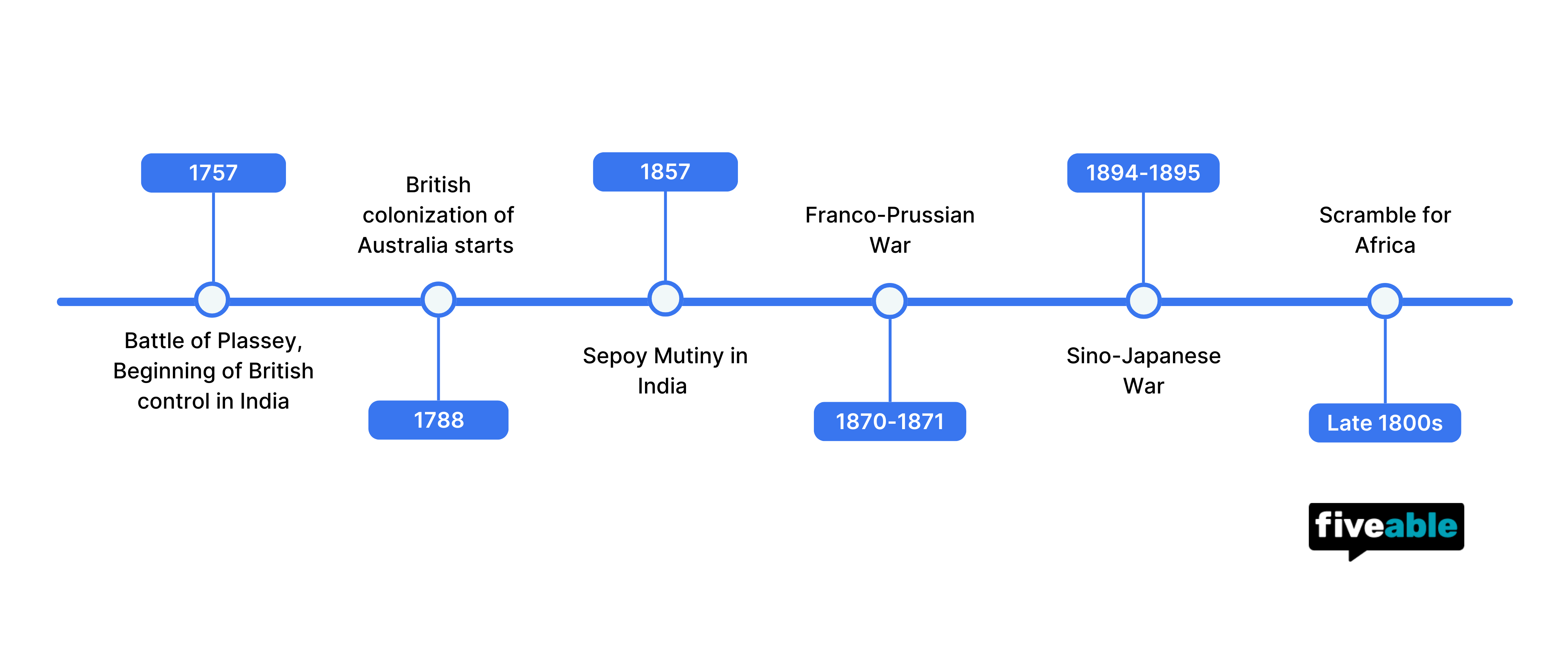
Key Timeline of Imperialism (1750-1900): Pivotal events marking the rise of global empires and the reshaping of world politics
Image Courtesy of Nora Anzer
Key Takeaways
- Nationalism pushed countries to seek colonies as proof of greatness; Britain expanded after losing its American colonies, France expanded after defeat by Prussia, and newly unified Italy and Germany sought prestige.
- Japan's victory in the Sino-Japanese War pushed China out of Korea and gave Japan control of Taiwan, establishing it as an imperial power.
- Colonizers claimed they were helping the people they ruled, while false racial theories and Social Darwinism were used to justify imperialism.
- Missionaries spread Christianity and provided schools and medical care, but critics argued their work opened the door to imperialism and economic gain.
- Chartered trading companies gained commercial rights from local rulers, and some raised armies and took territory to form colonies.
- Industrialization increased demand for colonial raw materials, food, markets, and low-wage labor, fueling competition among imperial powers.
Nationalist Motives for Imperialism
Nationalism, the strong identification with and loyalty to one's nation-state, pushed countries to compete for colonies as proof of national greatness. The 1800s in Western Europe were defined by revolutions, rising nationalism, and the creation of nation-states. Building an empire in Asia or Africa was a way to flex national identity on the global stage.
Britain and France Expand
Britain looked for new lands after losing its American colonies, and France used empire to rebuild its pride after a military humiliation.
- The first British settlers arrived in 1788 in the colony of New South Wales on the east coast of today's Australia (originally a penal colony).
- Britain gradually took control of India from the East India Company. Control began with the Battle of Plassey in 1757 and, by 1857, Britain controlled the entire Indian subcontinent.
- Britain also held Ceylon (Sri Lanka), Burma (Myanmar), the Malay States (including Singapore), and parts of Borneo in Southeast Asia.
- France compensated for its defeat by Prussia in the Franco-Prussian War (1870-1871) by expanding overseas. It already held Algeria in North Africa, Senegal in West Africa, Indochina in Southeast Asia, and New Caledonia and other South Pacific islands.
The Newcomers and the Has-Been
Italy and Germany were both newly unified states in the late 19th century. Each wanted colonies for economic and strategic reasons, but also simply for prestige. Neither started acquiring an empire until the mid-1880s.
Spain is the contrast case. It led the first wave of imperialism in the 16th and 17th centuries, but its power had faded so much by the 19th century that it played no dominant role in this second wave. That first wave vs. second wave distinction is a useful comparison for essays.
Japan in East Asia
Japan proved that imperialism wasn't just a European project. Japanese incursions into Korea irritated China, which had exerted a strong presence there for centuries. The conflict became the Sino-Japanese War (1894-1895). Japan won, pushing China out of Korea and seizing Taiwan (called Formosa from the era of Portuguese colonization in the 16th century until the end of World War II). The victory announced Japan's arrival as an imperial power.
Cultural and Religious Motives for Imperialism
Imperial powers told themselves they were helping the people they colonized. Kipling's poem captures the attitude: colonized peoples are described as "half-devil and half-child," and colonizers cast themselves as benevolent protectors on a "civilizing mission" rather than as invaders.
Racial Ideologies and the Misuse of Science
Colonial powers generally believed they were inherently superior to the people they subjugated, and pseudoscience gave that racism a fake stamp of authority.
- Pseudoscientists presented theories as science even though they were incompatible with the scientific method. Phrenologists studied skull sizes and shapes and claimed smaller skulls proved the mental "feebleness" of Africans, indigenous Americans, and Asians. These ideas have been proven false.
- Legitimate science got twisted too. Charles Darwin's theory of evolution by natural selection held that biological competition "weeded out" weaker species over millions of years. Some thinkers applied this to human societies, creating Social Darwinism.
- Darwin himself was not a Social Darwinist. But advocates used "survival of the fittest" to argue that European and U.S. power proved white biological superiority, and writers and politicians used that claim to justify more imperialism.
Cultural Ideologies
Pointing to their technological edge over indigenous societies, colonizers felt justified in imposing their own cultures on colonies. For administrative convenience, colonies often lumped together peoples with different languages and customs, and the colonizer's language became a unifying tool. Colonial powers also exported their political, educational, and religious institutions, and even influenced architecture and recreation.
Congregationalist minister Josiah Strong put the mindset bluntly in 1885, predicting the Anglo-Saxon race was "destined to dispossess many weaker races, assimilate others, and mold the remainder" until it had "Anglo-Saxonized mankind."
Religious Motives
Missionaries were among the most tireless "civilizing" influences. Just as Spanish and Portuguese Catholic missionaries combined conquest and evangelism during the Age of Discovery, British Protestant missionaries of the 18th and 19th centuries participated in colonization.
Critics argued missionaries paved the way for imperialism by persuading people to abandon traditional beliefs like ancestor veneration and adopt Christianity, opening the door for those focused on economic gain. Missionaries countered that they combined religion with humanitarian work:
- They set up schools that taught religion plus secular subjects, preparing students to become teachers, lawyers, and other professionals.
- Many provided improved medicines and medical care.
- Some, most famously David Livingstone of Scotland, worked in Sub-Saharan Africa to end the illegal slave trade.
Economic Motives for Imperialism
Some historians argue the ideologies above were really just cover stories for the pursuit of profit. Companies chartered by the British, French, and Dutch governments signed commercial treaties with local rulers in India, East Africa, and the East Indies, gaining rights to build trading posts and forts. These companies originally formed for the spice trade, but many held quasi-governmental powers, raising armies and conquering territory to form colonies. A private company with its own army is the key idea here.
East India Company (EIC)
The English monarch granted the EIC a royal charter in 1600, giving it a monopoly on England's trade with India. After driving out the Portuguese, it traded primarily in cotton, silk, indigo, and spices. By the early 18th century it was the major agent of British imperialism in India, and after 1834 it served as the British government's managing agency there. Its record was ugly: it engaged in the slave trade starting in 1620 and illegally exported opium to China in exchange for tea during the 19th century. (After 1707 it's often called the British East India Company to distinguish it from the Dutch company.)
Dutch East India Company (VOC)
In 1602 the Dutch government gave the VOC (Vereenigde Oost-Indische Compagnie) a monopoly on trade between the Cape of Good Hope and the Straits of Magellan. The VOC concentrated on the islands around Java, replacing the Portuguese there. Corruption and debt led the Dutch government to take over the company's possessions in 1799, creating the Dutch East Indies (today's Indonesia).
The "New Imperialism"
The Industrial Revolution turbocharged the economic logic of empire. After the Napoleonic Wars, Britain was the world's leading economic power through the first half of the 19th century, and its colonies fed that economy in two directions:
- Colonies supplied raw materials for factories (cotton, wool, jute, vegetable oils, rubber) and foodstuffs for growing cities (wheat, tea, coffee, cocoa, meat, butter).
- Colonies, especially settler colonies like Australia, New Zealand, and South Africa, served as markets for British manufactured goods.
As the Second Industrial Revolution progressed, other nations challenged Britain's lead and looked to Asia, Africa, and the Pacific for markets, raw materials, and food. Demands for low-wage labor, market access, and control of natural resources fueled fierce competition among imperial powers. That competition sets up the Scramble for Africa and the state expansion covered in AMSCO 6.2 State Expansion notes.
Key Terms to Know
| Term | Why it matters |
|---|---|
| Imperialism | The policy of extending a country's power over other territories; the central concept of all of Unit 6. |
| Nationalism | Strong identity and loyalty to one's nation-state, which drove powers to seek colonies as proof of national greatness. |
| "The White Man's Burden" | Rudyard Kipling's 1899 poem, used to justify colonization as a duty to "civilize" supposedly inferior peoples. |
| Civilizing mission | The self-justifying belief that colonizers were benevolent protectors improving colonized peoples, not invaders. |
| Social Darwinism | The misapplication of "survival of the fittest" to human societies, used to claim white superiority and justify empire. |
| Charles Darwin | The British scientist whose theory of evolution by natural selection was twisted by others; he was not a Social Darwinist. |
| Phrenologists | Pseudoscientists who claimed skull size and shape proved the inferiority of nonwhite peoples; their ideas were false. |
| David Livingstone | Scottish missionary who worked in Sub-Saharan Africa to end the illegal slave trade while spreading Christianity. |
| Sino-Japanese War | The 1894-1895 war whose Japanese victory won Taiwan and ended China's influence in Korea, marking Japan as an imperial power. |
| Formosa | The name for Taiwan from 16th-century Portuguese colonization until the end of World War II. |
| East India Company (EIC) | Chartered in 1600 with a monopoly on England's India trade; became the main agent of British imperialism in India. |
| Dutch East India Company (VOC) | Chartered in 1602 with a vast trade monopoly; its Java holdings became the Dutch East Indies (Indonesia) in 1799. |
| Franco-Prussian War | France's 1870-1871 defeat by Prussia, which it compensated for by expanding its overseas empire. |
| Josiah Strong | The minister whose 1885 writing predicted Anglo-Saxons would "Anglo-Saxonize mankind," voicing the cultural ideology of empire. |
| New Imperialism | The second, industrial-era wave of empire-building driven by demand for raw materials, markets, and low-wage labor. |
Practice and Next Steps
These notes pair with the Topic 6.1 Rationales for Imperialism study guide, which frames the same content the way the exam tests it. When you're solid on the why of imperialism, move on to how empires actually grew in AMSCO 6.2 State Expansion and how colonized peoples fought back in AMSCO 6.3 Indigenous Responses.
To check yourself, run through AP World guided practice questions on Unit 6, drill vocabulary with the key terms glossary, and find the rest of the chapter notes on the AMSCO notes unit page.
Frequently Asked Questions
What are the main rationales for imperialism in AP World Topic 6.1?
AMSCO 6.1 groups them into three categories: nationalist motives (empire as proof of national greatness), cultural and religious ideologies (the civilizing mission, Social Darwinism, missionary work), and economic motives (raw materials, markets, and low-wage labor for industrializing economies). The course expects you to explain how these ideologies contributed to imperialism from 1750 to 1900. The Topic 6.1 study guide frames the same content the way the exam tests it.
What is Social Darwinism and was Darwin a Social Darwinist?
Social Darwinism applied Darwin's idea of 'survival of the fittest' to human societies, arguing that European and U.S. power proved white biological superiority and justified imperialism. Darwin himself was not a Social Darwinist; other thinkers adapted his biological theory to society. On the exam, it's a go-to example of an ideology used to justify imperialism between 1750 and 1900.
What was 'The White Man's Burden' and why does AMSCO 6.1 open with it?
It's an 1899 poem by Rudyard Kipling, an English writer raised in British colonial India, urging Western whites to colonize for the supposed good of 'inferior' peoples. Whether Kipling actually supported the idea is unclear, but proponents of imperialism used the poem to justify the civilizing mission. AMSCO opens the chapter with it because it captures the condescending ideology behind 19th-century empire-building.
How was Japan an imperial power in this period, not just Europe?
Japan asserted nationalist pride through incursions into Korea, which triggered the Sino-Japanese War (1894-1895) with China. Japan's victory gave it control of Korea, and it also seized Taiwan (then called Formosa). Japan is the key non-European example of imperialism in Unit 6, so it makes a strong comparison point in essays.
What's the difference between the East India Company and the Dutch East India Company?
The English East India Company (chartered 1600) held a monopoly on England's trade with India, traded cotton, silk, indigo, and spices, and became the main agent of British imperialism in India. The Dutch East India Company (VOC, chartered 1602) held a monopoly between the Cape of Good Hope and the Straits of Magellan and focused on the islands around Java; the Dutch government took over its possessions in 1799, creating the Dutch East Indies (today's Indonesia). Both were chartered companies with quasi-governmental powers, including raising armies and conquering territory.
How does Topic 6.1 show up on the AP World exam?
You need to be able to explain how ideologies like nationalism, Social Darwinism, the civilizing mission, and religious conversion contributed to imperialism from 1750 to 1900. That makes 6.1 prime material for document-based questions and LEQs about the causes of imperialism, where sources like Kipling's poem or Josiah Strong's writing appear as evidence. Try Unit 6 questions in guided practice to see how it's tested.
See Fiveable more often in Google
Mark Fiveable as a preferred source and Google is more likely to show you our guides in Top Stories, with a "preferred" badge in AI Mode and AI Overviews.