

Overview
AMSCO Topic 7.6, Causes of World War II (AMSCO p.503-507), explains how World War II grew out of the unresolved problems of World War I: an unsustainable peace settlement, the global Great Depression, continued imperialist ambitions, and above all the rise of fascist and totalitarian regimes that fueled the aggressive militarism of Nazi Germany under Adolf Hitler. The chapter traces Hitler's rise through the failing Weimar Republic, Nazi persecution of Jews, German territorial grabs from the Rhineland to Poland, and Japan's parallel expansion in Asia. It sits in Unit 7 (Global Conflict, 1900-present) as the bridge between the interwar tensions of Topic 7.5 and the fighting of World War II in Topic 7.7.
The big picture: World War I never really got resolved. Economic instability after the war brought Benito Mussolini and his National Fascist Party to power in Italy in 1922 on promises to rebuild the economy and create a new Italian empire. The Treaty of Versailles saddled Germany with crushing economic terms and territorial losses that bred resentment, and fascist ideology spread from Italy to Germany, where Hitler and the Nazis adopted it.
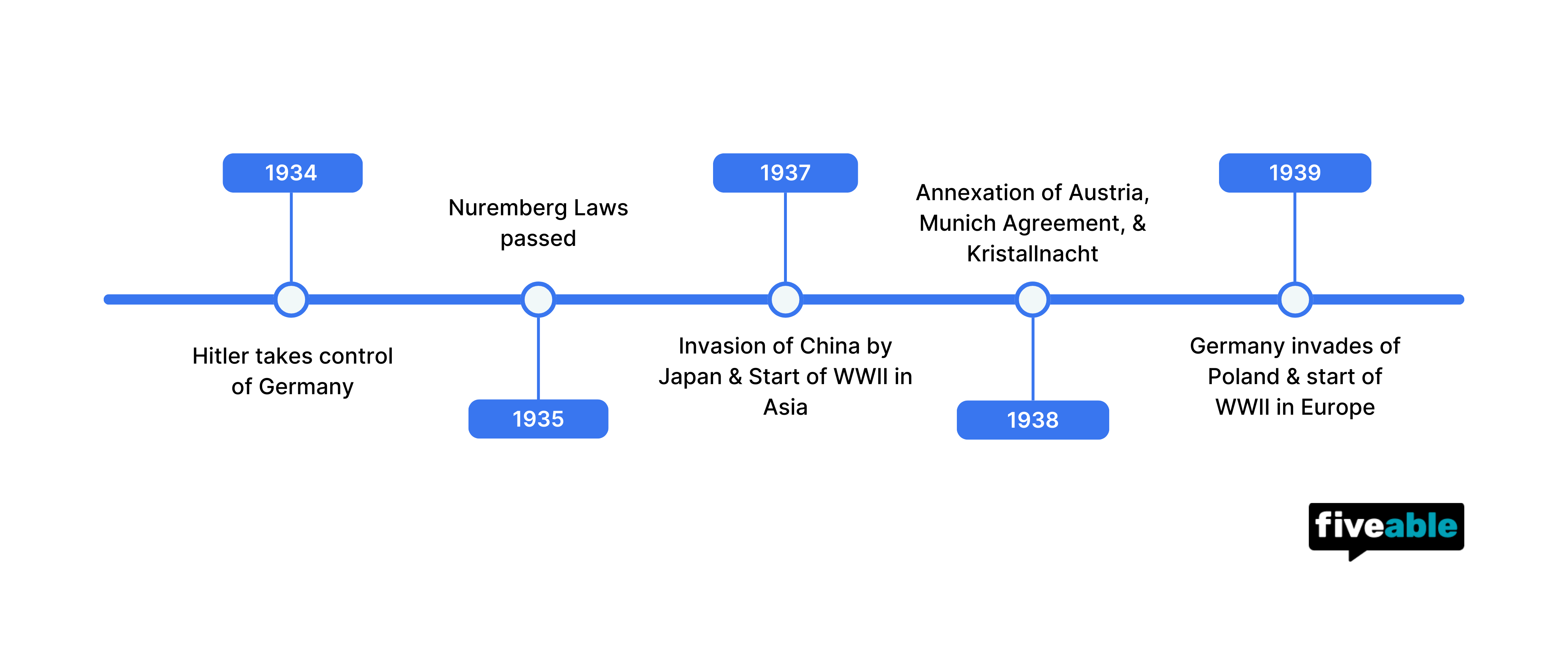
Timeline of events leading to WWII. Image Courtesy of Julia.

The Rise of Hitler and the Nazis
Hitler came to power legally in 1933 because Germans had lost faith in the Weimar Republic and turned to right-wing parties promising strong action. Here's how it happened.
Why the Weimar Republic failed
- After Germany's defeat in 1918, the democratically elected Weimar Republic replaced the kaiser's monarchy.
- Under the Treaty of Versailles, the new government had to pay billions in war reparations and was not allowed to have an army. It looked weak from day one.
- The Great Depression made everything worse. Unemployment swelled, and large numbers of young men (including many WWI veterans) had no job prospects. That alienation and bitterness pushed Germans toward right-wing parties.
How Hitler took control
- Hitler laid out his extreme anti-Semitic views in Mein Kampf ("My Struggle"), which he began writing in 1924 while in a Bavarian prison after a failed coup.
- The National Socialist German Workers' Party (the Nazis) did well in the 1932 parliamentary elections. In early 1933, President Paul von Hindenburg invited Hitler to form a government as chancellor.
- When Hindenburg died in 1934, Hitler declared himself president.
- The Nazis manufactured a sense of emergency to justify dictatorship. They staged the burning of the Reichstag (the German parliament building) and blamed radical extremists. Using "domestic security" as cover, Hitler outlawed all other political parties and all resistance to his rule.
Nazi Persecution of Jews and Other Minorities
Hitler's campaign against German Jews started with discriminatory laws, then escalated to organized violence, all before the war even began.
Ideology of hate
- Hitler promoted ultranationalism and scientific racism, the pseudoscientific claim that certain races are genetically superior to others, plus an extreme anti-Semitism (hostility toward Jews).
- He blamed German Jews for the nation's problems and called for a "pure" Aryan Germany purged of "outsiders": Jews, Slavs, communists, Roma, and gay men and women.
The Nuremberg Laws (1935)
- Forbade marriage between Jews and gentiles (non-Jews).
- Stripped Jews of their citizenship and triggered further decrees pushing Jews to the margins of German society.
- Many German Jews were successful and felt assimilated, which made the treatment shocking.
- Some Eastern European nations, such as Romania and Bulgaria, passed similar anti-Jewish laws.
Kristallnacht (November 1938)
- The "Night of Broken Glass" looked like spontaneous anti-Jewish riots after a Jewish teenager assassinated a German diplomat. In reality, Nazi leaders engineered the whole operation.
- More than 90 German Jews were killed, nearly every synagogue in Germany was destroyed, and some 7,000 Jewish shops were wrecked.
- More than 30,000 Jews were arrested and sent to concentration camps. Most were eventually released on orders to leave Germany, an option that later camp prisoners would not get. (Topic 7.8 on mass atrocities picks up this thread.)
Nazi Germany's Aggressive Militarism and Expansion
Hitler wanted Lebensraum ("living space") for a new German empire, and he openly aimed to conquer the continent. Each move tested whether Britain and France would push back. They didn't, until Poland.
Building the Axis Powers
- October 1936: the Rome-Berlin Axis, a military pact with Fascist Italy built on shared ideology and economic interests.
- The Anti-Comintern Pact, a military alliance with Japan based on mutual distrust of communism.
- Together, Germany, Italy, and Japan formed the Axis Powers.
Breaking the Treaty of Versailles
- March 1935: Hitler announced a German air force and conscription to enlarge the army, both banned by the treaty.
- March 7, 1936: German troops marched into the Rhineland, the 31-mile-wide demilitarized buffer zone between Germany and France. Britain and France protested but did nothing.
- Britain followed a policy of appeasement, giving in to Germany's demands in hopes of keeping the peace. Some British even saw Hitler as a useful anticommunist strongman; others simply dreaded another war.
- Germany's support for the fascist Nationalists in the Spanish Civil War (1936-1939) was another sign of Hitler's growing power. Compare this militarism to the buildup before WWI in Topic 7.2.
Anschluss: annexing Austria (March 1938)
- Hitler pressured the Austrian chancellor with the threat of invasion to hand power to the Austrian Nazi Party.
- Austrian Nazis then let German troops occupy the country without resistance. With the Anschluss (political union), Austria became part of the Third Reich, Hitler's new German empire.
Czechoslovakia and the Munich Agreement (1938-1939)
- September 1938: Hitler demanded the Sudetenland, a Czech border region where most people spoke German, claiming it was a natural extension of his Aryan empire.
- At Munich, British Prime Minister Neville Chamberlain argued appeasement would keep the peace. The Munich Agreement let Hitler annex the Sudetenland in exchange for a promise to take no more Czech territory.
- Fateful miscalculation. Hitler read it as proof Britain wouldn't stand up to him, and in 1939 he invaded and seized all of Czechoslovakia.
Poland: the war begins
- Hitler targeted the Polish port of Danzig. Germany had some historical claims there, but really he just wanted an excuse to invade Poland.
- Britain ended appeasement and agreed to protect Poland. Britain and France also reached out to the Soviet Union for an alliance, but Germany got there first.
- August 23, 1939: the German-Soviet Nonaggression Pact. The two nations pledged not to attack each other, and Hitler secretly offered Stalin control of eastern Poland and the Baltic States if the Soviets stood by during a German invasion of western Poland.
- September 1, 1939: Germany invaded Poland, claiming Poland attacked first. Britain and France declared war on Germany. World War II in Europe had officially begun.
Japan's Expansion in Asia
World War II in Asia started two years before the invasion of Poland. By 1939, Japan had been moving aggressively against Korea and China for almost 50 years.
- 1931: Japan invaded Manchuria and, after several months of fighting, set up the puppet state of Manchukuo under its control.
- 1937: a small incident between Japanese and Chinese troops escalated into a full-scale Japanese invasion of China. This marked the start of World War II in Asia.
Summary: Causes of World War II
For essays and the causation skills in Topic 7.9, sort the causes into categories:
- Diplomatic: the imbalance of the Treaty of Versailles, the failure of appeasement, and the failure of the League of Nations.
- Economic: the global depression and the economic burdens of the Treaty of Versailles.
- Political: Japan's militarism, and Germany's militarism with the rise of Hitler.
Key Terms to Know
| Term | Why it matters |
|---|---|
| Adolf Hitler | Nazi leader who became German chancellor in 1933; his racial ideology and aggressive expansion caused World War II in Europe. |
| Weimar Republic | Germany's post-WWI democratic government; its perceived weakness during the Depression opened the door for the Nazis. |
| Mein Kampf | Hitler's book, begun in prison in 1924, laying out his extreme anti-Semitic views. |
| Nazis | The National Socialist German Workers' Party, which came to power legally after strong results in the 1932 elections. |
| Reichstag | The German parliament building; the Nazis staged its burning to justify outlawing all other parties. |
| Scientific racism | Pseudoscientific theory that some races are genetically superior, used to justify Nazi persecution. |
| Anti-Semitism | Hostility toward Jews; the core of Nazi ideology and propaganda. |
| Aryans | The supposedly "pure" race Hitler claimed Germany had to be purged of "outsiders" to protect. |
| Nuremberg Laws | 1935 laws that stripped German Jews of citizenship and banned marriage between Jews and gentiles. |
| Kristallnacht | The Nazi-engineered "Night of Broken Glass" in November 1938: 90+ Jews killed, synagogues destroyed, 30,000+ arrested. |
| Lebensraum | "Living space," Hitler's justification for seizing territory for a German empire. |
| Rome-Berlin Axis | The October 1936 military pact between Nazi Germany and Fascist Italy. |
| Anti-Comintern Pact | Germany's alliance with Japan based on mutual distrust of communism; with Italy, these formed the Axis Powers. |
| Third Reich | Hitler's name for his new German empire. |
| Anschluss | The political union that made Austria part of the Third Reich in March 1938. |
| Sudetenland | German-speaking Czech border region Hitler annexed under the Munich Agreement. |
| Appeasement | Britain's policy of giving in to Hitler's demands to keep the peace; Chamberlain's Munich Agreement (1938) is the classic example, and it backfired. |
| German-Soviet Nonaggression Pact | The August 1939 deal that freed Hitler to invade Poland, with eastern Poland and the Baltics promised to Stalin. |
Practice and Next Steps
For the College Board's framing of this topic, read the 7.6 Causes of World War II course study guide, then continue to AMSCO 7.7 Conducting World War II. The full chapter series lives on the AP World AMSCO notes page.
To check your understanding, run Unit 7 questions in guided practice, drill causation arguments with FRQ practice and instant scoring, and look up any fuzzy vocab in the key terms glossary.
Frequently Asked Questions
What were the main causes of World War II in AP World?
The four big causes were the unsustainable peace settlement after World War I (the Treaty of Versailles), the global economic crisis of the Great Depression, continued imperialist ambitions, and the rise of fascist and totalitarian regimes, especially Nazi Germany's aggressive militarism under Hitler. AMSCO also sorts causes into diplomatic (Versailles, failed appeasement, failed League of Nations), economic (global depression), and political (German and Japanese militarism) categories.
What is appeasement and why did it fail?
Appeasement was Britain's policy of giving in to Hitler's demands in hopes of keeping the peace, most famously at the 1938 Munich Agreement, where Chamberlain let Hitler annex the Sudetenland in exchange for a promise of no further land grabs. It failed because Hitler read it as proof Britain wouldn't fight back, so he seized all of Czechoslovakia in 1939 and then invaded Poland.
When did World War II actually start?
It depends on the region, and AP World expects you to know both dates. In Europe, the war began on September 1, 1939, when Germany invaded Poland and Britain and France declared war. In Asia, it began in 1937, when a clash between Japanese and Chinese troops escalated into Japan's full-scale invasion of China.
What were the Nuremberg Laws and Kristallnacht?
The Nuremberg Laws (1935) stripped German Jews of citizenship and banned marriage between Jews and gentiles, pushing Jews to the margins of society. Kristallnacht (November 1938) was a Nazi-engineered night of anti-Jewish riots that killed more than 90 German Jews, destroyed nearly every synagogue in Germany and about 7,000 Jewish shops, and sent over 30,000 Jews to concentration camps.
How does Topic 7.6 show up on the AP World exam?
Causes of WWII is prime material for causation questions, so practice ranking causes (Versailles, the Depression, fascism, militarism) and explaining how they connect. It also pairs well with comparison prompts linking WWI and WWII causes. You can drill this with FRQ practice and instant scoring.