30.6 Practical Problems with Discretionary Fiscal Policy

💸Principles of Economics Unit 30 Review
30.6 Practical Problems with Discretionary Fiscal Policy
💸 Principles of Economics
Fiscal Policy Limitations
Fiscal policy is one of the government's main tools for stabilizing the economy, but putting it into practice is far messier than textbook models suggest. Several real-world problems can weaken or even neutralize discretionary fiscal policy. This section covers the economic limitations and the political constraints that get in the way.

Top images from around the web for Interest Rates and Investment
How Government Borrowing Affects Private Saving | OpenStax Macroeconomics 2e View original
Is this image relevant?
Reading: Ricardian Equivalence: How Government Borrowing Affects Private Saving | Macroeconomics View original
Is this image relevant?
Fiscal Policy, Investment, and Economic Growth | OpenStax Macroeconomics 2e View original
Is this image relevant?
How Government Borrowing Affects Private Saving | OpenStax Macroeconomics 2e View original
Is this image relevant?
Reading: Ricardian Equivalence: How Government Borrowing Affects Private Saving | Macroeconomics View original
Is this image relevant?
Interest Rates and Investment (Crowding Out)
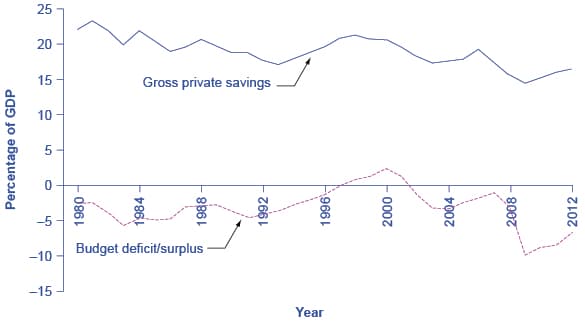
When the government uses expansionary fiscal policy, it borrows more money to finance spending or tax cuts. That extra borrowing increases the demand for loanable funds, which pushes interest rates up. Higher interest rates make it more expensive for businesses to borrow, so private investment falls. This effect is called crowding out, and it partially offsets the stimulus the government was trying to create.
The reverse happens with contractionary fiscal policy. Less government borrowing frees up loanable funds, pushing interest rates down and encouraging private investment. That extra private spending partially offsets the contractionary effect.
The takeaway: fiscal policy doesn't operate in a vacuum. Changes in government borrowing ripple through financial markets and can work against the policy's intended goal.

Policy Lags
One of the biggest practical problems with discretionary fiscal policy is that it takes a long time to work. There are three distinct lags:
-
Recognition lag — Economic data (GDP, unemployment, inflation) is released with a delay, often weeks or months after the fact. By the time policymakers realize the economy has entered a recession or is overheating, conditions may have already changed.
-
Legislative lag — Congress must debate, negotiate, and vote on fiscal policy changes. Partisan disagreements, filibusters, and budget negotiations can stretch this process out for months. The 2011 debt ceiling debate is a good example of how political gridlock slows fiscal action.
-
Implementation lag — Even after a bill is signed into law, it takes time for the policy to actually affect the economy. Infrastructure projects need to be planned and contracted. Tax withholding adjustments take time to show up in paychecks. New spending programs need to hire staff and distribute funds.
Because of these lags, a stimulus package designed for a recession might not hit the economy until the recovery is already underway, potentially adding fuel to an expansion that doesn't need it.

Temporary vs. Permanent Changes
Not all fiscal policy changes have the same punch. Temporary changes tend to have a smaller effect on aggregate demand because people adjust their behavior based on what they expect to last.
- A temporary tax cut is more likely to be saved than spent. During the 2008 recession, many households saved their one-time tax rebate checks rather than spending them, which limited the stimulus effect.
- Temporary spending increases (like one-time stimulus payments) don't give businesses enough confidence to make long-term hiring or investment decisions.
Permanent changes, by contrast, have a larger impact because consumers and businesses feel comfortable adjusting their long-run behavior.
- A permanent tax cut gives households reason to increase their ongoing spending.
- Permanent increases in government spending (such as expanded entitlement programs or sustained defense budgets) can lead to lasting investment and hiring.
This distinction matters for policy design: if the goal is maximum short-run stimulus, temporary measures may underdeliver.
Structural Economic Change
Fiscal policy works best against cyclical problems, the normal ups and downs of the business cycle. It's much less effective at addressing structural changes in the economy, such as the long-term decline of an industry or shifts in the labor market.
- Expansionary fiscal policy can boost overall demand, but it can't bring back jobs in industries that are permanently shrinking (like coal mining or certain manufacturing sectors).
- Contractionary fiscal policy can cool demand-driven inflation, but it can't fix inflation caused by supply-side disruptions like oil price shocks or widespread labor shortages.
Policymakers need to pair short-term fiscal tools with longer-term structural policies (investment in education, infrastructure, and research) to address these deeper economic shifts.
Political Constraints on Fiscal Policy
Even when economists agree on what fiscal policy should do, political realities often prevent it from happening. Several forces shape (and frequently delay) fiscal policy decisions:
- Ideological disagreements — Political parties often disagree fundamentally about the size and role of government. One side may push for tax cuts while the other favors spending increases, leading to gridlock rather than action.
- Deficit and debt concerns — Policymakers worried about long-term fiscal sustainability may resist expansionary policy even during a downturn. Proposals for balanced budget amendments or spending caps can limit the government's ability to run the deficits that stimulus requires.
- Interest group pressure — Lobbying from industries and organized groups can distort fiscal policy away from broad economic goals. Tax loopholes, industry-specific subsidies, and pork-barrel spending projects often reflect political influence rather than sound economic reasoning.
- Election cycles — Politicians facing reelection are reluctant to raise taxes or cut popular programs, even when the economy calls for contractionary policy. They may also favor policies with visible short-term benefits (unfunded tax cuts, deficit-financed spending) while ignoring the long-term costs. This creates a bias toward expansionary policy regardless of economic conditions.
These political constraints help explain why fiscal policy in practice rarely matches the clean, timely adjustments described in economic models. The result is often too little action, too late, or policy shaped more by politics than by economic need.
See Fiveable more often in Google
Mark Fiveable as a preferred source and Google is more likely to show you our guides in Top Stories, with a "preferred" badge in AI Mode and AI Overviews.