33.4 The Benefits of Reducing Barriers to International Trade

💸Principles of Economics Unit 33 Review
33.4 The Benefits of Reducing Barriers to International Trade
Barriers to International Trade

Top images from around the web for Tariffs
4.9 Tariffs – Principles of Microeconomics View original
Is this image relevant?
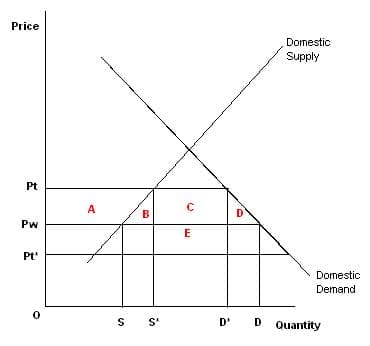
Barriers to Trade | Boundless Economics View original
Is this image relevant?
Tariffs vs. Quotas | Marginal Revolution University View original
Is this image relevant?
4.9 Tariffs – Principles of Microeconomics View original
Is this image relevant?
Barriers to Trade | Boundless Economics View original
Is this image relevant?
Tariffs
A tariff is a tax placed on an imported good. By raising the price of imports, tariffs make foreign products less attractive to domestic consumers and shield local producers from competition.
Here's how the chain of effects works:
- The tariff raises the price of the imported good (think imported steel or electronics).
- At the higher price, consumers buy less of the import, so the quantity of imports falls.
- With less foreign competition, domestic producers can charge higher prices too.
- Consumers end up paying more and having fewer choices, even though domestic firms benefit.
Tariffs can also affect goods you might not expect. When tariffs raise the price of imported raw materials like fruits, vegetables, or lumber, those higher input costs get passed along to consumers in the final product.

Reducing Trade Barriers
Lowering or removing tariffs and other trade barriers produces three major economic benefits:
1. Promotes specialization based on comparative advantage
Comparative advantage means a country can produce a good at a lower opportunity cost than another country. When barriers fall, each country shifts production toward the goods where it holds this advantage. That specialization raises efficiency, enables economies of scale, and drives technological improvement.
2. Increases competition
Foreign firms entering a domestic market force all producers to innovate, improve quality, and cut costs. The result for consumers is lower prices and better products. The drop in electronics prices over the past few decades is a textbook example of this dynamic at work.
3. Expands markets for domestic producers
Trade isn't one-directional. Removing barriers also gives domestic firms access to millions of new customers abroad. Larger markets mean higher sales volume, which lets firms spread fixed costs over more units and achieve economies of scale, further lowering per-unit production costs.

Economic Output and International Trade
International Trade Expands Output
One of the most powerful ideas in trade theory is that trade allows a country to consume beyond its production possibilities curve (PPC). The shows the maximum combination of goods and services a country can produce with its current resources and technology. Without trade, consumption is stuck on or inside that curve. With trade, a country can specialize in what it produces efficiently, export that output, and import goods that would have been costly to make domestically.
This leads to a more efficient allocation of resources:
- Countries import goods that are relatively expensive to produce at home (for example, labor-intensive goods in a high-wage country).
- The resources that would have gone toward producing those expensive goods are freed up and redirected toward industries where the country has a comparative advantage.
Trade also increases the variety of goods and services available to consumers. Access to products from around the world, from foreign car brands to tropical produce, gives consumers more choice, better quality, and improved standards of living overall.
Key takeaway: Without trade, a country is limited to what it can produce on its own. With trade, it can specialize, produce more efficiently, and consume a combination of goods that lies beyond its . That's why economists broadly view reducing trade barriers as a net gain for economic output.
See Fiveable more often in Google
Mark Fiveable as a preferred source and Google is more likely to show you our guides in Top Stories, with a "preferred" badge in AI Mode and AI Overviews.