21.3 What Causes Changes in Unemployment over the Short Run

💸Principles of Economics Unit 21 Review
21.3 What Causes Changes in Unemployment over the Short Run
Factors Influencing Short-Run Unemployment
Short-run unemployment changes when the economy expands or contracts. Unlike structural or frictional unemployment, these shifts are driven by swings in aggregate demand and the fact that wages don't adjust quickly. Understanding this connection between demand, wages, and unemployment is central to explaining business cycles.

Top images from around the web for Labor Demand Shifts
How the AD/AS Model Incorporates Growth, Unemployment, and Inflation | OpenStax Macroeconomics 2e View original
Is this image relevant?
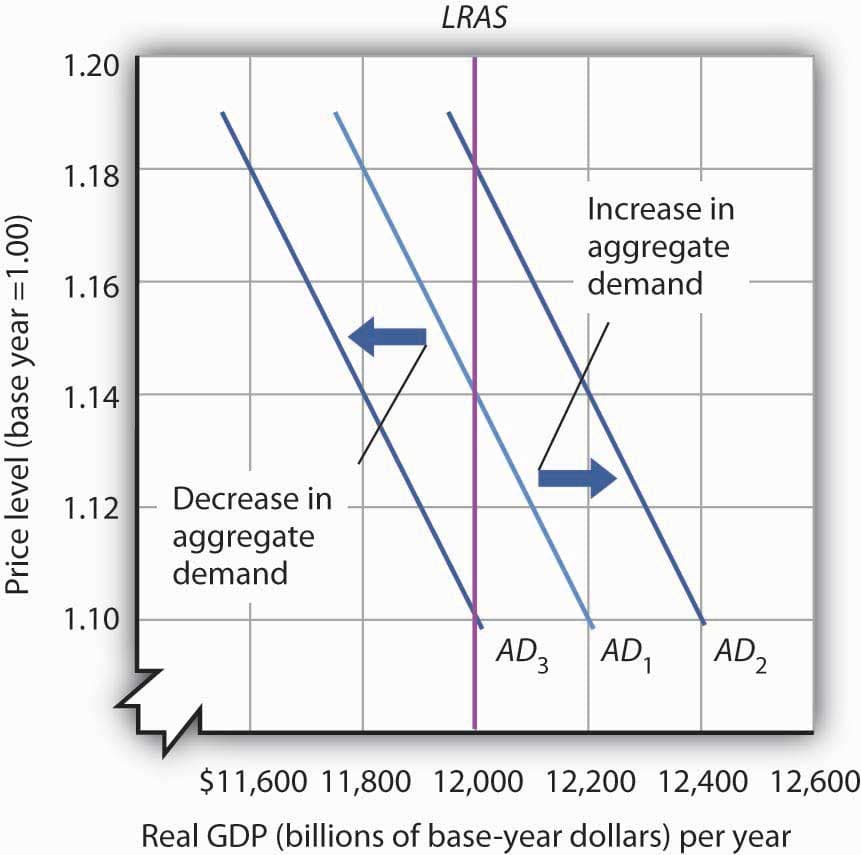
Reading: The Long Run and the Short Run | Macroeconomics View original
Is this image relevant?
Cyclical Unemployment | Macroeconomics View original
Is this image relevant?
How the AD/AS Model Incorporates Growth, Unemployment, and Inflation | OpenStax Macroeconomics 2e View original
Is this image relevant?
Reading: The Long Run and the Short Run | Macroeconomics View original
Is this image relevant?
Labor Demand Shifts
Aggregate demand is the total spending in the economy, and it directly drives how much labor firms need. When aggregate demand rises, firms need more workers to produce more output, so unemployment falls. When aggregate demand drops, firms cut back and lay off workers, so unemployment rises.
Aggregate demand has four components:
- Consumer spending (roughly 70% of U.S. GDP), the single largest driver
- Investment spending (business purchases of equipment, software, and structures)
- Government spending (infrastructure, defense, public services)
- Net exports (exports minus imports)
A change in any of these shifts aggregate demand, which shifts labor demand along with it. During an expansion, rising consumer confidence and business investment push firms to hire. During a recession, falling spending forces firms to cut jobs and reduce output.

Sticky Wages
If wages could drop freely whenever demand fell, the labor market would adjust and unemployment wouldn't spike as much. But in the real world, wages are "sticky downward," meaning they resist falling even when economic conditions weaken. Several forces cause this:
- Efficiency wages: Firms deliberately pay above the market-clearing wage to boost productivity, reduce turnover, and attract higher-quality workers. Cutting pay risks losing your best employees and tanking morale, so firms avoid it even during downturns.
- Implicit contracts: These are unwritten understandings between employers and workers that wages will stay relatively stable. Employers honor them to maintain loyalty and morale, even when the market would justify lower pay.
- Minimum wage laws: A legal wage floor prevents wages from dropping below a set level, regardless of labor market conditions.
- Collective bargaining agreements: Union contracts lock in wage rates for a fixed period (often 2-3 years), preventing downward adjustments even if demand falls mid-contract.
- Menu costs: Changing wages involves real administrative costs like updating payroll systems, renegotiating contracts, and communicating changes. These costs discourage frequent adjustments.
The result is that when a recession hits, wages stay higher than they "should" be given the drop in demand, and that gap creates unemployment.

Labor Market Model
The standard labor market model has two curves:
- A downward-sloping labor demand curve, reflecting the marginal product of labor (firms hire more workers only at lower wages because each additional worker adds less output)
- An upward-sloping labor supply curve, reflecting workers' willingness to supply more labor at higher wages
In a healthy economy, these curves intersect at the market-clearing wage, where everyone who wants a job at that wage can find one.
Here's what changes in a recession:
- Aggregate demand falls, reducing the demand for goods and services.
- Firms need fewer workers, so the labor demand curve shifts left.
- At the new, lower demand level, the market-clearing wage should drop.
- But sticky wages keep the actual wage above that new equilibrium.
- At the stuck-high wage, the quantity of labor supplied exceeds the quantity demanded.
- That surplus of labor is cyclical unemployment.
On a graph, the sticky wage appears as a horizontal line at the current wage rate. Employment is determined where that horizontal line intersects the labor demand curve. When labor demand shifts left (recession), that intersection moves left too, meaning fewer workers are employed. The horizontal distance between the quantity of labor supplied and the quantity demanded at the sticky wage represents cyclical unemployment.
Cyclical unemployment is the type most directly tied to the business cycle. It rises during recessions and falls during expansions. The key takeaway: it exists because wages don't adjust downward fast enough to keep the labor market in equilibrium.
See Fiveable more often in Google
Mark Fiveable as a preferred source and Google is more likely to show you our guides in Top Stories, with a "preferred" badge in AI Mode and AI Overviews.