14.1 The Theory of Labor Markets

💸Principles of Economics Unit 14 Review
14.1 The Theory of Labor Markets
💸 Principles of Economics
Labor Demand
Labor demand comes down to one question: how much extra revenue does each additional worker generate for the firm? Firms keep hiring as long as each new worker brings in more revenue than they cost. Once the cost of hiring one more worker exceeds the revenue that worker produces, the firm stops.
How labor demand works also depends on the market structure the firm operates in. In perfectly competitive markets, firms can't influence the price of their product. In less competitive markets, firms have some pricing power, which changes the math on how many workers they'll hire and at what wage.

Top images from around the web for Marginal revenue product of labor
The Demand for Labor | Microeconomics View original
Is this image relevant?
The Demand for Labor | Microeconomics View original
Is this image relevant?
The Demand for Labor | Public Economics View original
Is this image relevant?
The Demand for Labor | Microeconomics View original
Is this image relevant?
The Demand for Labor | Microeconomics View original
Is this image relevant?
Marginal Revenue Product of Labor
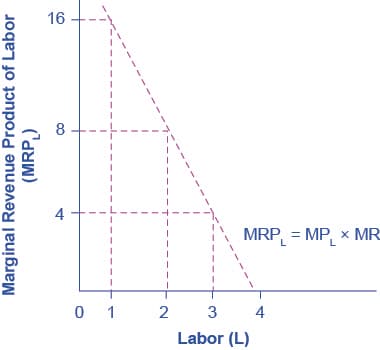
The key concept here is the marginal revenue product of labor (MRPL): the additional revenue a firm earns by employing one more worker. You calculate it by multiplying two things together:
- Marginal product of labor (MPL): the extra output one additional worker produces
- Marginal revenue (MR): the extra revenue the firm earns from selling one more unit of output
The firm's hiring rule is straightforward: keep hiring until MRPL equals the wage rate. At that point, the last worker hired generates exactly enough revenue to cover their wage. Hiring beyond that means the worker costs more than they bring in.

Labor Demand in Different Market Structures
The market structure a firm operates in determines what MR looks like, which directly affects MRPL.
Perfectly competitive product markets:
- The firm is a price taker, so it sells every unit at the market price
- MR equals the market price (P)
- Labor demand is calculated as
Imperfectly competitive product markets:
- The firm faces a downward-sloping demand curve for its product, so selling more units requires lowering the price
- MR is less than the market price (P)
- Labor demand is calculated as
Because MR is lower in imperfectly competitive markets, MRPL is also lower at every level of employment. That means these firms demand less labor at any given wage compared to a perfectly competitive firm with the same MPL. This is one reason why market power in the product market can translate into fewer jobs and lower wages.

Labor Market Equilibrium
Factors Determining the Equilibrium Wage Rate
The equilibrium wage rate is set where labor supply and labor demand intersect, just like price in a product market. Labor supply is the number of workers willing to work at various wage rates, and labor demand is the number of workers firms are willing to hire at those wages.
Several factors can shift each curve:
Factors affecting labor supply:
- Population size and demographics (age distribution, education levels)
- Labor force participation rates: the proportion of the population that is working or actively looking for work
- Alternative employment opportunities, such as jobs in other industries or self-employment
- Non-labor income sources like government benefits, inheritance, or savings (higher non-labor income can reduce the incentive to work, shifting supply left)
Factors affecting labor demand:
- MRPL, which is the core driver
- Output prices: if the price of what the firm sells rises, MRPL increases and labor demand shifts right
- Technology and productivity improvements: these raise MPL, which raises MRPL
- Prices of other inputs like capital or raw materials (if capital becomes cheaper, firms might substitute capital for labor, reducing labor demand)
When any of these factors change, the relevant curve shifts, producing a new equilibrium wage. For example, if worker productivity rises (higher MPL), the labor demand curve shifts to the right. With supply unchanged, the equilibrium wage increases and more workers are employed.
See Fiveable more often in Google
Mark Fiveable as a preferred source and Google is more likely to show you our guides in Top Stories, with a "preferred" badge in AI Mode and AI Overviews.