32.1 The Diversity of Countries and Economies across the World

💸Principles of Economics Unit 32 Review
32.1 The Diversity of Countries and Economies across the World
💸 Principles of Economics
Measuring and Categorizing Economies
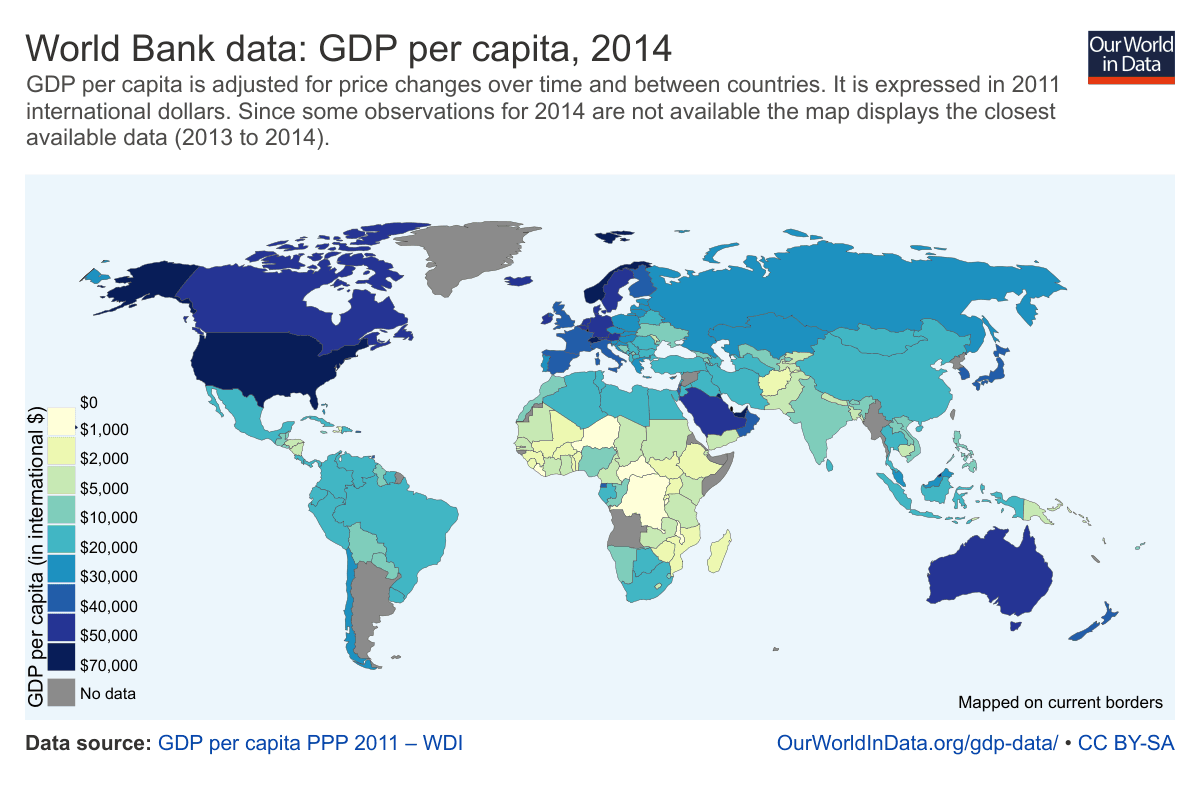
Understanding how economies are measured is the starting point for comparing countries around the world. GDP per capita and GNI per capita are the two most common yardsticks, and international organizations like the World Bank use them to classify countries by income level. These metrics aren't perfect, but they give you a useful baseline for thinking about development.

Top images from around the web for GDP and GNI Per Capita
File:GDP nominal per capita world map IMF figures for year 2005.png - Wikipedia View original
Is this image relevant?
Economic Growth - Our World In Data View original
Is this image relevant?
Political and Economic Differences | Introduction to Business View original
Is this image relevant?
File:GDP nominal per capita world map IMF figures for year 2005.png - Wikipedia View original
Is this image relevant?
Economic Growth - Our World In Data View original
Is this image relevant?
GDP and GNI Per Capita
GDP per capita takes the total value of all goods and services produced within a country's borders and divides it by the population. It's a rough measure of average income and living standards.
GNI per capita is slightly different. It measures the total income earned by a country's residents, regardless of where that income is generated. This means it accounts for international income flows like remittances (money sent home by workers abroad) and returns on foreign investments. For countries where lots of citizens work overseas or where foreign companies dominate domestic production, the gap between GDP and GNI per capita can be significant.
Both metrics have real limitations:
- They don't capture income inequality. A country can have a high GDP per capita while most of its population lives in poverty.
- They miss non-market activities like household production, childcare, and the informal economy.
- They say nothing about quality of life factors such as health outcomes, educational access, or environmental sustainability.
Income Level Classification
The World Bank classifies economies into four groups based on GNI per capita. The thresholds are updated annually; using 2021 figures:
| Classification | GNI Per Capita | Characteristics | Examples |
|---|---|---|---|
| Low-income | $1,045 | Predominantly agricultural; limited infrastructure and human capital | Afghanistan, Haiti, Somalia |
| Lower-middle-income | $1,046 – $4,095 | Transitioning from agriculture toward manufacturing and services; improving infrastructure | India, Nigeria, Vietnam |
| Upper-middle-income | $4,096 – $12,695 | Diversified economies with growing service sectors; relatively strong infrastructure and human capital | Brazil, China, South Africa |
| High-income | $12,696 | Advanced, service-oriented economies; well-developed infrastructure and highly skilled labor | United States, Japan, Germany |
These categories aren't just labels. They determine which countries qualify for certain types of international aid, lending terms, and trade preferences.

Factors Influencing Economic Development
No single factor explains why some countries grow quickly and others stagnate. Development is shaped by the interaction of geography, demographics, industry structure, and institutions.
Geography
Climate and natural resources matter. Favorable agricultural conditions and abundant resources can jumpstart growth, while harsh climates and resource scarcity create persistent obstacles. That said, resource abundance alone doesn't guarantee development (the "resource curse" is a real phenomenon in countries like Nigeria, where oil wealth has coexisted with widespread poverty).
Access to trade routes is equally important. Coastal locations and navigable waterways make it cheaper to move goods and integrate into global markets. Landlocked countries face significantly higher transportation costs, which acts as a drag on trade and growth.

Demographics
Population growth and age structure directly affect per capita income. Rapid population growth can strain resources and slow improvements in living standards. On the other hand, a large working-age population relative to dependents creates a demographic dividend, boosting productivity and savings.
Human capital is the other side of the demographic equation. Investment in education and skills development raises productivity and supports innovation. Poor health outcomes and malnutrition do the opposite, reducing the workforce's potential and limiting what an economy can achieve.
Industry Structure
Economies tend to follow a pattern as they develop: they shift from agriculture to manufacturing and eventually toward services. This structural transformation usually comes with rising incomes and productivity.
- Diversification reduces vulnerability. An economy dependent on a single export commodity is exposed to price swings and sector-specific shocks.
- Technological advancement drives competitiveness. Countries that adopt and develop new technologies see productivity gains, while those that fall behind technologically find it harder to catch up.
Institutions
Strong institutions may be the single most important long-run driver of development.
- Political stability and governance: Stable, effective governments create an environment where businesses can plan and invest. Corruption, armed conflict, and weak state capacity undermine those conditions.
- Property rights and rule of law: When people trust that their property is secure and contracts will be enforced, they're far more willing to invest and start businesses. Weak legal frameworks deter both domestic entrepreneurship and foreign investment.
The interaction between these factors matters as much as any single one. A country with abundant natural resources but weak institutions (poor governance, corruption) may grow more slowly than a resource-poor country with strong rule of law and educated citizens.
See Fiveable more often in Google
Mark Fiveable as a preferred source and Google is more likely to show you our guides in Top Stories, with a "preferred" badge in AI Mode and AI Overviews.