18.2 Special Interest Politics

💸Principles of Economics Unit 18 Review
18.2 Special Interest Politics
💸 Principles of Economics
Special Interest Groups and Political Influence

Top images from around the web for Special Interest Groups
Pathways of Interest Group Influence | American National Government View original
Is this image relevant?
Interest Groups as Political Participation – American Government (2e) View original
Is this image relevant?
Interest Groups: Who or what are they? | United States Government View original
Is this image relevant?
Pathways of Interest Group Influence | American National Government View original
Is this image relevant?
Interest Groups as Political Participation – American Government (2e) View original
Is this image relevant?
Special Interest Groups
A special interest group is any organization that advocates for specific policies or issues on behalf of its members. Labor unions, business associations, trade groups, and environmental organizations all fall into this category. These groups exist because individuals with shared interests can accomplish more by pooling resources than by acting alone.
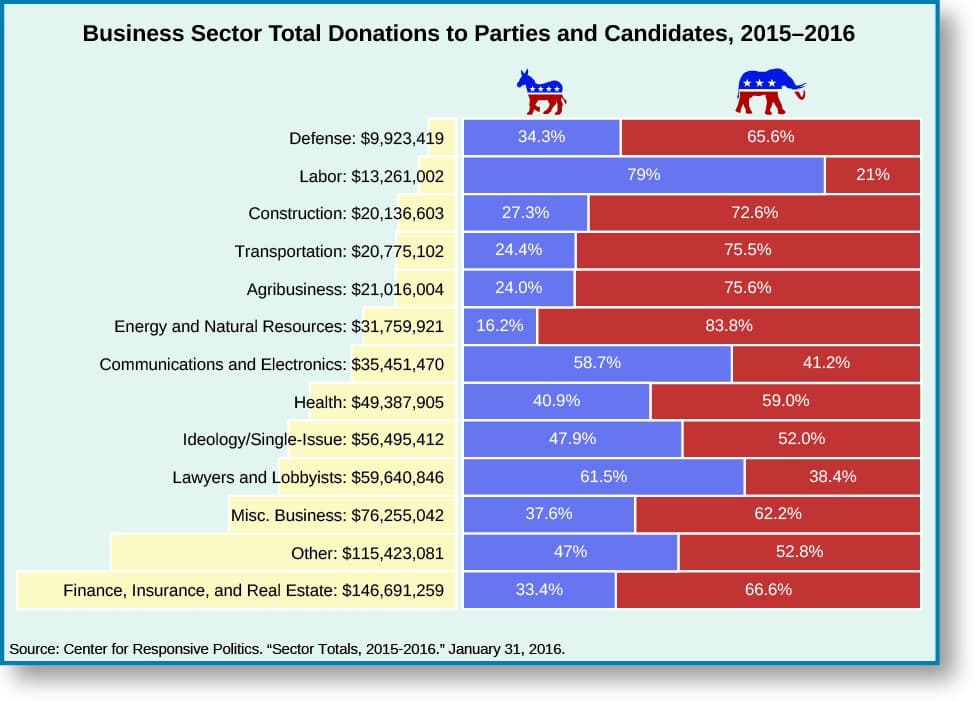
Special interest groups influence politics through two main channels:
Campaign influence:
- Contributing money to candidates who support their positions
- Endorsing aligned candidates publicly
- Mobilizing voters and volunteers during elections
Policymaking influence:
- Lobbying legislators and government officials directly
- Providing specialized information and expertise on their issues
- Mobilizing public opinion to pressure policymakers
The result is that policies sometimes favor narrow interests rather than the broader public good. This isn't necessarily because politicians are corrupt. It's because special interest groups are organized, well-funded, and persistent, while the general public often isn't paying close attention to any single issue.

Pork-Barrel Spending and Logrolling
Pork-barrel spending refers to government spending on local projects that primarily benefit a specific district or constituency, like funding for a local museum, bridge, or highway project. These items are often tucked into larger legislation to secure votes from the representatives of those districts.
Logrolling is the practice of legislators trading votes with each other. Here's how it works:
- Representative A wants funding for a highway in her district.
- Representative B wants funding for a research facility in his district.
- Neither project would win a majority vote on its own merits.
- A and B agree to vote for each other's project, and they recruit other legislators to do the same by offering reciprocal support.
The problem with both practices is that they allocate government resources based on political deal-making rather than economic merit or public need. Projects that wouldn't pass a straightforward cost-benefit analysis get funded because the political incentives line up.

Economic Impacts of Concentrated Benefits and Dispersed Costs
Concentrated Benefits vs. Dispersed Costs
This concept explains why special interest politics works so well. Some policies deliver large benefits to a small group while spreading the costs thinly across millions of people.
Consider a tariff on imported sugar. U.S. sugar producers gain substantial profits from reduced foreign competition. Each individual consumer, though, pays only a few extra dollars per year in higher prices. Multiply that across the entire population and the total cost to society is enormous, but no single person has enough at stake to fight it.
This asymmetry creates a predictable pattern:
- Concentrated groups (like sugar producers) have strong incentives to organize and lobby. The potential payoff per member is high, and coordinating a small group is relatively easy.
- Dispersed groups (like consumers) have weak incentives to organize and oppose these policies. The individual cost is low, and coordinating millions of people around a single issue is extremely difficult.
The economic consequences are real:
- Resources get diverted from more productive uses toward less productive ones favored by special interests
- Consumers pay higher prices or face fewer choices due to reduced competition and market distortions
- Total costs to society can outweigh the benefits, yet the policy persists because the political pressure from the concentrated group is far stronger than any opposition from the dispersed public
This is one of the core reasons why policies that fail a basic cost-benefit test can survive for decades. Policymakers face intense, organized pressure to support concentrated benefits, while the diffuse costs generate little organized resistance.
See Fiveable more often in Google
Mark Fiveable as a preferred source and Google is more likely to show you our guides in Top Stories, with a "preferred" badge in AI Mode and AI Overviews.