29.4 Exchange Rate Policies

💸Principles of Economics Unit 29 Review
29.4 Exchange Rate Policies
💸 Principles of Economics
Exchange Rate Regimes
An exchange rate regime is the system a country uses to determine the value of its currency relative to others. The choice of regime shapes how much control a country has over its monetary policy, how stable its currency is, and how it interacts with global trade and capital markets.
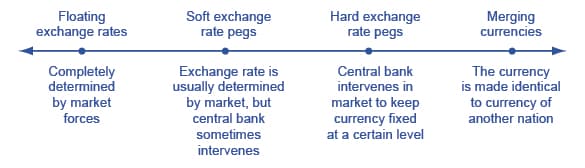
There are three main types: floating, pegged, and merged currencies. Each involves a fundamental tradeoff between flexibility and stability.

Top images from around the web for Floating, Pegged, Merged Currencies
Exchange-Rate Policies | Microeconomics View original
Is this image relevant?
Reading: Exchange-Rate Policies | Microeconomics View original
Is this image relevant?
A Model To Explain The Monetary Trilemma Using Tools From Principles of Macroeconomics View original
Is this image relevant?
Exchange-Rate Policies | Microeconomics View original
Is this image relevant?
Reading: Exchange-Rate Policies | Microeconomics View original
Is this image relevant?
Floating Exchange Rates
A floating exchange rate is determined by market forces of supply and demand, without direct central bank intervention. If demand for a currency rises (say, because foreign investors want to buy that country's assets), the currency appreciates. If demand falls, it depreciates.
- Allows automatic adjustment to economic shocks. If a country enters a recession, its currency tends to weaken, which makes its exports cheaper and can help the economy recover.
- Gives the central bank full monetary policy autonomy. It can raise or lower interest rates based on domestic needs like inflation or unemployment, without worrying about defending a fixed exchange rate.
- The downside is volatility. Exchange rates can swing significantly in short periods, creating uncertainty for businesses engaged in international trade and for foreign investors.
The U.S. dollar, Japanese yen, and British pound all float freely.
Pegged Exchange Rates
A pegged (or fixed) exchange rate is one where a country's central bank commits to keeping its currency at a set value relative to another currency or a basket of currencies. The central bank actively buys or sells foreign exchange reserves to maintain the peg.
- Provides stability and predictability, which is especially valuable for small, open economies that depend heavily on trade with the anchor-currency country.
- Reduces exchange rate risk for businesses and investors, encouraging cross-border trade and investment.
- The tradeoff: the central bank loses monetary policy autonomy. To maintain the peg, it must align its interest rates closely with the anchor country's rates, even if domestic conditions call for something different. It also needs large foreign exchange reserves to defend the peg if market pressure pushes against it.
The Hong Kong dollar is pegged to the U.S. dollar, and the Danish krone is pegged to the euro.

Merged Currencies
A merged currency (or currency union) occurs when multiple countries adopt a single shared currency, completely eliminating exchange rate fluctuations among them.
- Eliminates transaction costs and exchange rate risk within the union, making trade and investment between member countries much easier.
- Requires a supranational central bank (like the European Central Bank) to set a single monetary policy for all members.
- The major drawback: individual countries give up all monetary policy independence. A single interest rate must serve economies that may be in very different conditions. For example, during the 2010s European debt crisis, countries like Greece needed looser monetary policy, but the ECB had to consider the entire Eurozone.
The euro, used by 20 Eurozone countries, is the most prominent example.
Exchange Rate Policy Tradeoffs
The core tradeoff across all three regimes is monetary policy autonomy versus currency stability. You can visualize it as a spectrum:
More autonomy → Floating → Pegged → Merged → More stability
| Feature | Floating | Pegged | Merged |
|---|---|---|---|
| Monetary policy autonomy | High | Limited | None |
| Currency stability | Low | High | Highest (within union) |
| Exchange rate risk for trade | Higher | Lower | Eliminated (within union) |
| Ability to respond to domestic shocks | Strong | Weak | Weakest |
No regime is objectively "best." The right choice depends on a country's size, openness to trade, economic structure, and political relationships.

Exchange Rate Movements, Trade, and Capital Flows
Changes in exchange rates directly affect a country's trade balance and the direction of capital flows.
Currency Appreciation
When a currency appreciates (gains value relative to other currencies):
- Exports become more expensive for foreign buyers, reducing export competitiveness. A stronger dollar means American-made goods cost more in euros or yen.
- Imports become cheaper for domestic buyers, increasing import demand. Consumers benefit from lower prices on foreign goods, but the trade balance may worsen.
- Capital inflows tend to increase because foreign investors are attracted to assets denominated in the stronger currency, expecting higher returns.
Currency Depreciation
When a currency depreciates (loses value relative to other currencies):
- Exports become cheaper for foreign buyers, boosting export competitiveness. A weaker yen makes Japanese cars more affordable in the U.S.
- Imports become more expensive for domestic buyers, reducing import demand. This can improve the trade balance but raises costs for consumers and businesses that rely on imported goods.
- Capital outflows may increase as domestic investors look abroad for better returns, since foreign assets are now relatively more valuable.
These effects don't happen instantly. In the short run, a depreciation can actually worsen the trade balance before improving it (a pattern economists call the J-curve effect), because existing trade contracts take time to adjust and import prices rise before export volumes have a chance to increase.
See Fiveable more often in Google
Mark Fiveable as a preferred source and Google is more likely to show you our guides in Top Stories, with a "preferred" badge in AI Mode and AI Overviews.