23.1 Measuring Trade Balances

💸Principles of Economics Unit 23 Review
23.1 Measuring Trade Balances
💸 Principles of Economics
Measuring Trade Balances
Trade balances tell you whether a country is sending more money abroad or receiving more from the rest of the world. They're one of the most direct ways to assess a nation's economic relationship with its trading partners. This section covers the key types of balances, what goes into each one, and how to calculate them.

Top images from around the web for Merchandise Trade Balance, Current Account Balance, and Unilateral Transfers
Fiscal Policy and the Trade Balance | OpenStax Macroeconomics 2e View original
Is this image relevant?
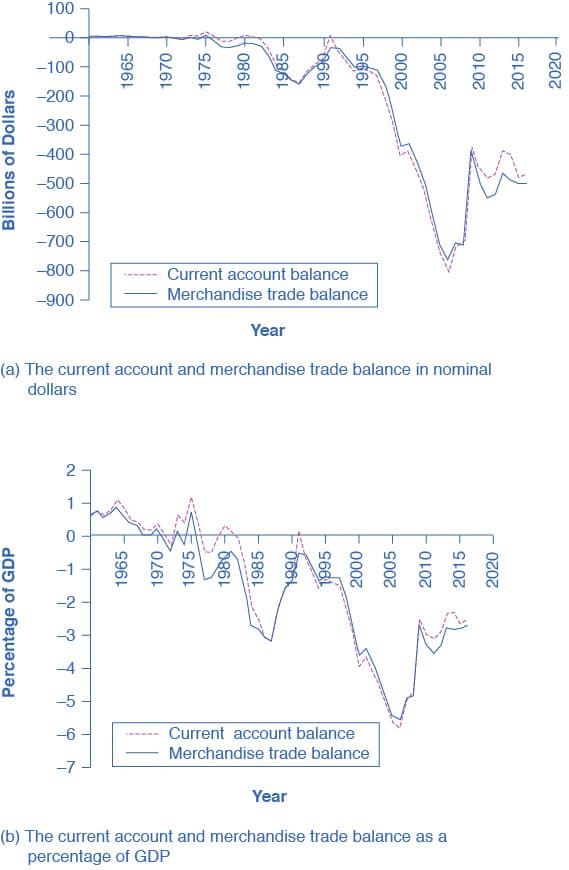
Trade Balances in Historical and International Context | OpenStax Macroeconomics 2e View original
Is this image relevant?
Trade Balances and Flows of Financial Capital – Principles of Economics: Scarcity and Social ... View original
Is this image relevant?
Fiscal Policy and the Trade Balance | OpenStax Macroeconomics 2e View original
Is this image relevant?
Trade Balances in Historical and International Context | OpenStax Macroeconomics 2e View original
Is this image relevant?
Measuring International Trade and Capital Flows

Merchandise Trade Balance, Current Account Balance, and Unilateral Transfers
The merchandise trade balance is the simplest measure. It tracks only physical, tangible goods shipped between countries (cars, oil, electronics, agricultural products). Services and financial flows are excluded.
The current account balance is a broader measure that includes the merchandise trade balance as just one component. It captures the overall flow of goods, services, investment income (interest, dividends, profits from foreign direct investment), and unilateral transfers between a country and the rest of the world. If you want the full picture of money moving in and out, this is the number to look at.
Unilateral transfers are one-way flows of assets with nothing sent back in return. Think of foreign aid a government sends to another country, remittances that migrant workers send to family back home, or gifts between individuals across borders. These transfers are included as a component of the current account balance.

U.S. Current Account Balance Components
The U.S. current account has four components:
- Merchandise trade balance: Exports minus imports of goods. The U.S. has run a trade deficit here for decades, meaning imports of goods consistently exceed exports.
- Trade in services: Exports minus imports of services, including tourism, transportation, financial services, and intellectual property licensing. The U.S. typically runs a surplus in services.
- Investment income: Income earned by U.S. investors on foreign assets (interest, dividends, profits) minus income earned by foreign investors on U.S. assets. This reflects the returns flowing from cross-border investments in both directions.
- Unilateral transfers: Net one-way flows such as foreign aid and remittances. The U.S. is generally a net sender of unilateral transfers, so this component is usually negative.
Calculating Merchandise Trade Balance and Current Account Balance
A positive balance means a surplus (more flowing in), and a negative balance means a deficit (more flowing out).
Here's how to work through a full calculation:
- Exports of goods: $100 billion
- Imports of goods: $120 billion
- Exports of services: $50 billion
- Imports of services: $40 billion
- Investment income received: $30 billion
- Investment income paid: $20 billion
- Net unilateral transfers received: $5 billion
Step 1: Merchandise trade balance
Step 2: Services balance
Step 3: Investment income balance
Step 4: Add all components for the current account balance
Notice that even though the U.S. ran surpluses in services and investment income in this example, the large merchandise trade deficit still pulled the overall current account into deficit. That pattern is common in practice: the goods deficit tends to be the biggest driver of the U.S. current account deficit.
See Fiveable more often in Google
Mark Fiveable as a preferred source and Google is more likely to show you our guides in Top Stories, with a "preferred" badge in AI Mode and AI Overviews.