30.2 Taxation

💸Principles of Economics Unit 30 Review
30.2 Taxation
💸 Principles of Economics
Tax Structures and Sources of Government Revenue
Tax structures determine who bears the burden of funding government services, and different structures distribute that burden very differently across income levels. Understanding these structures helps you analyze debates about tax fairness and evaluate how governments actually raise revenue.

Top images from around the web for Regressive, Proportional, Progressive
Local Taxes Are Naturally Regressive | CEPR Blog | CEPR View original
Is this image relevant?
Progressive, Proportional, and Regressive Taxes | Boundless Economics View original
Is this image relevant?
Tax Incidence | Microeconomics View original
Is this image relevant?
Local Taxes Are Naturally Regressive | CEPR Blog | CEPR View original
Is this image relevant?
Progressive, Proportional, and Regressive Taxes | Boundless Economics View original
Is this image relevant?
Regressive, Proportional, and Progressive Taxes
These three structures describe the relationship between someone's income and the percentage of that income they pay in taxes.
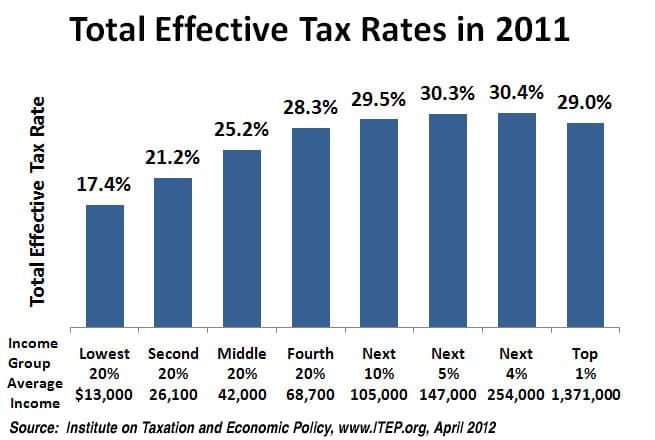
- Regressive tax: The tax rate (as a share of income) decreases as income rises. Lower-income taxpayers end up paying a higher percentage of their income than higher-income taxpayers. Sales taxes are the classic example: if two people each pay 8% sales tax on a $50 purchase, that $4 matters a lot more to someone earning $20,000 than to someone earning $200,000. Excise taxes and payroll taxes are also regressive.
- Proportional tax (also called a flat tax): Everyone pays the same percentage of their income, regardless of how much they earn. If the rate is 15%, someone earning $30,000 pays $4,500 and someone earning $300,000 pays $45,000. The dollar amounts differ, but the rate stays constant.
- Progressive tax: The tax rate increases as income rises. Higher-income taxpayers pay a larger percentage of their income. The U.S. federal income tax works this way, using marginal tax brackets where each additional chunk of income is taxed at a higher rate. Estate taxes are also progressive.
A common misconception: in a progressive system, moving into a higher tax bracket doesn't mean all your income gets taxed at the higher rate. Only the income within that bracket does.

Federal Revenue Sources
The federal government draws revenue from several sources, but two dominate:
- Individual income taxes are the largest source of federal revenue, accounting for roughly half of all federal receipts. These are collected through payroll withholding during the year and reconciled when you file an annual tax return.
- Payroll taxes are the second-largest source. They fund Social Security and Medicare specifically, and both employees and employers split the cost (each paying 7.65% of wages, for a combined 15.3%).
Beyond those two major sources:
- Corporate income taxes are levied on the profits that corporations earn.
- Excise taxes target specific goods or services, such as gasoline, tobacco, and alcohol.
- Estate and gift taxes apply to the transfer of wealth. Estate taxes are paid when assets pass from a deceased person to heirs, and gift taxes apply to transfers above a certain threshold while the giver is still alive.
- Customs duties are taxes on imported goods.
- Miscellaneous sources include Federal Reserve System earnings, fees, fines, and penalties.

State and Local Revenue Sources
State and local governments rely on a different mix of revenue than the federal government does.
- Property taxes are the primary revenue source for local governments. They're based on the assessed value of real estate (and sometimes personal property like vehicles). This is why local school funding often varies so much between wealthy and lower-income areas.
- Sales taxes are levied on the sale of goods and services. Rates vary widely by state and locality, and some states (like Oregon) have no sales tax at all.
- State income taxes exist in most states on top of the federal income tax, though rates and bracket structures differ significantly. A few states, like Texas and Florida, have no state income tax.
- Excise taxes at the state level target specific products such as cigarettes, fuel, and hotel stays.
- Corporate income taxes are levied by some states on corporate profits earned within their borders.
- Fees and charges are collected for specific government services: driver's license fees, park entrance fees, building permits, and similar items.
- Intergovernmental transfers are funds received from the federal government (or from state governments flowing down to localities). These include grants, revenue sharing, and targeted aid for education or transportation projects. For many local governments, these transfers make up a significant share of their budgets.
See Fiveable more often in Google
Mark Fiveable as a preferred source and Google is more likely to show you our guides in Top Stories, with a "preferred" badge in AI Mode and AI Overviews.