28.4 Monetary Policy and Economic Outcomes

💸Principles of Economics Unit 28 Review
28.4 Monetary Policy and Economic Outcomes
💸 Principles of Economics
Monetary policy is how the Federal Reserve influences the economy's overall direction. By adjusting interest rates and the money supply, the Fed can encourage growth during slowdowns or rein things in when inflation runs too hot. Understanding how these tools work, and how they ripple through the economy, is central to this unit.
Monetary Policy

Top images from around the web for Expansionary vs Contractionary Policies
Introduction to Fiscal Policy | Boundless Economics View original
Is this image relevant?
9.4: Monetary Policy - Chemistry LibreTexts View original
Is this image relevant?
Monetary Policy Tools | Boundless Economics View original
Is this image relevant?
Introduction to Fiscal Policy | Boundless Economics View original
Is this image relevant?
9.4: Monetary Policy - Chemistry LibreTexts View original
Is this image relevant?
Expansionary vs. Contractionary Policies
The Fed has two basic stances it can take, depending on what the economy needs.
Expansionary monetary policy aims to stimulate growth and increase aggregate demand. The Fed does this by increasing the money supply and lowering interest rates. Its main tools:
- Open market operations: The Fed buys government securities, which injects money into the banking system.
- Lowering the discount rate: This makes it cheaper for banks to borrow directly from the Fed, encouraging them to lend more.
- Lowering the reserve requirement: Banks are required to hold a certain fraction of deposits in reserve. Lowering that fraction frees up more money for lending.
Contractionary monetary policy does the opposite. It slows growth and reduces aggregate demand by decreasing the money supply and raising interest rates. The tools work in reverse:
- Open market operations: The Fed sells government securities, pulling money out of the banking system.
- Raising the discount rate: Borrowing from the Fed becomes more expensive, so banks lend less.
- Raising the reserve requirement: Banks must hold more in reserve, which restricts how much they can lend.

Interest Rates and Aggregate Demand
Interest rates are the main channel through which monetary policy reaches the real economy.
When the Fed pursues expansionary policy and rates fall:
- Borrowing gets cheaper, so consumers are more willing to take out mortgages, auto loans, and use credit cards.
- Saving becomes less attractive because returns on savings accounts and CDs drop.
- Businesses face lower borrowing costs, making it easier to finance new equipment, buildings, or expansion.
When the Fed pursues contractionary policy and rates rise:
- Borrowing becomes more expensive, which discourages consumer spending on big-ticket items.
- Saving becomes more attractive because returns on savings accounts and bonds increase.
- Businesses cut back on investment because financing costs are higher.
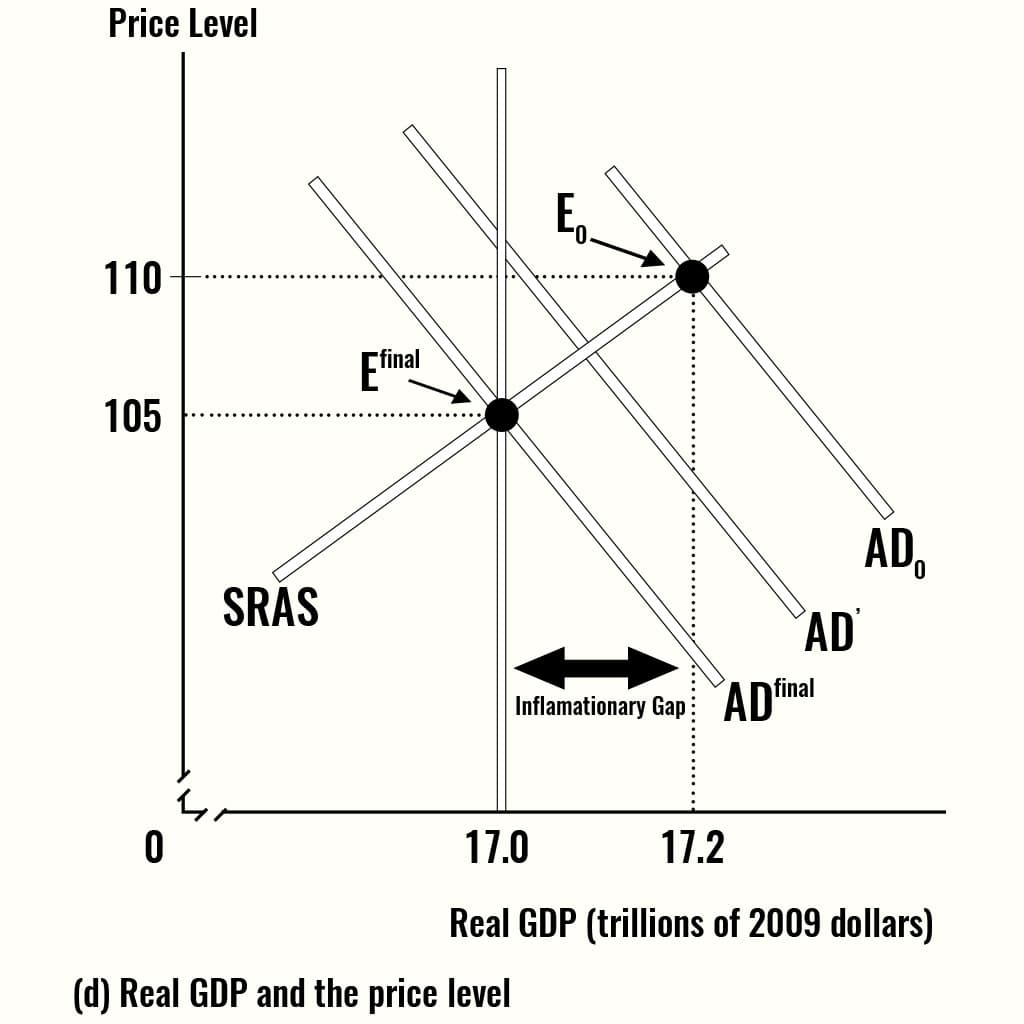
Effect on aggregate demand (AD): Lower interest rates boost AD through multiple components. Consumption (C) rises as financing gets cheaper. Investment (I) rises as businesses borrow more. Net exports (NX) may also increase, because lower rates can cause the dollar to depreciate, making U.S. exports cheaper abroad and imports more expensive at home. Higher interest rates push AD in the opposite direction across all three components.
The transmission mechanism traces this chain of cause and effect:
Read the first line as: money supply increases → interest rates fall → investment and consumption rise → aggregate demand increases.

Federal Reserve's Policy Decisions
Policy Decisions Over Four Decades
Seeing how the Fed has actually used these tools in different situations helps make the theory concrete.
1980s: The Volcker Era
The biggest challenge was runaway inflation, which hit about 14% in 1980. Fed Chair Paul Volcker responded with aggressive contractionary policy, raising the federal funds rate to a peak of roughly 20% in 1981. This dramatically reduced the money supply's growth rate. It worked: inflation fell to around 4% by 1983. But the tradeoff was severe. The tight money triggered a painful recession in 1981–1982, with unemployment climbing above 10%. This is a textbook example of the short-run tradeoff between inflation and unemployment.
1990s: The Greenspan Era
The Fed maintained low, stable inflation (around 3%) through most of the decade. When crises hit, such as the Asian financial crisis in 1997 and the Long-Term Capital Management collapse in 1998, the Fed responded by lowering rates to keep markets functioning. Critics later argued that Greenspan kept rates too low for too long during the mid-to-late 1990s, which may have fueled the dot-com stock bubble (1995–2000).
2000s: Greenspan and Bernanke
After the dot-com crash in 2000 and the 9/11 attacks in 2001, the Fed cut rates sharply to support the economy. Rates stayed low for an extended period, which some economists argue contributed to the housing bubble. When that bubble burst in 2007–2008, it triggered the worst financial crisis since the Great Depression. The Fed, now under Chair Ben Bernanke, slashed the federal funds rate to a range of 0–0.25% and introduced quantitative easing (QE), a new tool involving large-scale purchases of mortgage-backed securities and Treasury bonds to push long-term rates down and inject liquidity into the financial system.
2010s–2020: Bernanke, Yellen, and Powell
Recovery from the financial crisis was slow, so the Fed kept rates near zero and continued QE for years. As the economy strengthened, the Fed gradually raised rates from 2015 to 2018 and began reducing its balance sheet in 2017 by letting bonds mature without replacing them. Then COVID-19 hit in early 2020. The Fed cut rates back to 0–0.25% and relaunched QE on a massive scale, buying Treasury bonds and mortgage-backed securities to stabilize markets and support the economy through the pandemic shutdown.
See Fiveable more often in Google
Mark Fiveable as a preferred source and Google is more likely to show you our guides in Top Stories, with a "preferred" badge in AI Mode and AI Overviews.