29.2 Demand and Supply Shifts in Foreign Exchange Markets

💸Principles of Economics Unit 29 Review
29.2 Demand and Supply Shifts in Foreign Exchange Markets
💸 Principles of Economics
Factors Influencing Currency Demand and Supply
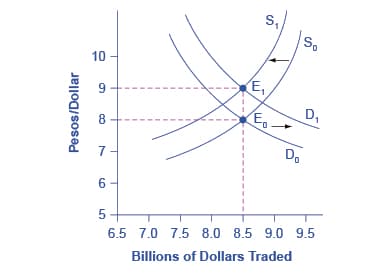
Exchange rates are determined by the demand for and supply of currencies in foreign exchange markets. When demand for a currency rises (or its supply falls), the currency appreciates. When demand falls (or supply rises), it depreciates. Three major factors drive these shifts: expectations about future exchange rates, differences in interest rates across countries, and relative inflation rates.

Top images from around the web for Future Exchange Rate Expectations
Demand and Supply Shifts in Foreign Exchange Markets | OpenStax Macroeconomics 2e View original
Is this image relevant?
Reading: Demand and Supply Shifts in Foreign Exchange Markets | Microeconomics View original
Is this image relevant?
Reading: Demand and Supply Shifts in Foreign Exchange Markets | Macroeconomics View original
Is this image relevant?
Demand and Supply Shifts in Foreign Exchange Markets | OpenStax Macroeconomics 2e View original
Is this image relevant?
Reading: Demand and Supply Shifts in Foreign Exchange Markets | Microeconomics View original
Is this image relevant?
Future Exchange Rate Expectations
Currency markets are heavily driven by what traders expect to happen next. If investors believe a currency will appreciate in the future, they buy it now to profit from the expected gain. That increased demand (and decreased supply, since current holders are less willing to sell) pushes the currency's value up today.
The reverse works the same way: if people expect a currency to lose value, they sell it off quickly, increasing supply and decreasing demand, which causes depreciation right now.
This creates what's called a self-fulfilling prophecy. The expectation of appreciation causes people to buy, which actually causes the appreciation. The expectation of depreciation causes people to sell, which actually causes the depreciation. The belief itself triggers the outcome.

Cross-Country Rate of Return Differences
Investors move money to wherever they can earn the best return. If Country A offers higher interest rates than Country B, foreign investors will want to buy Country A's currency so they can invest there and earn those higher returns. That increased demand causes Country A's currency to appreciate.
- Higher relative interest rates → more foreign capital flows in → demand for the currency rises → appreciation
- Lower relative interest rates → capital flows out to higher-return countries → demand for the currency falls → depreciation
Interest rate parity is the equilibrium condition that ties this together. It states that the difference in interest rates between two countries should equal the expected change in the exchange rate between their currencies. If U.S. interest rates are 2% higher than Japan's, the dollar is expected to depreciate by roughly 2% against the yen over that period. This prevents investors from earning guaranteed profits just by moving money between countries.

Relative Inflation Rates
Inflation erodes a currency's purchasing power, and that shows up in exchange rates. If Country A has higher inflation than Country B, Country A's goods become relatively more expensive. Its exports become less competitive, so foreign buyers demand less of its currency. At the same time, Country A's consumers shift toward cheaper imports, increasing the supply of their own currency on foreign exchange markets. Both effects push the currency toward depreciation.
- Higher relative inflation → exports less competitive, imports more attractive → currency depreciates
- Lower relative inflation → exports more competitive → currency appreciates
Purchasing Power Parity (PPP) formalizes this relationship. PPP says the exchange rate between two currencies should adjust until the same basket of goods costs the same in both countries. The formula is:
where is the exchange rate, is the price level in country 1, and is the price level in country 2. For example, if a basket of goods costs $150 in the U.S. and €100 in Europe, PPP predicts an exchange rate of dollars per euro. In practice, PPP holds better over the long run than the short run, but it's a useful benchmark for understanding how inflation differences feed into exchange rate movements.
See Fiveable more often in Google
Mark Fiveable as a preferred source and Google is more likely to show you our guides in Top Stories, with a "preferred" badge in AI Mode and AI Overviews.