28.5 Pitfalls for Monetary Policy

💸Principles of Economics Unit 28 Review
28.5 Pitfalls for Monetary Policy
💸 Principles of Economics
Monetary Policy Tools and Challenges
Monetary policy gives central banks a way to influence the broader economy by adjusting the money supply and interest rates. The goals sound straightforward: price stability, low unemployment, and sustainable growth. But actually hitting those targets is harder than it looks. Several built-in problems can weaken or delay the effects of even well-designed policy.

Top images from around the web for Monetary Policy Tools
Introducing the Federal Reserve | Boundless Economics View original
Is this image relevant?
Reading: Tools of Monetary Policy | Macroeconomics View original
Is this image relevant?
Monetary Policy Tools | Boundless Economics View original
Is this image relevant?
Introducing the Federal Reserve | Boundless Economics View original
Is this image relevant?
Reading: Tools of Monetary Policy | Macroeconomics View original
Is this image relevant?
Monetary Policy Tools
Central banks have a few main instruments at their disposal:
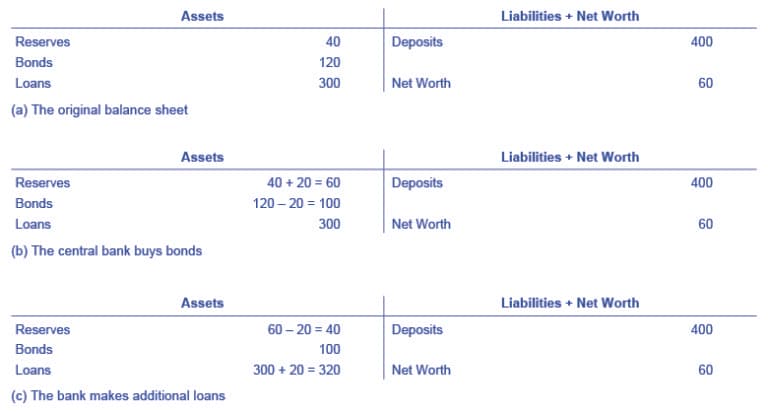
- Open market operations are the most commonly used tool. When a central bank buys government bonds, it puts money into the banking system, increasing the money supply and pushing interest rates down (expansionary policy). When it sells bonds, it pulls money out, shrinking the money supply and pushing interest rates up (contractionary policy).
- Reserve requirements set the fraction of deposits that banks must hold in reserve rather than lend out. Raising the requirement means banks can lend less, which reduces the money multiplier and contracts the money supply. Lowering it has the opposite effect.
- The discount rate is the interest rate a central bank charges when commercial banks borrow directly from it. A higher discount rate discourages borrowing and tightens the money supply; a lower rate encourages borrowing and loosens it.
- Forward guidance is when central banks publicly communicate their future policy intentions. By signaling where interest rates or inflation targets are headed, they shape market expectations before any actual policy change takes effect.

Monetary Policy Challenges
Even when a central bank picks the right tool, several pitfalls can undermine the results:
Time lags are one of the biggest problems. Policy doesn't work instantly. There are four distinct lags to keep track of:
- Recognition lag — It takes time to realize the economy has a problem. Economic data arrives with a delay, and trends aren't always obvious right away.
- Decision lag — Once the problem is identified, policymakers need time to agree on the right response.
- Implementation lag — After a decision is made, it takes time to actually carry out the policy action.
- Impact lag — Even after implementation, months can pass before the policy change fully works its way through the economy.
Because of these lags, a policy designed for today's conditions might not take full effect until the economy has already shifted. This means central banks can accidentally make things worse by responding to a problem that's already resolving on its own.
Excess reserves create another obstacle. When banks hold reserves above the required level, injecting more money through open market operations doesn't necessarily lead to more lending. This is especially common when interest rates are near zero or when banks are too risk-averse to lend. In a liquidity trap, the central bank keeps pushing money into the system, but banks just sit on it, and the extra liquidity never reaches the broader economy.
Velocity instability makes money supply changes less predictable. Velocity () is how quickly money changes hands, captured in the equation . If were constant, increasing (money supply) would reliably raise (nominal GDP). But velocity shifts due to things like financial innovations (credit cards and digital payments let people hold less cash), economic uncertainty (people hoard money in recessions), and shifts in money demand. When moves unpredictably, the central bank can't be sure how a given change in will actually affect prices and output.

Financial Stability and Central Banking
Beyond managing inflation and unemployment, central banks also work to keep the financial system itself from breaking down. Financial instability can cause damage that's far worse than a normal recession, so central banks monitor a range of risks and use specialized tools to address them.
Financial Stability Risks
Asset bubbles form when prices for stocks, housing, or other assets climb far above what economic fundamentals justify. The late-1990s dotcom bubble and the mid-2000s housing bubble are classic examples. The tricky question for central banks is whether to intervene early ("lean against the wind" by raising rates to cool speculation) or wait and deal with the fallout after a bubble bursts ("clean up afterwards"). Leaning against the wind risks slowing the economy unnecessarily if it turns out there's no bubble. Cleaning up afterwards risks letting the bubble grow so large that the crash is devastating.
Leverage cycles refer to swings in how much debt borrowers carry relative to their assets. During good times, borrowing increases and leverage builds up. The danger is that high leverage amplifies losses when conditions turn. A small drop in asset values can wipe out a highly leveraged borrower, and those losses can cascade through the system. Central banks use macroprudential policies to limit this buildup, such as countercyclical capital buffers (requiring banks to hold more capital during booms) and loan-to-value ratio limits (capping how much someone can borrow relative to an asset's value).
Interconnectedness and contagion add another layer of risk. Financial institutions are deeply linked through lending, derivatives, and other contracts. When one institution fails, its counterparty risk (the chance it can't meet its obligations) spreads losses to others. If the failing institution is large or central enough to the system, it may be considered "too big to fail" because its collapse could trigger a chain reaction across the entire financial sector.
How Central Banks Respond
- Stress tests simulate worst-case economic scenarios (sharp recessions, market crashes) to check whether banks have enough capital to survive. These tests help regulators spot vulnerabilities before they become crises.
- Financial stability oversight councils coordinate regulation across agencies, since risks often span multiple parts of the financial system that no single regulator oversees alone.
- Lender of last resort is one of the central bank's most important emergency functions. When a bank is solvent (its assets exceed its liabilities) but illiquid (it can't convert assets to cash fast enough to meet short-term obligations), the central bank steps in with emergency loans through the discount window or special lending facilities. This prevents a temporary cash crunch from turning into a full-blown bank failure and potential panic.
See Fiveable more often in Google
Mark Fiveable as a preferred source and Google is more likely to show you our guides in Top Stories, with a "preferred" badge in AI Mode and AI Overviews.