26.1 The Building Blocks of Neoclassical Analysis

💸Principles of Economics Unit 26 Review
26.1 The Building Blocks of Neoclassical Analysis
💸 Principles of Economics
Neoclassical Analysis
Neoclassical economics focuses on how economies reach their full potential over the long run. Rather than worrying about short-term recessions or booms, this perspective asks: what is the maximum output an economy can sustain, and how does it get there? The answer rests on three building blocks: potential GDP, flexible wages and prices, and the aggregate demand–aggregate supply (AD-AS) model.
The core assumption is that prices and wages adjust freely, allowing markets to self-correct. That self-correction mechanism is what drives the economy back toward its long-run equilibrium. Understanding these building blocks will help you see why neoclassical economists tend to be optimistic about the economy's ability to fix itself over time.
Potential GDP
Potential GDP is the maximum sustainable output an economy can produce when all its resources are fully employed. Think of it as the economy's speed limit: you can briefly exceed it or fall short, but over time, actual GDP gravitates back toward this level.
Potential GDP depends on four main factors:
- Quantity and quality of labor (human capital): More workers, or better-educated and better-trained workers, raise the economy's capacity.
- Physical capital stock: Factories, equipment, and infrastructure all expand what the economy can produce.
- Technological progress: New inventions and more efficient processes let the same inputs produce more output.
- Natural resources: Land, minerals, and energy sources set a baseline for productive capacity.
When any of these factors improve, potential GDP increases, and the long-run aggregate supply (LRAS) curve shifts to the right. That rightward shift is economic growth. Conversely, if a country loses capital stock (say, through war or natural disaster), potential GDP falls and the LRAS shifts left.
Short-run fluctuations can push actual GDP above or below potential GDP temporarily, but the neoclassical view holds that the economy always trends back toward potential in the long run.
Flexible Wages and Prices
The neoclassical model assumes that wages and prices adjust quickly to changes in supply and demand. This flexibility is the engine of self-correction.
Here's how it works in two scenarios:
- During a recession: Demand falls, so businesses cut prices and workers accept lower wages. Those lower prices stimulate spending, and lower wages reduce production costs, encouraging firms to hire again. Output recovers toward potential GDP.
- During an expansion beyond potential: Demand exceeds capacity, so prices and wages rise. Higher prices discourage some spending, and higher wages raise costs for firms, slowing production. The economy cools back down toward potential GDP.
In both cases, the adjustment happens through the interaction of aggregate demand (AD) and aggregate supply (AS):
- A fall in AD leads to lower prices and wages, which stimulates demand and pulls output back up.
- A rise in AD leads to higher prices and wages, which dampens demand and eases inflationary pressure.
The takeaway: if wages and prices truly are flexible, the economy doesn't need much outside intervention to return to full employment. This is a key reason neoclassical economists are generally skeptical of aggressive government stabilization policies.

The Neoclassical AD-AS Model
The AD-AS model ties everything together by showing the relationship between the price level and real GDP. It has three curves, each playing a distinct role.
Aggregate Demand (AD) Curve
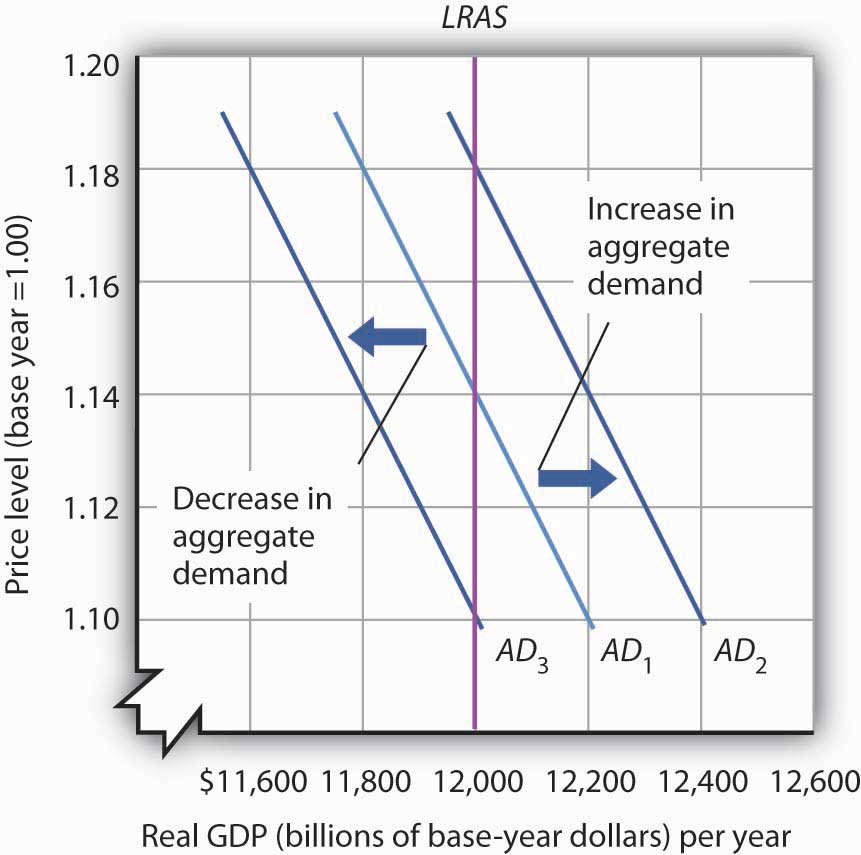
The AD curve represents total demand for goods and services across the entire economy. It slopes downward for three reasons:
- Wealth effect: When the price level falls, the real value of people's savings rises, so they spend more.
- Interest rate effect: Lower prices reduce the demand for money, which pushes interest rates down and encourages borrowing and investment.
- Exchange rate effect: Lower domestic prices make exports cheaper for foreign buyers, boosting net exports.
The AD curve shifts when there are changes in consumption, investment, government spending, or net exports.
Long-Run Aggregate Supply (LRAS) Curve
The LRAS curve is a vertical line at the level of potential GDP. Its vertical shape tells you something important: in the long run, the economy's output depends on its productive capacity, not on the price level. Prices can go up or down, but long-run output stays at potential.
The LRAS shifts when the factors behind potential GDP change (labor, capital, technology, natural resources).
Short-Run Aggregate Supply (SRAS) Curve
The SRAS curve slopes upward, reflecting the short-run reality that higher prices can temporarily boost output. Firms see higher prices for their products, and because some input costs (like wages locked into contracts) haven't caught up yet, they produce more.
The SRAS shifts due to changes in input prices, productivity, or expectations about future price levels.
Reaching Equilibrium
Equilibrium occurs where the AD curve intersects the AS curves:
- Long-run equilibrium: AD intersects LRAS. The economy is at full employment, producing at potential GDP. This is where the neoclassical model predicts the economy will end up.
- Short-run equilibrium: AD intersects SRAS. Output may be above or below potential GDP because wages and prices haven't fully adjusted yet.
The neoclassical prediction is that any gap between short-run and long-run equilibrium is temporary. Flexible wages and prices will shift the SRAS curve until the economy returns to the LRAS, restoring full-employment output.
See Fiveable more often in Google
Mark Fiveable as a preferred source and Google is more likely to show you our guides in Top Stories, with a "preferred" badge in AI Mode and AI Overviews.