24.4 Shifts in Aggregate Demand

💸Principles of Economics Unit 24 Review
24.4 Shifts in Aggregate Demand
💸 Principles of Economics
Factors Affecting Aggregate Demand
Aggregate demand (AD) is the total spending on goods and services in an economy at a given price level. It shifts when something other than the price level causes overall spending to change. This section covers three major shifters: imports, confidence, and government fiscal policy.

Top images from around the web for Imports
Reading: Shifts in Aggregate Demand | Macroeconomics View original
Is this image relevant?
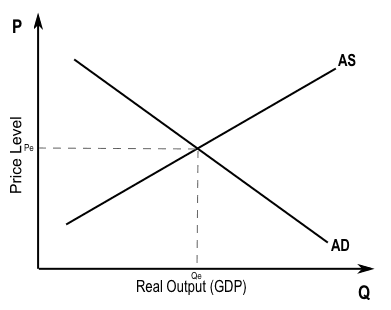
The Aggregate Demand-Aggregate Supply Model | Macroeconomics View original
Is this image relevant?
File:Aggregate Demand-Aggregate Supply.jpg - Wikimedia Commons View original
Is this image relevant?
Reading: Shifts in Aggregate Demand | Macroeconomics View original
Is this image relevant?
The Aggregate Demand-Aggregate Supply Model | Macroeconomics View original
Is this image relevant?
Imports
Imports are goods and services purchased from other countries. Because that spending goes to foreign producers rather than domestic ones, imports are subtracted from aggregate demand.
- When imports rise (say, consumers buy more foreign cars or electronics), money flows out of the domestic economy. This reduces AD and shifts the curve to the left.
- When imports fall, more spending stays domestic, which increases AD and shifts the curve to the right.
A key detail: it's net exports (exports minus imports) that appear in the AD equation. So a rise in imports with no change in exports lowers net exports and decreases AD. The reverse is also true.

Business and Consumer Confidence
Confidence reflects how optimistic businesses and households feel about the economy's direction. It matters because spending decisions depend heavily on expectations, not just current income.
- Economic stability builds confidence. Low inflation and steady GDP growth create a predictable environment where firms invest and consumers spend.
- Employment conditions are a major driver. Low unemployment encourages spending; rising layoffs or job insecurity cause households to pull back and save more.
- Expectations about future wealth shape behavior too. If people expect stock prices or home values to rise, they tend to spend more now. If they expect declines, they save instead.
- Political and social stability reduces uncertainty. Peaceful transitions of power and the absence of civil unrest make businesses more willing to commit to long-term investments.
When confidence rises across the economy, both consumption and investment spending increase, shifting AD to the right. When confidence drops, spending contracts and AD shifts left. This is why consumer confidence indexes are closely watched economic indicators.

Government Spending and Taxes
The government influences AD through fiscal policy, which has two tools: spending and taxation.
Government spending is a direct component of AD. When the government builds highways, purchases military equipment, or funds education and healthcare programs, that spending adds straight to aggregate demand, shifting the AD curve to the right. Cuts in government spending shift it left.
Taxes work indirectly by changing disposable income (income after taxes):
- Higher taxes reduce disposable income, so consumers have less to spend. AD shifts left.
- Lower taxes increase disposable income, giving consumers more purchasing power. AD shifts right.
These two tools combine into two types of fiscal policy:
- Expansionary fiscal policy increases AD to fight a recession. The government increases spending, cuts taxes, or both. Examples include stimulus packages and tax rebates.
- Contractionary fiscal policy decreases AD to fight inflation. The government cuts spending, raises taxes, or both. Examples include austerity measures and tax hikes.
The key distinction: government spending changes AD directly because it is a component of AD. Tax changes work indirectly by influencing how much consumers and businesses choose to spend.
See Fiveable more often in Google
Mark Fiveable as a preferred source and Google is more likely to show you our guides in Top Stories, with a "preferred" badge in AI Mode and AI Overviews.