5.3 Elasticity and Pricing

💸Principles of Economics Unit 5 Review
5.3 Elasticity and Pricing
💸 Principles of Economics
Elasticity measures how sensitive buyers and sellers are to price changes. It directly affects firm revenue, consumer behavior, and how tax burdens get split between buyers and sellers. This section connects elasticity concepts to real pricing decisions and market outcomes.
Elasticity and Its Impact on Markets

Top images from around the web for Price elasticity and firm revenue
Price Elasticity of Demand | Boundless Economics View original
Is this image relevant?
Price Elasticity of Demand | Boundless Economics View original
Is this image relevant?
Elasticity – Introduction to Microeconomics View original
Is this image relevant?
Price Elasticity of Demand | Boundless Economics View original
Is this image relevant?
Price Elasticity of Demand | Boundless Economics View original
Is this image relevant?
Price elasticity and firm revenue
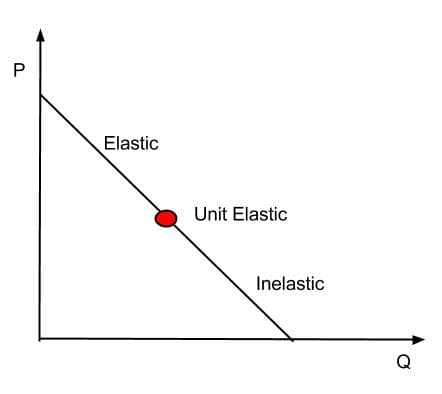
Price elasticity of demand measures how responsive quantity demanded is to a change in price. The key insight here is that raising your price doesn't always mean more revenue. It depends on how much quantity drops when price goes up.
Total revenue is calculated as , where is price and is quantity sold. Since the law of demand tells us that higher prices lead to lower quantity demanded (all else equal), the question becomes: which effect wins?
- Elastic demand (): Quantity demanded changes by a larger percentage than price.
- A price increase decreases total revenue because you lose too many buyers.
- A price decrease increases total revenue because you gain enough new buyers to more than offset the lower price.
- Example: soft drinks. If one brand raises its price 10%, many consumers just switch to a competitor, and quantity might drop 20%.
- Inelastic demand (): Quantity demanded changes by a smaller percentage than price.
- A price increase increases total revenue because buyers don't cut back much.
- A price decrease decreases total revenue because you earn less per unit without gaining many new buyers.
- Example: insulin. Diabetic patients need it regardless of price, so a 10% price hike barely changes the quantity purchased.
- Unit elastic demand (): Quantity demanded changes by the same percentage as price.
- Price changes have no effect on total revenue; the two effects exactly cancel out.
Elasticity's impact on market curves
The elasticity of demand and supply shows up visually in how steep or flat the curves are on a graph.
- Demand curve shape:
- More elastic demand produces a flatter curve (small price changes cause big quantity changes).
- Less elastic demand produces a steeper curve (price changes barely move quantity).
- Supply curve shape:
- More elastic supply produces a flatter curve. Digital goods are a good example: producers can scale output quickly at low cost.
- Less elastic supply produces a steeper curve. Land is the classic case: you can't easily produce more of it.
Don't confuse elasticity with shifts. Non-price determinants shift the demand or supply curve to a new position; they don't change its slope.
- Demand shifters: income, consumer preferences, prices of related goods, expectations (e.g., recession fears reducing spending)
- Supply shifters: input prices, technology, expectations, number of sellers (e.g., new firms entering the market)

Other types of elasticity
- Cross-price elasticity of demand measures how the quantity demanded of one good responds to a price change in a different good.
- Positive cross-price elasticity means the goods are substitutes. When Coca-Cola's price rises, quantity demanded for Pepsi increases.
- Negative cross-price elasticity means the goods are complements. When the price of printers rises, quantity demanded for ink cartridges falls.
- Income elasticity of demand measures how quantity demanded responds to a change in consumer income.
- Positive income elasticity means it's a normal good: people buy more as their income rises (restaurant meals, new cars).
- Negative income elasticity means it's an inferior good: people buy less as their income rises (instant noodles, bus tickets).
Elasticity Over Time and Tax Incidence

Short-term vs long-term elasticity effects
Elasticity isn't fixed. Both demand and supply tend to become more elastic over time as people and firms have more room to adjust.
In the short run, demand and supply are relatively inelastic:
- Consumers lack time to find substitutes or break habits. If gas prices spike today, you still need to drive to work tomorrow.
- Producers can't quickly change production capacity. A factory can't retool overnight.
In the long run, demand and supply become more elastic:
- Consumers find substitutes and change behavior. After sustained high gas prices, people buy fuel-efficient cars or move closer to work.
- Producers adjust capacity, adopt new technology, or enter/exit the market entirely.
Because both sides are more elastic in the long run, price shocks tend to produce larger quantity adjustments and smaller lasting price changes compared to the short run. This is the substitution effect at work: as a good's price rises, consumers gradually shift toward relatively cheaper alternatives.
Elasticity and tax burden distribution
Tax incidence refers to how the burden of a tax gets split between buyers and sellers. The sticker on the tax bill doesn't determine who really pays; relative elasticities do.
The core rule: the more inelastic side bears the larger share of the tax burden. That side can't easily escape the tax by changing behavior, so it absorbs more of the cost.
- Demand more elastic than supply → sellers bear more of the tax. Buyers can easily walk away, so sellers must absorb most of the tax to keep sales up. Think luxury goods: if a tax raises the price of designer handbags, consumers simply buy fewer, and sellers eat the cost.
- Supply more elastic than demand → buyers bear more of the tax. Sellers can easily reduce output or shift to other products, so they pass the tax along as higher prices. Think necessities like agricultural staples: consumers keep buying even at higher prices because they need the product.
- Equal elasticities → the tax burden splits roughly evenly between buyers and sellers.
This is why taxes on cigarettes fall heavily on smokers (very inelastic demand) rather than on tobacco companies, and why payroll taxes are largely borne by workers (relatively inelastic labor supply) rather than employers.
See Fiveable more often in Google
Mark Fiveable as a preferred source and Google is more likely to show you our guides in Top Stories, with a "preferred" badge in AI Mode and AI Overviews.