17.2 How Households Supply Financial Capital

💸Principles of Economics Unit 17 Review
17.2 How Households Supply Financial Capital
💸 Principles of Economics
Financial Markets and Investments
Financial markets connect people who have money to save with people who need to borrow it. This flow of funds powers economic growth by directing capital toward productive uses. This section covers the main ways households supply financial capital, the investment vehicles they use, and the tradeoffs between risk and return.

Top images from around the web for Financial Markets Connect Savers and Borrowers
Banks As Financial Intermediaries | Introduction to Business View original
Is this image relevant?
U.S. Financial Institutions | OpenStax Intro to Business View original
Is this image relevant?
How Households Supply Financial Capital | OS Microeconomics 2e View original
Is this image relevant?
Banks As Financial Intermediaries | Introduction to Business View original
Is this image relevant?
U.S. Financial Institutions | OpenStax Intro to Business View original
Is this image relevant?
Financial Markets Connect Savers and Borrowers
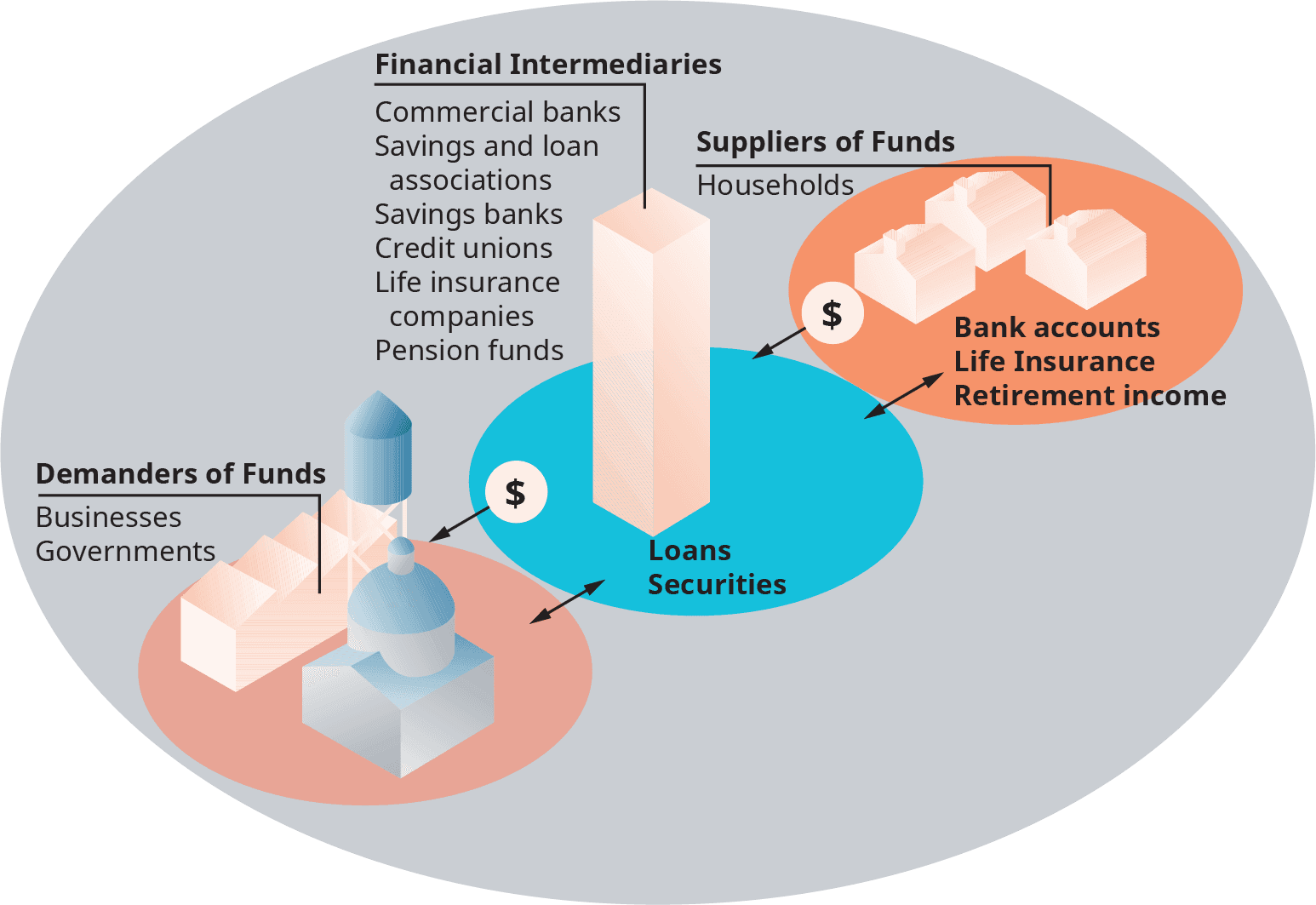
Financial markets exist to solve a basic problem: some people have more money than they need right now, and others need money they don't currently have. These markets channel funds from savers to borrowers through two main paths.
- Bond markets deal in debt securities. When you buy a bond, you're lending money to the issuer.
- Stock markets deal in equity securities. When you buy stock, you're purchasing partial ownership of a company.
Savers are households or institutions with excess funds. They lend money or invest in assets to earn a return. Borrowers are households, businesses, or governments that need funds. They borrow money, pay interest, or issue securities to raise capital.
Financial intermediaries sit between savers and borrowers, making the whole system run more smoothly. Banks, investment companies, and insurance companies all play this role. A bank, for example, takes deposits from savers and uses those funds to make loans to borrowers. By matching savers with borrowers efficiently, financial markets help direct capital toward its most productive uses.

Key Characteristics of Bonds, Stocks, and Mutual Funds
These are the three main vehicles households use to supply financial capital. Each works differently and carries different levels of risk.
Bonds are debt securities issued by governments or corporations. When you buy a bond, you're lending money to the issuer. In return, you receive regular interest payments (called coupon payments) and get your principal back when the bond reaches its maturity date. Bonds are generally lower risk than stocks because bondholders get paid before stockholders if a company runs into trouble. However, bonds typically offer lower returns over time.
Stocks are equity securities that represent ownership in a company. Stockholders have a claim on the company's assets and earnings. Returns come from two sources: capital appreciation (the stock price going up) and dividend payments (a share of the company's profits). Stocks are generally higher risk than bonds because stock prices can swing significantly, and stockholders are last in line if a company goes bankrupt. Over long periods, though, stocks have historically delivered higher average returns than bonds.
Mutual funds pool money from many investors and use it to buy a diversified portfolio of stocks, bonds, or other securities. A professional fund manager makes the investment decisions. You buy and sell shares of a mutual fund based on its net asset value (NAV), which is the total value of the fund's holdings divided by the number of shares. The main advantage for individual investors is diversification and professional management without needing large amounts of capital or expertise.
Quick comparison:
- Bonds = lending money → lower risk, lower expected return
- Stocks = owning a piece of a company → higher risk, higher expected return
- Mutual funds = a basket of investments → risk depends on what's in the basket

Tradeoffs Between Expected Return and Risk
The risk-return tradeoff is one of the most fundamental ideas in finance: higher expected returns generally come with higher levels of risk. Safer investments like government bonds offer modest returns, while riskier investments like individual stocks offer the potential for much larger gains but also larger losses.
Risk tolerance is how much risk you're willing to accept in pursuit of higher returns. It depends on factors like age, income, financial goals, and time horizon. A 25-year-old saving for retirement decades away can typically afford more risk than a 60-year-old who needs their savings soon.
Two key strategies help investors manage the risk-return tradeoff:
- Diversification means spreading your investments across different securities and asset classes. If one investment performs poorly, others may perform well, reducing the impact on your overall portfolio. Diversification helps manage risk without necessarily sacrificing expected returns.
- Asset allocation is the process of dividing your portfolio among different categories (stocks, bonds, cash, etc.) based on your risk tolerance and investment goals. A more aggressive allocation holds a larger share in stocks; a more conservative one leans toward bonds. Adjusting this mix is one of the most important decisions an investor makes.
See Fiveable more often in Google
Mark Fiveable as a preferred source and Google is more likely to show you our guides in Top Stories, with a "preferred" badge in AI Mode and AI Overviews.