4.1 Demand and Supply at Work in Labor Markets

💸Principles of Economics Unit 4 Review
4.1 Demand and Supply at Work in Labor Markets
💸 Principles of Economics
Labor Market Dynamics
Labor markets follow the same supply and demand logic you've seen in product markets, but here the "product" being bought and sold is labor. Employers are the buyers (demand side), and workers are the sellers (supply side). The wage rate acts as the price, and just like in any market, shifts in demand or supply change both wages and employment levels.

Top images from around the web for Factors shifting labor market curves
Demand and Supply at Work in Labor Markets | OpenStax Macroeconomics 2e View original
Is this image relevant?
Demand and Supply at Work in Labor Markets · Economics View original
Is this image relevant?
Demand and Supply at Work in Labor Markets | OpenStax Macroeconomics 2e View original
Is this image relevant?
Demand and Supply at Work in Labor Markets · Economics View original
Is this image relevant?
Factors Shifting Labor Market Curves
Several forces can shift labor demand or labor supply, changing the equilibrium wage and quantity of workers employed.
Factors that shift labor demand:
- Changes in demand for goods and services. If consumers buy more smartphones, firms producing smartphones need more workers. If demand for typewriters drops, firms producing typewriters need fewer workers. Labor demand is derived demand because it comes from demand for the product workers help produce.
- Changes in the prices of other factors of production. If the price of capital (like robots) falls, firms may substitute capital for labor, decreasing labor demand. If the price of capital rises, firms may substitute labor for capital, increasing labor demand.
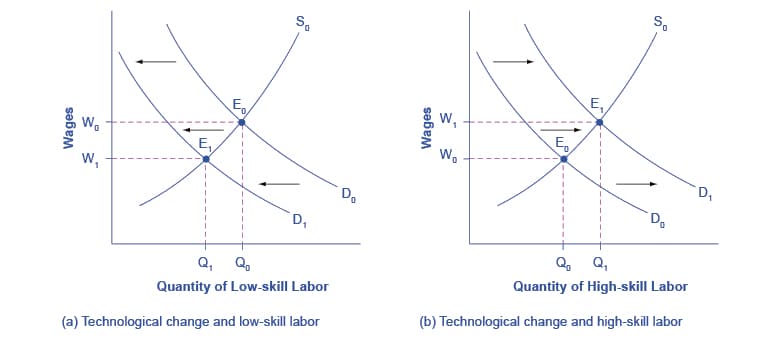
- Changes in technology. Automation that replaces routine tasks can decrease demand for certain types of labor. But technology that requires new skills (like AI development) can increase demand for workers who have those skills.
Factors that shift labor supply:
- Changes in population demographics. A larger working-age population increases labor supply. An aging population, like Japan's, shrinks labor supply as more people retire.
- Changes in education and training. Greater access to education (including online courses) increases the supply of skilled labor. Budget cuts to education can reduce it.
- Changes in alternative opportunities. If wages rise in the tech industry, workers may leave other industries to pursue tech jobs, decreasing labor supply in those other industries. The reverse happens when alternative industries decline.
- Changes in occupational mobility. When workers can move between jobs or industries more easily (fewer licensing barriers, more transferable skills), labor supply can increase in growing sectors.
Technology's Impact on Labor Markets
Technology reshapes labor markets in multiple directions at once.
Automation and job displacement. Machines and software can take over tasks previously done by humans, especially routine or repetitive tasks. This has led to job losses in industries like manufacturing, where assembly-line work is increasingly automated.
Skill-biased technological change. Many new technologies raise demand for skilled workers (software engineers, data analysts) while reducing demand for unskilled or routine workers. This widens the wage gap between high-skill and low-skill workers and contributes to job polarization, where middle-skill jobs shrink while high-skill and some low-skill service jobs grow.
Creation of new jobs and industries. Technology also generates entirely new occupations. App development, cybersecurity, and data science didn't exist a few decades ago. These new fields partially offset the jobs lost to automation.
Changes in labor productivity. Technology allows workers to produce more output per hour. Higher productivity can lead to higher wages and economic growth. However, it can also mean fewer workers are needed to produce the same amount of output, as seen in highly automated factories.

Human Capital and Labor Market Outcomes
Human capital refers to the skills, knowledge, and experience that make workers productive. It's one of the most important factors determining a worker's wages and job prospects.
- Investment in human capital happens through formal education, job training, and accumulated work experience. Each of these increases a worker's productivity and value to employers.
- Impact on wages and employment. Workers with more human capital generally earn higher wages, face lower unemployment rates, and have greater job security. A college degree, for example, is associated with significantly higher lifetime earnings on average.
- Connection to economic growth. Countries that invest heavily in human capital tend to have higher labor productivity and higher standards of living overall.
- Labor market discrimination. Discrimination based on race, gender, or other characteristics can limit access to education and job opportunities, reducing human capital accumulation for affected groups. This means discrimination doesn't just affect individuals; it reduces the economy's overall productive capacity.
- Collective bargaining. Labor unions sometimes negotiate for training programs and educational benefits, which can increase human capital for their members.
Labor Market Policies
Economic Effects of Wage Regulations
A minimum wage is a price floor set above the equilibrium wage. Its effects depend on how high the minimum wage is relative to the market wage and how responsive employers and workers are to wage changes.
Effects on employment:
- When the minimum wage is set above the equilibrium wage, the quantity of labor supplied exceeds the quantity demanded, creating a surplus of labor (unemployment).
- Low-skilled workers, including teenagers, are most likely to be affected because their market wages are closest to the minimum.
- The debate isn't settled, though. Some research (notably Card and Krueger, 1994) found that moderate minimum wage increases had little measurable effect on employment. The impact depends partly on the wage elasticity of demand: if labor demand is inelastic, employment falls less; if elastic, employment falls more.
Effects on income distribution:
- Minimum wage laws aim to raise incomes for the lowest-paid workers and reduce inequality.
- For workers who keep their jobs, a higher minimum wage compresses the wage distribution and can reduce poverty.
- But if the minimum wage causes job losses among the very workers it's meant to help, it could unintentionally increase poverty for some.
Impact on firms and prices:
- Firms may respond by cutting non-wage benefits (like health insurance), reducing hours, or passing higher labor costs to consumers through higher prices (common in fast food, for example).
- These adjustments can partially offset the benefits for low-income workers.
Alternatives to minimum wage policies:
- The Earned Income Tax Credit (EITC) subsidizes wages for low-income workers without directly raising labor costs for firms, which avoids the unemployment effect of a price floor.
- Job training and vocational education programs help low-skilled workers build human capital so they can command higher wages on their own.
- These alternatives may achieve similar goals with fewer unintended consequences, though they work through different mechanisms and aren't perfect substitutes for wage regulation.
See Fiveable more often in Google
Mark Fiveable as a preferred source and Google is more likely to show you our guides in Top Stories, with a "preferred" badge in AI Mode and AI Overviews.