4.2 Demand and Supply in Financial Markets

💸Principles of Economics Unit 4 Review
4.2 Demand and Supply in Financial Markets
💸 Principles of Economics
Financial Markets
Financial markets channel money from people who have savings to people who need funds. This matching of lenders and borrowers determines interest rates, shapes investment decisions, and drives economic activity across the entire economy.

Top images from around the web for Key participants in financial markets
Reading: Demand and Supply in Financial Markets | Macroeconomics View original
Is this image relevant?
Reading: Demand and Supply in Financial Markets | Macroeconomics View original
Is this image relevant?
Reading: Demand and Supply in Financial Markets | Macroeconomics View original
Is this image relevant?
Reading: Demand and Supply in Financial Markets | Macroeconomics View original
Is this image relevant?
Reading: Demand and Supply in Financial Markets | Macroeconomics View original
Is this image relevant?
Key Participants in Financial Markets
Two groups make financial markets work: borrowers who need funds and lenders who supply them.
Borrowers include:
- Individuals who take out mortgages, auto loans, and credit card debt for personal expenses
- Corporations that need capital for investments, expansions, and day-to-day operations
- Governments (federal, state, and local) that borrow to finance public projects, infrastructure, and budget deficits
Lenders include:
- Households that save money through bank deposits, bond purchases, and mutual fund investments
- Banks and financial institutions (commercial banks, credit unions) that accept deposits and make loans
- Institutional investors (pension funds, insurance companies, mutual funds) that invest in various financial instruments
- Central banks and government agencies that provide funds through monetary policy operations or by purchasing government securities

Interest Rates and the Market for Loanable Funds
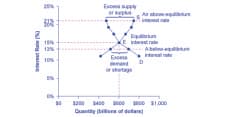
An interest rate is the price of borrowing money. Just like any other price, it's determined by supply and demand.
Demand for loanable funds (borrowers):
- Higher interest rates make borrowing more expensive, so the quantity of loans demanded falls
- Lower interest rates make borrowing cheaper, so the quantity of loans demanded rises
- The demand curve slopes downward, just like a typical demand curve
Supply of loanable funds (lenders):
- Higher interest rates give lenders a greater return, so they're willing to supply more funds
- Lower interest rates reduce the reward for lending, so the quantity supplied falls
- The supply curve slopes upward, just like a typical supply curve
The equilibrium interest rate is found where the supply and demand curves for loanable funds intersect. If either curve shifts (say, businesses suddenly want to invest more, or households decide to save more), the equilibrium rate adjusts accordingly.

Impact of U.S. Government Debt
When the government borrows heavily, it competes with private borrowers for the same pool of available funds. This is called the crowding out effect.
Here's how it works:
- The government increases its borrowing, raising demand for loanable funds
- With more competition for funds, interest rates rise
- Higher interest rates discourage some private investment and consumption
- The economy may see less business expansion as a result
Two additional concerns come with high government debt:
- Inflationary pressure: If the central bank monetizes the debt (buys government securities to fund spending), the money supply grows and inflation can follow. Lenders then demand higher nominal interest rates to compensate for the expected loss in purchasing power.
- Default risk: Very high debt levels raise doubts about the government's ability to repay. Lenders respond by adding a risk premium to government bond rates, and that higher cost of borrowing can spill over into other domestic financial markets.
Price Ceilings and Usury Laws
Usury laws are a type of price ceiling that sets a maximum interest rate lenders can charge. They're intended to protect borrowers from excessively high rates, but they create predictable side effects when the ceiling is set below the market equilibrium rate:
- Lenders become less willing to supply funds at the lower, regulated rate
- Borrowers demand more loans than lenders are willing to provide at that rate
- A shortage of loanable funds results
When a shortage exists, lenders must ration credit. They allocate limited funds based on factors other than price, such as credit history and collateral. Some borrowers can't get loans at all, even if they'd willingly pay a higher rate.
This hits high-risk borrowers hardest. Lenders won't extend credit to them at the capped rate because the allowed return doesn't compensate for the risk. These borrowers may then turn to informal or unregulated markets (payday lenders, loan sharks) where rates are much higher and consumer protections are limited.
Types of Financial Markets
- Capital markets handle long-term securities like stocks and bonds, typically with maturities over one year
- Money markets deal in short-term debt instruments (like Treasury bills) that are highly liquid
The key distinction is investment duration. Capital markets fund long-term growth, while money markets provide short-term liquidity for businesses and governments.
See Fiveable more often in Google
Mark Fiveable as a preferred source and Google is more likely to show you our guides in Top Stories, with a "preferred" badge in AI Mode and AI Overviews.