11.3 Regulating Natural Monopolies

💸Principles of Economics Unit 11 Review
11.3 Regulating Natural Monopolies
💸 Principles of Economics
Regulation of Natural Monopolies

Top images from around the web for Policies for natural monopolies
11.3 Regulating Natural Monopolies – Principles of Economics View original
Is this image relevant?
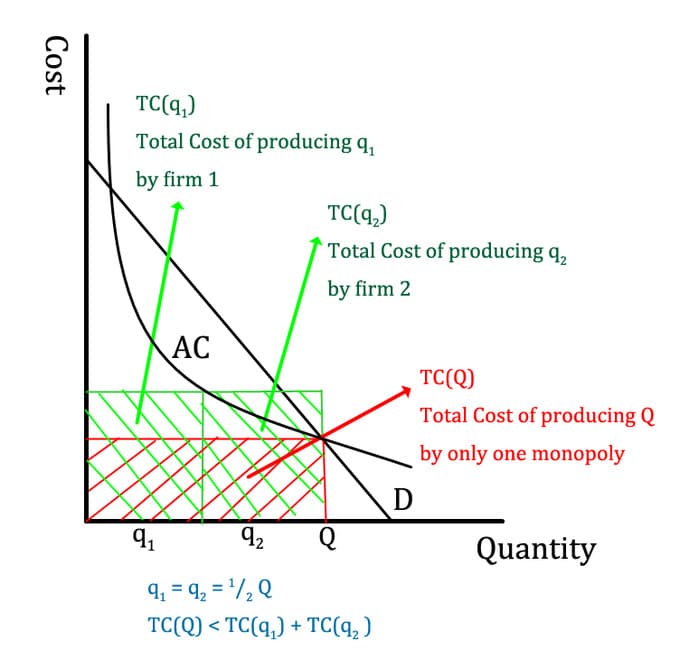
Monopoly in Public Policy | Boundless Economics View original
Is this image relevant?
Regulating Natural Monopolies | Microeconomics View original
Is this image relevant?
11.3 Regulating Natural Monopolies – Principles of Economics View original
Is this image relevant?
Monopoly in Public Policy | Boundless Economics View original
Is this image relevant?
Policies for Natural Monopolies
A natural monopoly exists when a single firm can supply an entire market at lower cost than two or more firms could. This happens because of economies of scale: the firm's average total cost keeps falling over the entire range of market demand. Water utilities, electric grids, and cable TV networks are classic examples.
Because competition would actually raise costs in these markets, governments can't just break up the monopoly and expect things to improve. Instead, they choose among three broad policy approaches:
- Government ownership — The state runs the utility directly and can set price equal to marginal cost (), which gives you the allocatively efficient outcome. The downside is that government-run firms often have weak incentives to minimize costs or innovate, since losses get covered by taxpayers.
- Government regulation of a private monopoly — The firm stays privately owned, but a regulatory agency controls the price it can charge. Private ownership preserves the profit motive to cut costs, though the regulated price may not land exactly at the efficient level.
- Antitrust policy and forced divestiture — The government breaks the monopoly into competing firms. This works in some industries, but for natural monopolies it usually backfires. If economies of scale are the whole reason one firm is cheapest, splitting it up just raises costs for everyone.

Graphs of Regulatory Options
On a natural monopoly graph, the key feature is that the ATC curve is still declining where it crosses the demand curve. That's what makes the monopoly "natural." Three pricing strategies show up on this graph:
- Marginal cost pricing () — Price is set where the MC curve crosses the demand curve, producing the efficient quantity (). The problem: at , price sits below ATC, so the firm takes an economic loss. It won't stay in business long without help.
- Subsidizing the monopolist — The government pays a subsidy to cover the gap between price and ATC at . This lets the firm charge , produce the efficient quantity, and still break even. The tradeoff is that taxpayers foot the bill, and the firm has little reason to reduce its costs.
- Fair-return (average cost) pricing — Price is set where the ATC curve intersects the demand curve. The firm earns a normal profit (zero economic profit), so no subsidy is needed. But the quantity produced () is less than the efficient quantity (), meaning some allocative inefficiency remains. This is the most common regulatory compromise in practice.

Cost-Plus vs. Price Cap Regulation
These are two specific methods regulators use to set the price a private monopoly can charge:
Cost-plus regulation guarantees the firm a set rate of return on its capital investments. The allowed price covers all costs plus a "fair" profit margin.
- The firm faces little risk, which can attract investment in infrastructure.
- The big drawback is the Averch-Johnson effect: since profits are tied to the size of the capital base, the firm has an incentive to overinvest in capital and little incentive to cut costs. Why reduce spending when your allowed profit is a percentage of what you spend?
Price cap regulation sets a maximum price the firm can charge, typically adjusted each year for inflation minus an expected productivity improvement (sometimes written as CPI - X).
- Because the firm keeps any profit it earns below the cap, it has a strong incentive to minimize costs and innovate.
- The risk is that if the cap is set too low, the firm may cut corners on service quality or underinvest in maintenance to stay profitable.
Cost-plus rewards spending; price caps reward efficiency. That contrast is the core idea regulators weigh when choosing between them.
Natural Monopoly Regulation and Infrastructure Industries
Infrastructure industries like electricity, water, and telecommunications are where natural monopoly regulation matters most. These services are essential, and the physical networks (pipes, wires, towers) create the massive fixed costs that drive economies of scale.
Regulators in these industries constantly balance three goals: keeping prices affordable for consumers, ensuring the firm invests enough to maintain and expand the infrastructure, and pushing for efficient use of resources. No single regulatory approach perfectly achieves all three, which is why real-world regulation tends to mix elements of the strategies described above.
See Fiveable more often in Google
Mark Fiveable as a preferred source and Google is more likely to show you our guides in Top Stories, with a "preferred" badge in AI Mode and AI Overviews.