5.2 Polar Cases of Elasticity and Constant Elasticity

💸Principles of Economics Unit 5 Review
5.2 Polar Cases of Elasticity and Constant Elasticity
💸 Principles of Economics
Elasticity Polar Cases

Top images from around the web for Infinite vs zero elasticity
Price Elasticity of Supply | Boundless Economics View original
Is this image relevant?
File:Elasticity and the Demand Curve.jpg - Wikimedia Commons View original
Is this image relevant?
File:Supply and demand curves.svg - Wikimedia Commons View original
Is this image relevant?
Price Elasticity of Supply | Boundless Economics View original
Is this image relevant?
File:Elasticity and the Demand Curve.jpg - Wikimedia Commons View original
Is this image relevant?
Infinite vs. zero elasticity
These two extremes sit at opposite ends of the elasticity spectrum, and they're the easiest to visualize.
Perfectly elastic (infinite elasticity) means any price change causes quantity demanded or supplied to change by an unlimited amount. On a graph, this is a perfectly horizontal curve. Even the tiniest price increase above the market price drives quantity demanded to zero, and any price at or below market price means consumers will buy as much as is available.
This shows up in perfectly competitive markets where firms are price takers. Think of a single wheat farmer: if they raise their price even slightly above the market price, buyers just go to another farmer selling identical wheat. The demand curve facing that individual firm is essentially flat.
Perfectly inelastic (zero elasticity) means price changes have no effect on quantity at all. The curve is perfectly vertical. Consumers buy the same amount regardless of what happens to price.
Real-world examples that come close: life-saving medications like insulin or EpiPens. If you need insulin to survive, a price increase won't make you buy less of it (at least in the short run). Basic utilities like water behave similarly over normal price ranges.
Perfectly elastic = horizontal curve = infinite responsiveness to price Perfectly inelastic = vertical curve = zero responsiveness to price

Interpreting elasticity graphs
The shape of a demand or supply curve tells you a lot about elasticity at a glance:
- Flatter curves signal greater elasticity. Quantity responds strongly to price changes.
- Steeper curves signal less elasticity. Quantity barely budges when price moves.
- A rectangular hyperbola represents constant unitary elasticity, where elasticity equals exactly 1 at every point along the curve. A 1% price increase leads to exactly a 1% decrease in quantity demanded (or vice versa). Total revenue stays the same no matter where you are on the curve.
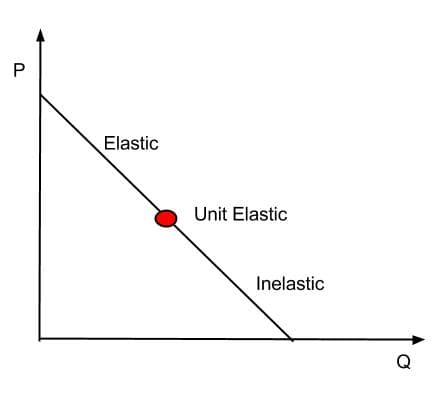
One common mistake: students assume a straight-line demand curve has constant elasticity. It doesn't. Elasticity changes along a linear demand curve, being more elastic near the top (high price, low quantity) and more inelastic near the bottom (low price, high quantity). Only the rectangular hyperbola has truly constant elasticity throughout.

Elasticity and Curve Shapes
Demand and supply curve shapes
Here's a summary of how elasticity values map to curve shapes and real-world behavior:
- Elastic (): Relatively flat curve. Quantity is highly responsive to price. Luxury goods and products with many close substitutes tend to be elastic because consumers can easily switch to alternatives when prices rise.
- Inelastic (): Relatively steep curve. Quantity barely changes with price. Necessities and addictive products (cigarettes, gasoline) fall here because people keep buying them even as prices climb.
- Unit elastic (): Rectangular hyperbola. The percentage change in quantity exactly matches the percentage change in price.
- Perfectly elastic (): Horizontal line. Seen with identical products in competitive markets where buyers won't pay a cent above the going price.
- Perfectly inelastic (): Vertical line. Seen with life-sustaining goods that have no substitutes.
Market dynamics and elasticity
Elasticity has direct consequences for how markets behave and how firms make pricing decisions.
Total revenue and elasticity is the connection you'll use most often. Total revenue equals price times quantity (). When demand is inelastic, raising the price increases total revenue because the drop in quantity sold is proportionally smaller than the price increase. When demand is elastic, raising the price decreases total revenue because quantity drops by a larger proportion than the price rose. With unit elastic demand, total revenue stays constant regardless of price changes.
Elasticity also affects how markets reach equilibrium. When both supply and demand are relatively elastic, prices and quantities adjust quickly to shocks. When one side is inelastic, the other side absorbs more of the adjustment. For example, if supply is perfectly inelastic (think fixed land in a city), an increase in demand raises price but doesn't change quantity at all.
Finally, complementary goods have interrelated elasticities. A rise in the price of printers (reducing printer sales) can also reduce demand for ink cartridges. The cross-price elasticity between complements is negative, which ties back to how elasticity concepts connect across different goods in a market.
See Fiveable more often in Google
Mark Fiveable as a preferred source and Google is more likely to show you our guides in Top Stories, with a "preferred" badge in AI Mode and AI Overviews.