13.3 Public Goods

💸Principles of Economics Unit 13 Review
13.3 Public Goods
💸 Principles of Economics
Public Goods and Common Resources

Top images from around the web for Characteristics of Public Goods
United States Government: Why form a government? | United States Government View original
Is this image relevant?
Public Goods | Boundless Economics View original
Is this image relevant?
Public Goods | Boundless Economics View original
Is this image relevant?
United States Government: Why form a government? | United States Government View original
Is this image relevant?
Public Goods | Boundless Economics View original
Is this image relevant?
Characteristics of Public Goods
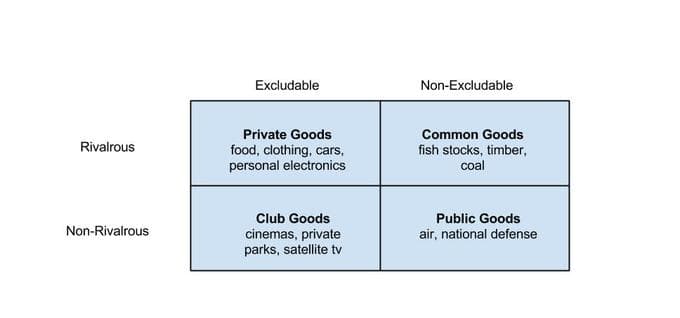
Most goods you encounter in daily life are private goods: if you buy a sandwich, no one else can eat it, and the store can refuse to sell it to you. Public goods work completely differently, and understanding why requires two key properties.
Non-excludable means it's impossible (or extremely costly) to prevent someone from consuming the good, even if they haven't paid for it. Once a country funds its military, every resident is protected whether they contributed tax dollars or not. Other examples include streetlights and public radio broadcasts.
Non-rivalrous means one person's consumption doesn't reduce what's available for anyone else. When you benefit from national defense, that doesn't leave less defense for your neighbor. The marginal cost of providing the good to one additional person is zero. Compare this to a sandwich: if you eat it, it's gone.
Some textbooks also mention a third property:
- Non-rejectable: individuals can't opt out of consuming the good. You can't choose not to be protected by national defense or not to breathe the air improved by pollution controls.
These properties together are what make public goods so tricky for markets to handle.
Quick classification tip: If a good is both non-excludable and non-rivalrous, it's a public good. If it's non-excludable but rivalrous (like fish in the ocean), it's a common resource, which is a related but distinct concept.

Free Rider Problem
Because public goods are non-excludable, people can enjoy them without paying. This creates the free rider problem: rational individuals have every incentive to let others foot the bill.
Think about a neighborhood fireworks display. If your neighbors pool money to fund it, you can watch from your yard for free. If everyone reasons this way, nobody contributes, and the fireworks never happen.
This is exactly why private markets tend to underprovide public goods or fail to provide them at all:
- Firms can't charge consumers who benefit for free, so there's little profit motive to supply the good.
- Lighthouses are a classic example: a private lighthouse owner can't stop ships from using the light without paying.
- Scientific research faces a similar issue: once findings are published, anyone can use them.
Because of this market failure, government intervention is often necessary to ensure public goods are provided at socially optimal levels. Tax revenue can fund goods like national defense and public education, and mandates can compel provision of things like vaccinations.

Government Strategies for Public Goods and Common Resources
Governments use several tools to address the underprovision problem. Each has different strengths depending on the type of good involved.
Direct provision is the most straightforward approach. The government supplies the good itself, funded by tax revenue. National defense, public schools, and roads are all examples. This works well when the good is essential and the free rider problem is severe.
Subsidies and grants keep production in private hands but use government funding to make it worthwhile. Renewable energy subsidies and research grants are common examples. The advantage is that private firms may produce the good more efficiently than the government could.
Regulation and mandates require firms or individuals to provide certain goods or meet certain standards. Environmental regulations, building codes, and food safety rules all fall here. Rather than paying for the good directly, the government compels its provision.
User fees and taxes charge the people who benefit from a public good. National park entrance fees and gasoline taxes (which fund highway maintenance) are typical examples. These don't fully solve the free rider problem, but they help cover costs and can signal how much people value the good.
Property rights and market-based solutions work especially well for common resources that face overuse. By establishing clear ownership or creating markets, the government aligns private incentives with social efficiency:
- Tradable pollution permits set a cap on total emissions, then let firms buy and sell the right to pollute. Firms that can reduce emissions cheaply do so and sell their permits; firms that can't, buy them. Total pollution stays within the cap.
- Fishing quotas assign each fisher a share of the total allowable catch, preventing the overfishing that happens when the ocean is treated as a free-for-all.
The common thread across all these strategies is the same: when markets fail to provide a good because of the free rider problem or non-excludability, government action can step in to move the outcome closer to what's socially efficient.
See Fiveable more often in Google
Mark Fiveable as a preferred source and Google is more likely to show you our guides in Top Stories, with a "preferred" badge in AI Mode and AI Overviews.