33.1 Absolute and Comparative Advantage

💸Principles of Economics Unit 33 Review
33.1 Absolute and Comparative Advantage
Absolute and Comparative Advantage
Trade between countries exists because no single nation can produce everything efficiently. The concepts of absolute and comparative advantage explain why countries specialize and what they should specialize in. Understanding these ideas is central to grasping how international trade increases total output and benefits all trading partners.

Top images from around the web for Absolute Advantage and Comparative Advantage
Production Cost | Boundless Economics View original
Is this image relevant?
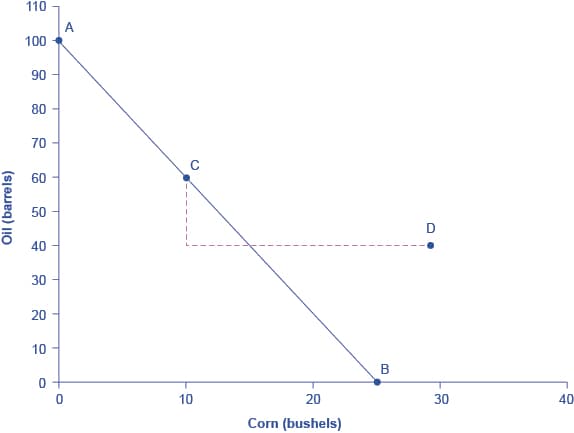
Absolute and Comparative Advantage | OpenStax Macroeconomics 2e View original
Is this image relevant?
Reading: Absolute and Comparative Advantage | Microeconomics View original
Is this image relevant?
Production Cost | Boundless Economics View original
Is this image relevant?
Absolute and Comparative Advantage | OpenStax Macroeconomics 2e View original
Is this image relevant?
Absolute and Comparative Advantage
Absolute Advantage and Comparative Advantage
Absolute advantage means a country can produce a good using fewer resources than another country. You determine it by directly comparing productivity or resource costs.
- If Country A produces 1 car using 100 labor hours and Country B needs 150 labor hours per car, Country A has the absolute advantage in car production.
Absolute advantage tells you who's more productive, but it doesn't tell you who should specialize in what. That's where comparative advantage comes in.
Comparative advantage means a country can produce a good at a lower opportunity cost than another country. Opportunity cost is the value of the next best alternative you give up when making a choice.
- If Country A's opportunity cost of producing 1 car is 2 tons of wheat, and Country B's opportunity cost is 3 tons of wheat per car, then Country A has the comparative advantage in cars.
- Country B, meanwhile, gives up less car production for each ton of wheat it makes, so Country B has the comparative advantage in wheat.
A country can have the absolute advantage in both goods but still benefit from trade. What matters for trade is comparative advantage, not absolute advantage.

Gains from Specialization and Trade
Each country should specialize in producing the good where it has the lowest opportunity cost compared to the other country. Then countries trade to get the goods they didn't produce.
Why this works:
- More efficient resource allocation. Resources flow toward the production each country does relatively cheaply.
- Increased total output. The world produces more of both goods than if each country tried to make everything on its own.
- Consumption beyond production possibilities. Through trade, each country can consume combinations of goods it couldn't reach by producing alone.
Using the earlier example: Country A has a lower opportunity cost for cars (2 tons of wheat per car vs. Country B's 3 tons), so Country A specializes in cars. Country B has a lower opportunity cost for wheat, so Country B specializes in wheat. Both end up with more goods after trading than they'd have without specialization.
Production Possibilities and Trade Benefits
Here's a concrete numerical example showing how specialization and trade create gains.
Setup: Two countries, two goods.
- Country A can produce either 10X or 20Y (using all its resources on one good)
- Country B can produce either 5X or 15Y
Step 1: Calculate opportunity costs.
| Cost of 1X | Cost of 1Y | |
|---|---|---|
| Country A | 2Y | X |
| Country B | 3Y | X |
Country A has the lower opportunity cost of X (2Y vs. 3Y), so it has the comparative advantage in X. Country B has the lower opportunity cost of Y (X vs. X), so it has the comparative advantage in Y.
Step 2: Compare output before specialization.
If each country splits its resources evenly between the two goods:
- Country A produces 5X and 10Y
- Country B produces 2.5X and 7.5Y
- World total: 7.5X and 17.5Y
Step 3: Specialize according to comparative advantage.
- Country A puts all resources into X → produces 10X
- Country B puts all resources into Y → produces 15Y
- World total: 10X and 15Y
World production of X increased from 7.5 to 10. World production of Y fell from 17.5 to 15, but trade will redistribute goods so both countries are better off.
Step 4: Trade.
Suppose Country A trades 6X to Country B in exchange for 10Y.
| X | Y | Better off? | |
|---|---|---|---|
| Country A (before trade) | 5 | 10 | |
| Country A (after trade) | 4 | 10 | Same Y, lost 1X |
| Country B (before trade) | 2.5 | 7.5 | |
| Country B (after trade) | 6 | 5 | Gained 3.5X, lost 2.5Y |
In this example, Country B clearly gains more of X than it had before. The specific terms of trade (how many units are exchanged) determine exactly how the gains are split. As long as the exchange rate falls between the two countries' opportunity costs, both sides can benefit. Here, any trade ratio between 2Y per X and 3Y per X leaves both countries better off than producing everything on their own.
The key takeaway: comparative advantage, not absolute advantage, determines who should produce what. Even if one country is better at making everything, both countries gain from specializing and trading based on their opportunity costs.
See Fiveable more often in Google
Mark Fiveable as a preferred source and Google is more likely to show you our guides in Top Stories, with a "preferred" badge in AI Mode and AI Overviews.