30.4 Using Fiscal Policy to Fight Recession, Unemployment, and Inflation

💸Principles of Economics Unit 30 Review
30.4 Using Fiscal Policy to Fight Recession, Unemployment, and Inflation
💸 Principles of Economics
Fiscal Policy and Economic Stabilization
Fiscal policy refers to how the government uses its spending and taxation powers to influence the economy. When the economy slips into recession or overheats into inflation, fiscal policy gives policymakers direct tools to shift aggregate demand and push output back toward its potential level.

Top images from around the web for Government Spending, Taxes, and Aggregate Demand
Recessionary and Inflationary Gaps in the Income-Expenditure Model | Macroeconomics View original
Is this image relevant?
Introduction to Fiscal Policy | Boundless Economics View original
Is this image relevant?
The Aggregate Demand-Aggregate Supply Model | Macroeconomics View original
Is this image relevant?
Recessionary and Inflationary Gaps in the Income-Expenditure Model | Macroeconomics View original
Is this image relevant?
Introduction to Fiscal Policy | Boundless Economics View original
Is this image relevant?
Government Spending, Taxes, and Aggregate Demand
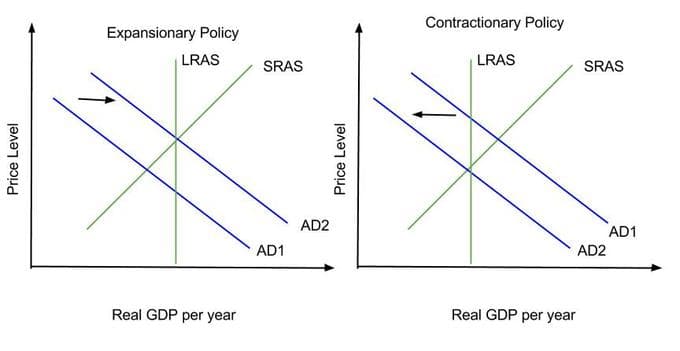
Government spending (G) is one of the four components of aggregate demand (AD). When the government spends more, that money flows directly into the economy, shifting the AD curve to the right and raising both output and the price level. When the government cuts spending, AD shifts left, reducing output and the price level.
Taxes (T) work indirectly. Lowering taxes increases households' disposable income, which leads to more consumption (C) and shifts AD to the right. Raising taxes does the opposite: less disposable income means less spending, shifting AD to the left.
Both tools are amplified by the multiplier effect, which means an initial change in spending or taxes produces a larger total change in output. The two key multipliers are:
- Government spending multiplier:
- Tax multiplier:
Here, MPC stands for marginal propensity to consume, which is the fraction of each additional dollar of income that households spend rather than save. Notice the spending multiplier is larger in absolute value than the tax multiplier. That's because government spending enters AD directly, while a tax cut only increases AD by the portion people actually spend.
Example: If the MPC is 0.8, the spending multiplier is , and the tax multiplier is . A $10 billion increase in government spending would raise output by $50 billion, while a $10 billion tax cut would raise output by $40 billion.

Expansionary Fiscal Policy During Recessions
When the economy is in a recession, actual output falls below potential output, creating a recessionary gap. Expansionary fiscal policy aims to close that gap by boosting aggregate demand. The government can:
- Increase government spending on things like infrastructure, education, or healthcare. This directly raises AD and creates jobs, which further increases household income and spending.
- Cut taxes, which raises disposable income and encourages more consumption and investment. Tax cuts targeted at low- and middle-income households tend to be more effective because those households have a higher MPC. They spend a larger share of each extra dollar compared to wealthier households.
- Use a combination of both for a stronger overall stimulus.
The economy also has built-in automatic stabilizers that cushion recessions without any new legislation. Progressive income taxes automatically collect less revenue when incomes fall, leaving more money in people's pockets. Unemployment insurance benefits automatically rise as more people lose jobs, supporting their spending. These stabilizers don't eliminate recessions, but they reduce their severity.

Contractionary Fiscal Policy and Inflation
When the economy is producing above its long-run potential, demand outpaces supply and prices rise. This creates an inflationary gap. Contractionary fiscal policy aims to cool things down by reducing aggregate demand. The government can:
- Decrease government spending, which directly lowers AD and eases upward pressure on prices. Cuts typically target non-essential or discretionary programs.
- Raise taxes, which reduces disposable income and discourages consumption and investment. Higher tax rates on high-income households and corporations can be particularly effective at pulling excess demand out of the economy.
- Use a combination of both to bring output back in line with potential.
One important caution: contractionary policy requires careful calibration. If the government tightens too aggressively, it can overshoot and push the economy into a recession. Policymakers also face time lags, since it takes time to recognize inflation, pass legislation, and see the effects. By the time contractionary measures fully kick in, economic conditions may have already changed.
Automatic stabilizers work in reverse here too. As incomes rise during an overheated economy, progressive taxes automatically collect more revenue, and fewer people qualify for government transfer payments. This naturally dampens demand without any new policy action.
See Fiveable more often in Google
Mark Fiveable as a preferred source and Google is more likely to show you our guides in Top Stories, with a "preferred" badge in AI Mode and AI Overviews.