20.1 The Relatively Recent Arrival of Economic Growth

💸Principles of Economics Unit 20 Review
20.1 The Relatively Recent Arrival of Economic Growth
💸 Principles of Economics
Factors Enabling Economic Growth
For most of human history, economic growth was basically nonexistent. Living standards in 1700 weren't dramatically different from those in 1000 BCE. Then, starting in the mid-1700s, something changed. The Industrial Revolution launched a period of sustained economic growth that transformed the world in just a few generations. Understanding why growth finally took off helps explain what keeps it going today.

Top images from around the web for Industrial Revolution Enablers
The Industrial Revolution | Boundless US History View original
Is this image relevant?
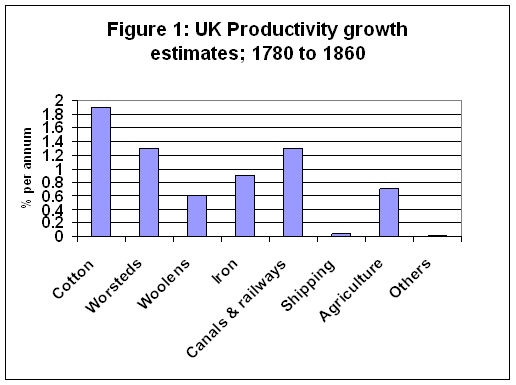
Freedom and Flourishing: Was the industrial revolution mainly about the growth of manufacturing ... View original
Is this image relevant?
Industrial Revolution - Wikipedia View original
Is this image relevant?
The Industrial Revolution | Boundless US History View original
Is this image relevant?
Freedom and Flourishing: Was the industrial revolution mainly about the growth of manufacturing ... View original
Is this image relevant?
Industrial Revolution Enablers
Technological advancements were at the heart of the transformation. The steam engine mechanized production, replacing human and animal muscle with machine power. In textiles, the spinning jenny and power loom made mass production possible, slashing the cost of cloth and clothing.
Agricultural productivity improved through several reinforcing changes:
- Crop rotation maintained soil fertility, allowing farmers to grow more food on the same land
- Selective breeding improved both crop yields and livestock quality
- The enclosure movement consolidated small, scattered landholdings into larger farms that could be managed more efficiently
These agricultural gains meant fewer people were needed on farms, freeing up labor for factory work.
Natural resources provided the raw fuel for industrialization. Coal powered steam engines, and iron ore was used to build machinery and infrastructure like bridges and railways.
International trade expanded rapidly, driven by mercantilist policies (the idea that nations should maximize exports and accumulate wealth) and colonial empires that supplied raw materials and served as markets for finished goods.
Capital accumulation made large-scale investment possible. The rise of banking and financial institutions mobilized savings and extended credit to entrepreneurs. That capital funded infrastructure like canals and railways, which in turn lowered the cost of moving goods and people.
Demographic changes rounded out the picture. Population growth supplied the labor force factories needed, and urbanization accelerated as workers migrated from rural areas to cities in search of employment.

Institutional and Policy Factors
Technology and resources alone don't guarantee growth. Without the right institutions and policies, investment dries up and innovation stalls. This section covers the "rules of the game" that allow economies to grow over the long run.

Property Rights and Legal Systems
- Secure property rights encourage investment because people and businesses know they can keep the rewards of their efforts. They also promote entrepreneurship by letting individuals capitalize on their ideas.
- Contract enforcement makes transactions smoother. When parties trust that agreements will be honored, the costs of monitoring and enforcing deals drop significantly.
- Rule of law provides stability and predictability. It also limits arbitrary government actions that could disrupt economic activity.
- Intellectual property protection (patents, copyrights, trademarks) gives inventors and creators exclusive rights to profit from their work. Without these protections, firms have less reason to invest in research and development since competitors could simply copy their innovations.
Public Policies
Investment in human capital is one of the most reliable drivers of growth. Education improves workforce skills and productivity, while healthcare keeps the labor force healthy and able to work.
Infrastructure development (transportation networks, communication systems) reduces the cost of trade and connects producers to markets. Think of how railways transformed commerce in the 1800s, or how internet access does the same today.
Macroeconomic stability matters more than it might seem at first. Low, stable inflation gives businesses and consumers a predictable environment for making decisions. Sustainable fiscal policies, like manageable debt levels and balanced budgets, help maintain that stability over time.
Several other policy areas also shape growth prospects:
- Trade openness through free trade agreements and reduced barriers (tariffs, quotas) expands markets and encourages countries to specialize in what they produce most efficiently
- Regulatory environment that makes it straightforward to start and operate a business, with streamlined procedures and competitive markets, fosters entrepreneurship
- Taxation policies that keep marginal tax rates low enough to incentivize work and investment, while still generating revenue for public goods, support long-run growth
The core takeaway: sustained economic growth is historically new, and it depends on a combination of technological progress, resource availability, strong institutions, and sound policy. Remove any one of those pillars and growth tends to slow or stall.
See Fiveable more often in Google
Mark Fiveable as a preferred source and Google is more likely to show you our guides in Top Stories, with a "preferred" badge in AI Mode and AI Overviews.