12.1 The Economics of Pollution

💸Principles of Economics Unit 12 Review
12.1 The Economics of Pollution
💸 Principles of Economics
Externalities and Pollution

Top images from around the web for Externalities of pollution
Health impacts of air pollution View original
Is this image relevant?
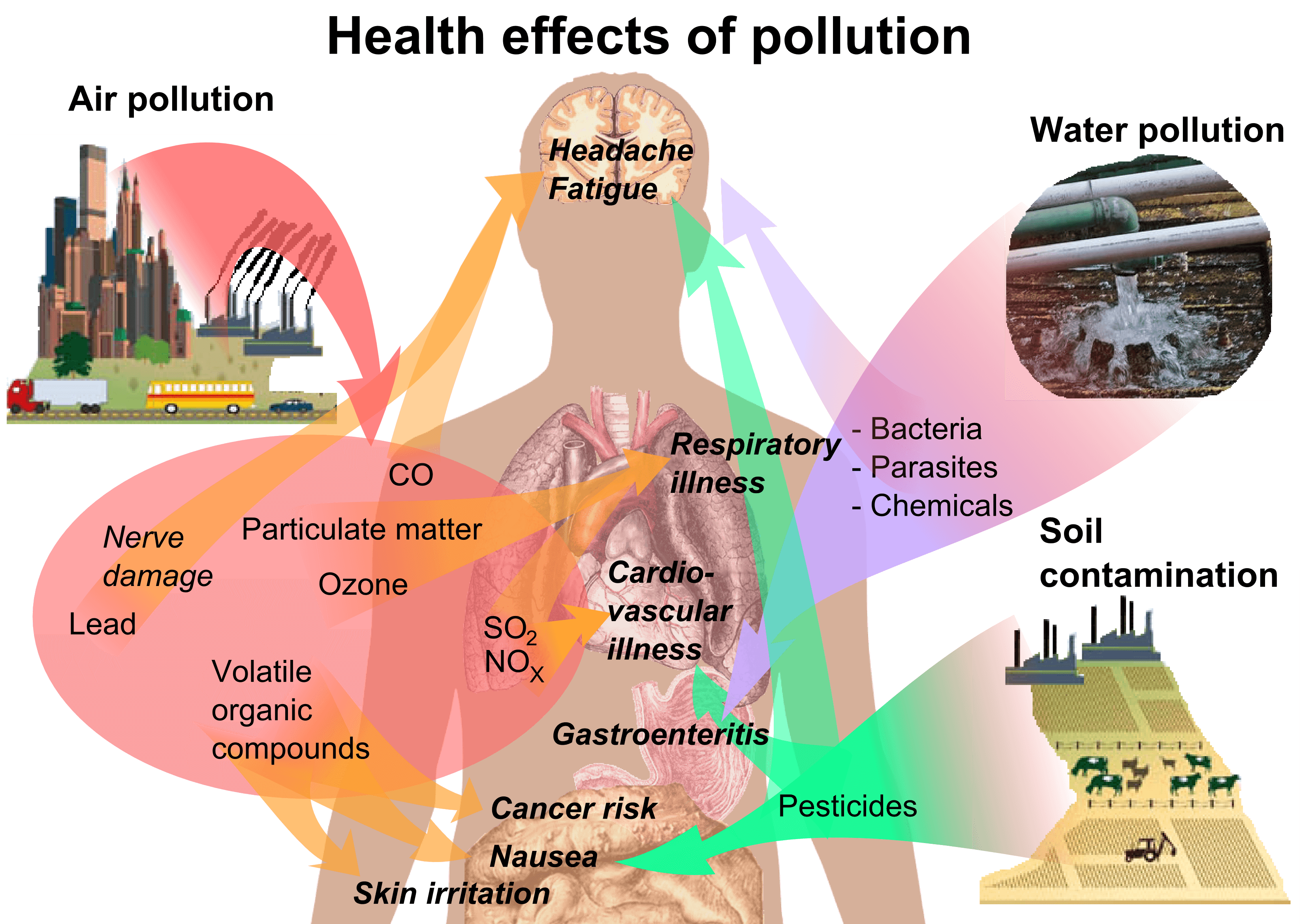
File:Health effects of pollution.png - Wikipedia View original
Is this image relevant?
Air pollution View original
Is this image relevant?
Health impacts of air pollution View original
Is this image relevant?
File:Health effects of pollution.png - Wikipedia View original
Is this image relevant?
Externalities of pollution
An externality is a cost or benefit that falls on a third party who wasn't part of the original market transaction. Pollution is the classic example of a negative externality, but pollution reduction can generate positive externalities too.
- Negative externalities impose costs on third parties. A coal-fired power plant releases sulfur dioxide into the air, causing respiratory diseases in nearby communities and driving up their healthcare costs. The people breathing that air never agreed to bear those costs.
- Positive externalities provide benefits to third parties. When a factory installs scrubbers to reduce its emissions, nearby residents enjoy cleaner air even though they didn't pay for the equipment.
The key idea: whenever externalities exist, the market price doesn't reflect the full cost or benefit of production. That gap between private and social costs is where the problems start.
Market equilibrium with pollution
When a negative externality like pollution exists, the cost to society is higher than the cost the firm actually pays. Economists capture this with two cost curves:
- The marginal private cost (MPC) curve reflects only the costs the firm bears (labor, materials, etc.).
- The marginal social cost (MSC) curve adds the external costs (health damage, environmental cleanup) on top of MPC. So MSC sits above MPC on a graph.
The socially optimal quantity of output is where MSC = MSB (marginal social benefit). At that point, total social welfare is maximized. But the market, left alone, produces where MPC = MSB, which yields a higher quantity than the social optimum. That overproduction is the core problem.
For positive externalities, the logic flips. The MSB curve lies above the marginal private benefit (MPB) curve because third parties receive benefits the buyer doesn't account for. The market underproduces relative to the social optimum.

Pollution and market failures
Market failure occurs when the market equilibrium doesn't maximize social welfare. With negative externalities from pollution, this plays out in a predictable way:
- Firms only consider their private costs when deciding how much to produce.
- The marginal external cost (MEC), the damage imposed on third parties, goes unaccounted for.
- Because firms ignore MEC, they produce more than the socially optimal quantity.
- The result: too much output and too much pollution.
The gap between the market quantity and the socially optimal quantity represents a deadweight loss to society.
Three broad categories of solutions exist:
- Government intervention through taxes or regulations that force firms to internalize external costs
- Property rights assignment so affected parties can bargain directly (the Coase Theorem)
- Technology incentives that encourage cleaner production methods (renewable energy, energy-efficient equipment)
Market Failures and Policy Interventions

Government policies addressing pollution-related market failures
Pigouvian Taxes
A Pigouvian tax is levied directly on the polluting activity to make the firm pay for the external damage it causes.
- The tax should equal the marginal external cost (MEC) at the socially optimal output level.
- Graphically, the tax shifts the MPC curve upward so that it aligns with the MSC curve. Firms now face the true social cost and reduce output to the efficient quantity.
- Example: A carbon tax of $50 per ton of on fossil fuel combustion. Sweden's carbon tax, introduced in 1991, is one of the highest in the world and has contributed to significant emissions reductions.
Cap-and-Trade (Emission Permits)
Instead of taxing each unit of pollution, the government sets a hard cap on total emissions and distributes tradable permits.
- Each permit allows a firm to emit a specific amount of pollution.
- Firms that can reduce emissions cheaply will do so and sell their extra permits. Firms facing high abatement costs will buy permits instead.
- This trading ensures that emissions reductions happen where they're cheapest, lowering the overall cost of hitting the cap.
- Example: The European Union Emissions Trading System (EU ETS) covers emissions from power plants and heavy industry across 30 countries.
Command-and-Control Regulations
These set specific standards or technology requirements rather than using price signals.
- The government might mandate maximum emission levels or require specific equipment.
- Example: Requiring catalytic converters in vehicles to reduce nitrogen oxide and carbon monoxide emissions.
- The downside: these regulations don't give firms flexibility to find the cheapest way to cut pollution, so they tend to be less cost-efficient than market-based approaches.
Subsidies for Clean Technology
Subsidies lower the cost of adopting cleaner production methods, effectively shifting the MPC curve downward.
- Example: Federal tax credits for installing solar panels or purchasing electric vehicles reduce the upfront cost, making clean alternatives more competitive with fossil fuels.
Environmental Economics and Sustainability
Environmental economics examines how economic activity affects the environment and how policy can improve environmental outcomes. It applies standard economic tools (cost-benefit analysis, market design) to questions about resource use and pollution.
Sustainability means meeting present needs without undermining future generations' ability to meet theirs. In economic terms, this requires balancing growth with environmental protection and social equity.
Two additional concepts tie these ideas together:
- Market-based instruments (pollution taxes, tradable permits, subsidies) use price signals rather than direct mandates to achieve environmental goals. They tend to be more cost-effective because they let firms decide how to reduce pollution.
- The tragedy of the commons describes what happens when a shared resource has no defined ownership: individuals each have an incentive to overuse it, and the resource gets depleted. Overfishing, deforestation, and groundwater depletion are all real-world examples. This concept reinforces why property rights or government regulation are often necessary to protect shared environmental resources.
See Fiveable more often in Google
Mark Fiveable as a preferred source and Google is more likely to show you our guides in Top Stories, with a "preferred" badge in AI Mode and AI Overviews.