23.3 Trade Balances and Flows of Financial Capital

💸Principles of Economics Unit 23 Review
23.3 Trade Balances and Flows of Financial Capital
💸 Principles of Economics
International Trade and Capital Flows
Every country both buys from and sells to other countries. The balance between those purchases and sales creates trade balances, and those balances are directly tied to how financial capital moves across borders. Understanding this connection is central to grasping how the global economy works.

Top images from around the web for Trade Balances and Financial Capital Flows
Fiscal Policy and the Trade Balance | OpenStax Macroeconomics 2e View original
Is this image relevant?
Trade Balances and Flows of Financial Capital – Principles of Economics: Scarcity and Social ... View original
Is this image relevant?
Trade Balances in Historical and International Context | OpenStax Macroeconomics 2e View original
Is this image relevant?
Fiscal Policy and the Trade Balance | OpenStax Macroeconomics 2e View original
Is this image relevant?
Trade Balances and Flows of Financial Capital – Principles of Economics: Scarcity and Social ... View original
Is this image relevant?
Trade Balances and Financial Capital Flows
A trade balance is the difference between what a country exports and what it imports.
- Trade surplus: Exports exceed imports. The country sells more to the rest of the world than it buys.
- Trade deficit: Imports exceed exports. The country buys more from the rest of the world than it sells.
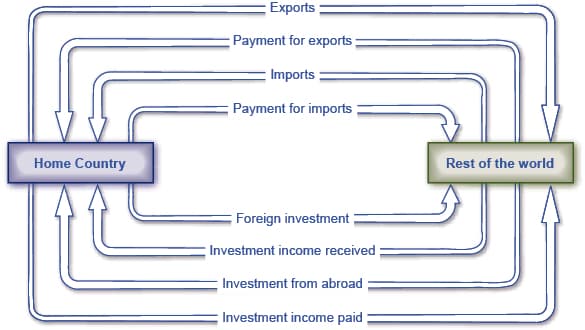
Financial capital flows are movements of money across borders for investment purposes, such as buying stocks, bonds, or real estate in another country.
Here's the key relationship: trade balances and capital flows are two sides of the same coin. They must mirror each other.
- A country running a trade surplus receives more foreign currency from its exports than it spends on imports. That extra foreign currency flows back into the country as investment, creating a net inflow of financial capital. Foreign buyers are essentially paying for the surplus goods by investing in the surplus country's assets.
- A country running a trade deficit spends more on imports than it earns from exports. To cover the difference, it sells assets to foreigners or borrows from them, creating a net outflow of financial capital. Think of the U.S., which has run persistent trade deficits: foreign governments and investors hold trillions of dollars in U.S. Treasury bonds and other American assets.
A trade deficit doesn't mean financial capital is "leaving" the country. It actually means financial capital is flowing in from abroad to finance the deficit. The deficit country attracts foreign investment. This is a common point of confusion.

Comparative Advantage Determinants
Comparative advantage means a country can produce a good or service at a lower opportunity cost than another country. It's not about being the absolute best at something; it's about what you give up to produce it.
Several factors shape where comparative advantage falls:
- Factor endowments (land, labor, capital, entrepreneurship): A country with abundant fertile land, like Brazil, has a comparative advantage in agricultural products. A country with a highly skilled labor force, like South Korea, has a comparative advantage in high-tech manufacturing like semiconductors.
- Technology and productivity: Countries with advanced production technology can produce goods more efficiently. Investments in automation or lean manufacturing techniques lower per-unit costs and shift comparative advantage toward those goods.
- Economic policies and institutions: Stable legal systems, favorable tax structures, and streamlined regulations can attract investment and production, reinforcing a country's comparative advantage in certain industries.
When countries specialize based on comparative advantage and trade with each other, all sides benefit through increased total output, lower prices, and greater variety of goods available to consumers.

Balanced Trade Dynamics
Balanced trade occurs when the value of a country's exports equals the value of its imports, giving a trade balance of zero.
In this scenario, the flows of goods/services and financial capital offset each other exactly:
- When the country exports, it receives foreign currency as payment.
- That foreign currency gets used to purchase foreign assets or invest abroad (foreign stocks, bonds, real estate).
- When the country imports, it pays in its own currency.
- Foreigners then use that currency to purchase the country's domestic assets or invest in the country.
Because exports and imports are equal, the currency flowing out to pay for imports matches the currency flowing in from exports. There's no net inflow or outflow of financial capital.
In practice, perfectly balanced trade is rare. Most countries run either a surplus or a deficit in any given year. But the balanced-trade case is useful because it shows clearly how trade flows and capital flows are always connected: every dollar spent on imports eventually returns as either a purchase of exports or an investment in the country's assets.
See Fiveable more often in Google
Mark Fiveable as a preferred source and Google is more likely to show you our guides in Top Stories, with a "preferred" badge in AI Mode and AI Overviews.