33.3 Intra-Industry Trade between Similar Economies

💸Principles of Economics Unit 33 Review
33.3 Intra-Industry Trade between Similar Economies
Intra-Industry Trade and Specialization
Intra-industry trade happens when countries exchange similar products within the same industry. Germany exports BMWs to Japan while Japan exports Toyotas to Germany. This is different from inter-industry trade, where countries swap fundamentally different goods (like coffee for machinery). Intra-industry trade is especially common between economies at similar levels of development, and it's driven by specialization, economies of scale, and consumer demand for variety.

Top images from around the web for Specialization and Splitting the Value Chain
Examining Intra-Industry Trade between India & China: Is India on the Right Track? View original
Is this image relevant?
Intra-industry Trade between Similar Economies · Economics View original
Is this image relevant?
Intra-industry Trade between Similar Economies | OpenStax Macroeconomics 2e View original
Is this image relevant?
Examining Intra-Industry Trade between India & China: Is India on the Right Track? View original
Is this image relevant?
Intra-industry Trade between Similar Economies · Economics View original
Is this image relevant?
Specialization and Splitting the Value Chain
Rather than building an entire product from scratch, countries often specialize in specific stages of production. A single smartphone might have its chips designed in the U.S., manufactured in Taiwan, assembled in China, and packaged with software from South Korea. This is what economists call splitting the value chain: breaking the production process into distinct stages spread across different countries.
Each country takes on the stage where it has a comparative advantage, whether that's cheap labor, advanced technology, or abundant raw materials. This arrangement creates gains from trade in two ways:
- Lower production costs: Each stage is handled by the country that can do it most efficiently, reducing the overall cost of the finished product.
- Higher productivity and quality: Workers and firms that focus on a narrow task develop deeper expertise. A factory that only produces camera lenses will get better at it than one that tries to build entire cameras.
Countries can also import components at lower prices from partners who specialize in those parts, which pulls down the total cost of production even further.

Economies of Scale, Competition, and Variety
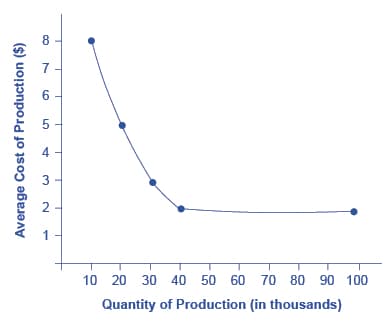
Economies of scale occur when the average cost of production falls as output increases. This happens because fixed costs (factory rent, equipment, R&D spending) get spread over a larger number of units. If a factory costs $10 million to build and produces 1 million units, the fixed cost per unit is $10. Produce 10 million units, and it drops to $1.
International trade fuels economies of scale by giving firms access to markets far larger than their domestic customer base. A Danish wind turbine manufacturer selling only within Denmark faces a small market, but selling across Europe and beyond lets it ramp up production and drive down average costs.
This expanded market also brings increased competition. Foreign firms entering a domestic market pressure local producers to become more efficient, cut costs, and innovate. Firms that can't keep up may be forced out. While that's painful for those firms, the overall effect is a more productive economy.
For consumers, the payoff is greater variety. Intra-industry trade means you're not limited to whatever your home country produces. You get access to differentiated products from many countries: Japanese, German, American, and Korean cars all competing for your purchase, each offering different features, styles, and price points.

Dynamic Comparative Advantage and New Specializations
A country's comparative advantage isn't fixed. Dynamic comparative advantage describes how nations develop new areas of specialization over time through investment in technology, education, and skills.
This shift typically follows a pattern:
- A country starts by specializing in industries that match its current resources (often labor-intensive manufacturing for developing economies).
- Through investment in R&D, education, and learning from foreign firms, it builds new capabilities.
- As its workforce becomes more skilled and capital accumulates, its comparative advantage shifts toward higher-value industries.
- The country moves into more advanced, capital-intensive or knowledge-intensive production.
Two clear examples illustrate this process:
- South Korea transitioned from labor-intensive textiles in the 1960s to world-leading production of semiconductors, smartphones (Samsung), and automobiles (Hyundai) by the 2000s.
- China is currently shifting from low-cost assembly manufacturing toward advanced industries like robotics, artificial intelligence, and electric vehicles.
Developing new specializations matters because it keeps countries competitive as global conditions change. Economies that stay locked into low-value-added activities face limited growth potential and vulnerability to being undercut by even lower-cost competitors. Continually upgrading into higher-value production is how countries sustain long-term economic growth in a trading world.
See Fiveable more often in Google
Mark Fiveable as a preferred source and Google is more likely to show you our guides in Top Stories, with a "preferred" badge in AI Mode and AI Overviews.