23.2 Trade Balances in Historical and International Context

💸Principles of Economics Unit 23 Review
23.2 Trade Balances in Historical and International Context
💸 Principles of Economics
U.S. Trade Balances

Top images from around the web for Trade Balance Graphs and Data
Demand and Supply Analysis of International Trade | Macroeconomics View original
Is this image relevant?
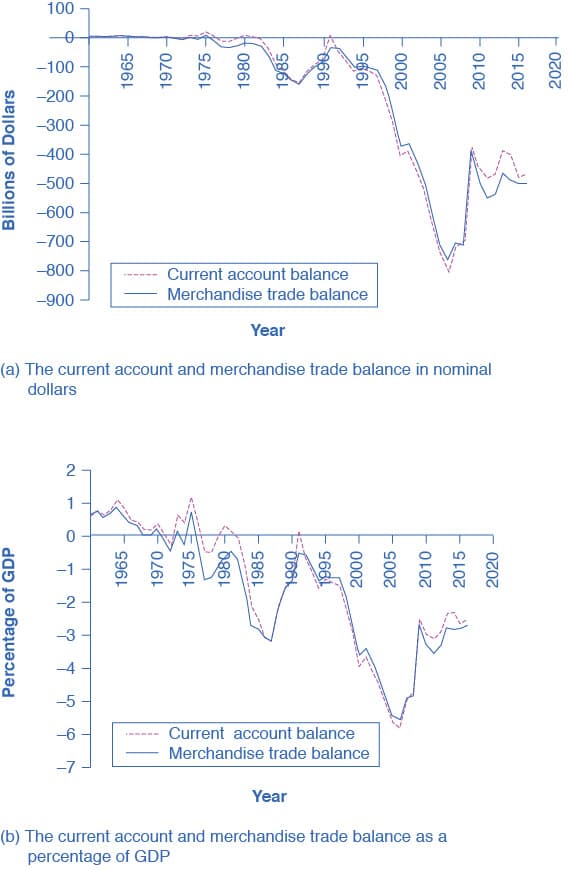
Trade Balances in Historical and International Context | OpenStax Macroeconomics 2e View original
Is this image relevant?
Gains from Trade | Boundless Economics View original
Is this image relevant?
Demand and Supply Analysis of International Trade | Macroeconomics View original
Is this image relevant?
Trade Balances in Historical and International Context | OpenStax Macroeconomics 2e View original
Is this image relevant?
Trade Balance Graphs and Data
A country's trade balance is calculated by subtracting the value of its imports from the value of its exports.
- Exports are goods and services produced within a country and sold to foreign buyers
- Imports are goods and services purchased from other countries and brought in
When imports exceed exports, the result is a trade deficit. On a graph, you'll see the imports line sitting above the exports line. When exports exceed imports, that's a trade surplus, with the exports line on top.

Patterns in U.S. Trade Deficits and Surpluses
The U.S. has run persistent trade deficits since the 1970s. The last time the country recorded a trade surplus was 1975.
Starting in the 1990s, the deficit grew sharply, rising from around billion in 1990 to over billion by 2020. Several forces drove this expansion:
- Increased global competition and outsourcing. Manufacturing jobs shifted to countries with lower labor costs, especially China and Mexico, meaning more goods Americans buy are produced abroad.
- Rising energy imports. Higher oil prices and continued reliance on energy from the Middle East and Canada pushed up the import bill.
- Consumer demand for imported goods. Americans increasingly purchased foreign-made electronics, clothing, and other consumer products.
The deficit also moves with the business cycle. During economic expansions, consumer spending rises and pulls in more imports, widening the deficit. During recessions, spending drops, import demand falls, and the deficit tends to shrink.

International Trade Balances
U.S. Trade Balances Compared to Other Major Economies
The U.S. holds the world's largest trade deficit in absolute dollar terms. However, as a percentage of GDP, the U.S. deficit is actually smaller than that of some other countries, such as the UK and Canada. This distinction matters because raw dollar figures can be misleading without accounting for the size of an economy.
On the surplus side, China has the world's largest trade surplus. That surplus grew significantly after China joined the World Trade Organization (WTO) in 2001, which opened up access to global markets. Germany and Japan also run large surpluses, driven by strong manufacturing sectors that specialize in exports like automobiles and machinery.
Several factors shape why trade balances differ across countries:
- Exchange rates. A weaker currency makes a country's exports cheaper for foreign buyers. Some countries have been accused of currency manipulation, keeping their currency artificially low to boost exports.
- Comparative advantage and specialization. Countries tend to export what they produce most efficiently. Germany specializes in high-end manufacturing, while China has focused on low-cost manufacturing.
- Trade policies. Tariffs, quotas, and subsidies can tilt the balance by protecting domestic industries or making exports more competitive.
These global imbalances often create economic and political friction. Countries with large surpluses (like China and Japan) face pressure from trading partners to let their currencies appreciate and reduce export subsidies. Countries with large deficits sometimes respond with protective measures. The U.S. tariffs on steel and aluminum imports are a well-known example of this dynamic.
See Fiveable more often in Google
Mark Fiveable as a preferred source and Google is more likely to show you our guides in Top Stories, with a "preferred" badge in AI Mode and AI Overviews.