2.2 The Production Possibilities Frontier and Social Choices

💸Principles of Economics Unit 2 Review
2.2 The Production Possibilities Frontier and Social Choices
💸 Principles of Economics
The production possibilities frontier (PPF) is one of the first models you'll encounter in economics, and it does a lot of heavy lifting. It shows the maximum output an economy can produce with its available resources, and in doing so, it illustrates trade-offs, opportunity cost, and efficiency all in one graph.
The PPF also helps explain economic growth, specialization, and the benefits of trade. By analyzing shifts in the curve and comparing different points on it, you can see how economies make choices about resource allocation.
Production Possibilities and Efficiency

Top images from around the web for Production possibilities frontier analysis
Production–possibility frontier - Wikipedia View original
Is this image relevant?
Production–possibility frontier - Wikipedia View original
Is this image relevant?
The Production Possibilities Frontier and Social Choices | OpenStax Macroeconomics 2e View original
Is this image relevant?
Production–possibility frontier - Wikipedia View original
Is this image relevant?
Production–possibility frontier - Wikipedia View original
Is this image relevant?
Production possibilities frontier analysis
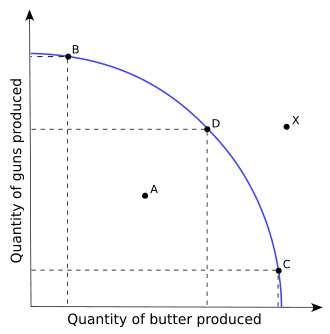
The PPF is a graph showing every maximum combination of two goods an economy can produce using all its available resources and technology.
- Points on the PPF represent productive efficiency: every resource is being fully used.
- Points inside the PPF represent inefficiency: some resources are sitting idle or being misused (think unemployment or underused factories).
- Points outside the PPF are unattainable with current resources and technology.
The PPF directly illustrates opportunity cost. Because resources are limited, producing more of one good means producing less of the other. The slope of the PPF at any point tells you the opportunity cost of one additional unit of that good, measured in how much of the other good you give up.
The PPF can also shift:
- An outward shift means economic growth: the economy can now produce more of both goods. This happens through things like discovering new resources, technological breakthroughs, or a growing labor force.
- An inward shift means the economy's capacity has shrunk, perhaps due to a natural disaster, war, or loss of resources.
Budget constraints vs production frontiers
Budget constraints and PPFs are built on the same logic: scarcity forces trade-offs. But they apply at different scales.
- A budget constraint shows the combinations of goods a consumer can buy given their income and the prices of goods. Its slope equals the ratio of prices: . Changes in income or prices shift or rotate the line (a raise lets you buy more; a price increase squeezes your options).
- A PPF shows the combinations of goods an economy can produce given its resources and technology. Its slope represents the opportunity cost of production. Changes in resources, technology, or productivity shift the curve (immigration expands it; a drought contracts it).
Both models force the same core question: given that you can't have everything, what combination do you choose?
Diminishing returns and frontier shape
Why is the PPF bowed outward (concave to the origin) instead of a straight line? The answer is the law of diminishing returns: as you keep shifting resources toward producing one good, each additional unit costs more and more of the other good.
This happens because resources aren't perfectly adaptable. A farmer reassigned to a software company won't be as productive as a trained programmer. Specialized machinery for making cars can't easily stamp out medical equipment. As you divert more and more resources away from what they're suited for, productivity drops and opportunity cost rises.
The result: the PPF gets steeper as you move along it. Near the endpoints (where you're producing almost entirely one good), the opportunity cost of squeezing out one more unit is very high.
A straight-line PPF would mean constant opportunity costs, which implies resources are equally productive in both uses. That's a special case, not the norm.
Productive vs allocative efficiency
These are two distinct types of efficiency, and the PPF helps distinguish them.
- Productive efficiency means producing goods at the lowest possible cost. Any point on the PPF is productively efficient because you can't make more of one good without making less of the other. All resources are fully employed and using the best available technology.
- Allocative efficiency means producing the right mix of goods to match what society actually wants. It's achieved when the marginal benefit of a good equals its marginal cost. You're not just producing efficiently; you're producing the things people value most.
Here's the key distinction: an economy can be productively efficient but allocatively inefficient. If a country is on its PPF but producing mostly luxury yachts while people lack affordable housing, resources aren't being allocated to match society's needs.

Comparative advantage and trade benefits
Comparative advantage means being able to produce a good at a lower opportunity cost than someone else. This is different from absolute advantage, which just means using fewer resources overall.
The classic example: Portugal might produce both wine and cloth more efficiently than England (absolute advantage in both). But if Portugal's opportunity cost of wine is lower and England's opportunity cost of cloth is lower, each country has a comparative advantage in one good.
The principle works like this:
- Each entity identifies the good it can produce at the lowest opportunity cost.
- Each specializes in that good.
- They trade their surplus for the other good.
The result is that total output increases, and both parties can consume beyond what their individual PPFs would allow. France exports wine and imports cars; both France and its trading partner end up better off than if each tried to produce everything domestically.
Social Choices and Trade-offs
Social decision-making trade-offs
The PPF frames the fundamental choices every society faces. With limited resources, producing more of one thing always means less of something else: consumer goods vs. capital goods, healthcare vs. defense spending, environmental protection vs. industrial output.
Where a society chooses to operate on its PPF depends on its preferences and values. Opportunity cost is central to these decisions. Allocating more to national defense means fewer resources for education or infrastructure. Society has to weigh the benefits of each option against what it gives up.
The shape of the PPF matters here too. If the curve is relatively flat in a particular region, the opportunity cost of producing more of that good is low, making it an easier call. If the curve is steep, each additional unit comes at a high cost, and the trade-off becomes harder to justify.
Marginal analysis in social decisions
Marginal analysis is the process of comparing the additional benefit of an action to its additional cost. Two key terms:
- Marginal benefit: the extra satisfaction or value gained from one more unit (one more public park, one more mile of highway).
- Marginal cost: the extra cost of producing that unit (the land, construction, ongoing maintenance).
The decision rule is straightforward: keep allocating resources to an activity as long as the marginal benefit exceeds the marginal cost. Stop when they're equal.
- If marginal benefit > marginal cost, society gains by doing more (subsidizing education when returns are high).
- If marginal cost > marginal benefit, society gains by doing less (scaling back a program that costs more than it delivers).
This is how society moves toward allocative efficiency. By evaluating each decision at the margin rather than in all-or-nothing terms, policymakers can fine-tune resource allocation to maximize overall well-being. Cost-benefit analysis in government is essentially marginal analysis applied to public spending.

Pareto efficiency and its limitations
Pareto efficiency describes a situation where you can't make anyone better off without making someone else worse off. All mutually beneficial trades and reallocations have been exhausted.
This is a useful benchmark. If an allocation isn't Pareto efficient, there's a way to improve someone's situation without hurting anyone, and that's a clear sign resources are being wasted. Removing market failures (like monopoly pricing or pollution externalities) can move an economy toward Pareto efficiency.
But Pareto efficiency has real limitations as a guide for social decisions:
- It ignores fairness. An allocation where one person owns everything and everyone else has nothing can still be Pareto efficient, since you can't help anyone without taking from that one person. Extreme inequality is fully compatible with the definition.
- It doesn't help you choose between efficient outcomes. There are many possible Pareto efficient allocations, and the concept gives no guidance on which one society should prefer.
Because of these gaps, real-world policy often involves trade-offs between efficiency and equity. Minimum wage laws, progressive taxation, and welfare programs may move society away from strict Pareto efficiency, but they can still be desirable if they advance fairness or reduce poverty. Efficiency is one goal among several, not the only one.
Economic Scarcity and Growth
Economic scarcity and its implications
Economic scarcity is the basic condition that drives all of economics: human wants are virtually unlimited, but the resources to satisfy them are not. Every society, no matter how wealthy, faces scarcity.
The PPF is a direct illustration of this. The boundary of the curve represents the hard limit on what can be produced. You can't operate outside it, so every production decision involves a trade-off.
Economic growth and its effects
Economic growth happens when an economy's productive capacity expands, pushing the PPF outward. This can result from:
- More resources: population growth, discovery of natural resources, increased capital investment.
- Better technology: innovations that let you produce more with the same inputs.
- Higher productivity: improved education, training, or organizational methods.
Growth is significant because it means society can produce more of both goods. Living standards can rise, and trade-offs become less painful when the overall pie is bigger.
Specialization and its benefits
Specialization means focusing production on the goods or services where you have a comparative advantage. Rather than trying to produce everything, an economy concentrates on what it does best relative to others.
Specialization boosts efficiency and productivity, which contributes to economic growth. Combined with trade, it allows societies to consume combinations of goods that lie beyond their own individual PPFs. That's the core payoff: by specializing and trading, everyone can end up with more than they could produce alone.
See Fiveable more often in Google
Mark Fiveable as a preferred source and Google is more likely to show you our guides in Top Stories, with a "preferred" badge in AI Mode and AI Overviews.