22.2 How to Measure Changes in the Cost of Living

💸Principles of Economics Unit 22 Review
22.2 How to Measure Changes in the Cost of Living
Measuring Changes in the Cost of Living

Top images from around the web for Consumer Price Index (CPI)
Consumer price index - Wikipedia View original
Is this image relevant?
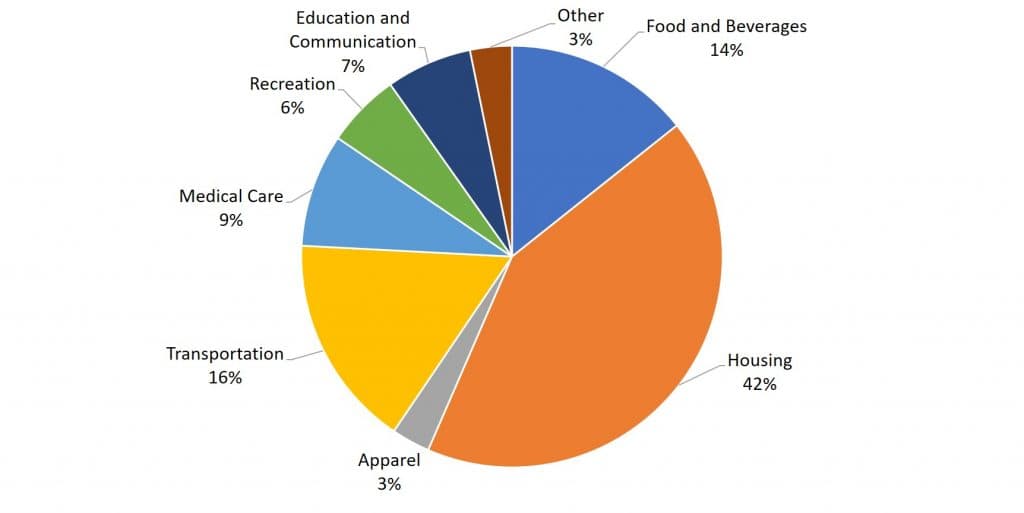
Inflation – Introduction to Macroeconomics View original
Is this image relevant?
The Consumer Price Index | Macroeconomics View original
Is this image relevant?
Consumer price index - Wikipedia View original
Is this image relevant?
Inflation – Introduction to Macroeconomics View original
Is this image relevant?
Consumer Price Index (CPI)
The Consumer Price Index (CPI) tracks how the cost of a fixed "basket" of goods and services changes over time. It's the most widely used measure of inflation and tells you whether everyday life is getting more or less expensive for a typical household.
The Bureau of Labor Statistics (BLS) builds and maintains this basket. It includes categories like food, clothing, shelter, transportation, and medical care. Each item is weighted based on how much of a typical consumer's budget it represents. Shelter, for example, carries a much heavier weight than something like apparel, because people spend a larger share of their income on housing.
To calculate the CPI, the BLS compares the cost of the basket in a given year to its cost in a base year (the base year CPI is set to 100). The inflation rate is then the percentage change in CPI from one period to the next:
where is the current period CPI and is the earlier period CPI.
So if the CPI rose from 250 to 260 over a year, the inflation rate would be .

Addressing Potential Biases
The CPI isn't perfect. Because it relies on a fixed basket, it can overstate or understate true changes in the cost of living. There are four main biases to know:
- Substitution bias occurs when consumers swap to cheaper alternatives as prices rise (say, ground beef instead of steak), but the CPI keeps tracking the original, pricier item. This makes inflation look higher than it really is. The chained CPI addresses this by updating the basket to reflect actual consumer behavior.
- Quality bias happens when products improve over time but the CPI records only the price change, not the added value. A smartphone that costs the same as last year's model but has a better camera and faster processor is effectively cheaper per unit of quality. The BLS uses quality adjustments (called hedonic adjustments) to account for this.
- New product bias arises when new goods enter the market (like streaming services or electric vehicles) but aren't included in the basket right away. Until the basket is updated, the CPI misses price changes in products consumers are actually buying. The BLS periodically revises the basket to include new products.
- Outlet bias shows up when consumers shift their shopping to lower-priced stores (discount retailers, online shops), but the CPI data doesn't capture that shift. The BLS now collects price data from a wider variety of outlets, including discount and online retailers, to reduce this bias.
Because of these biases, many economists believe the CPI slightly overstates true inflation. That matters because the CPI is used to adjust Social Security payments, tax brackets, and wage contracts.

Other Price Indices
The CPI focuses on what consumers buy, but economists also track prices elsewhere in the economy.
Producer Price Index (PPI)
- Measures the average change in prices that domestic producers receive for their output.
- It tracks goods and services from the seller's side, not the buyer's side. That means it excludes imports and sales/excise taxes.
- Rising PPI can signal that consumer prices may rise soon, since higher production costs often get passed along to buyers.
GDP Deflator
- Measures the average price level of all goods and services included in GDP, not just a consumer basket.
- Calculated as:
- Unlike the CPI, the GDP deflator does not use a fixed basket. It automatically adjusts as the mix of goods and services produced in the economy changes. This means it avoids substitution bias by design.
- However, it includes goods consumers don't directly buy (like military equipment or factory machinery), so it's less useful for measuring your personal cost of living.
CPI vs. GDP Deflator: The CPI uses a fixed basket and includes imported goods. The GDP deflator covers all domestically produced goods with a flexible basket but excludes imports. They often move together, but they can diverge when import prices shift or the composition of domestic output changes.
See Fiveable more often in Google
Mark Fiveable as a preferred source and Google is more likely to show you our guides in Top Stories, with a "preferred" badge in AI Mode and AI Overviews.