21.4 What Causes Changes in Unemployment over the Long Run

💸Principles of Economics Unit 21 Review
21.4 What Causes Changes in Unemployment over the Long Run
Factors Affecting Long-Run Unemployment
Long-run unemployment isn't just about recessions or job losses. It reflects deeper, structural features of the economy: how easily workers can find jobs, how productive firms are, and what rules the government sets for the labor market. Together, these factors determine the natural rate of unemployment, which is the baseline unemployment rate that persists even when the economy is healthy and growing.

Top images from around the web for Frictional Unemployment and Natural Rate
What Causes Changes in Unemployment over the Long Run · Economics View original
Is this image relevant?
The Labor Market and Full Employment Equilibrium – Principles of Economics: Scarcity and Social ... View original
Is this image relevant?
Unemployment - Wikipedia View original
Is this image relevant?
What Causes Changes in Unemployment over the Long Run · Economics View original
Is this image relevant?
The Labor Market and Full Employment Equilibrium – Principles of Economics: Scarcity and Social ... View original
Is this image relevant?
Frictional Unemployment and the Natural Rate
Frictional unemployment happens when workers are temporarily between jobs. This includes people who quit to find something better, recent graduates entering the workforce for the first time, or anyone in that gap between leaving one position and starting another. It's considered voluntary and short-term.
This type of unemployment is actually normal and unavoidable. In a dynamic economy, people will always be moving between jobs, and that process takes time. Frictional unemployment isn't a sign that something is wrong.
The natural rate of unemployment equals frictional unemployment plus structural unemployment combined. It represents the level of unemployment you'd expect even when the economy is operating at full capacity. The economy is considered "at full employment" when actual unemployment equals the natural rate, not when unemployment is literally zero.

How Productivity Shifts Affect Unemployment
Productivity measures how much output is produced per unit of input (labor, capital, etc.). Shifts in productivity can come from technological advancements, better worker skills, or improved production processes.
- Positive productivity shifts can lower the natural rate over time. When firms produce more per worker, they tend to become more profitable, which can lead to expansion and more hiring. Think of how computing technology made many industries more efficient and created entirely new job categories.
- Negative productivity shifts can raise the natural rate. If productivity falls, firms may need to cut workers to stay profitable. Worse, workers whose skills have become obsolete face structural unemployment, where their qualifications no longer match what employers need.
The key distinction: productivity gains don't automatically mean fewer jobs. Higher productivity often makes firms more competitive, which can increase demand for their products and lead to more hiring, not less.

Government Policies and Their Influence
Government policy is one of the biggest levers affecting long-run unemployment. Different policies push the natural rate in different directions.
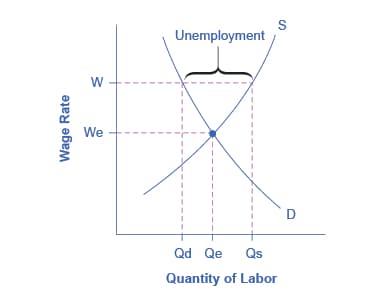
Minimum wage laws set a floor on how much workers must be paid. When the minimum wage is set above the market equilibrium wage, it can increase unemployment because:
- Firms reduce hiring to offset higher labor costs
- Low-skilled workers are hit hardest, since their productivity may not justify the mandated wage
- The result is a surplus of labor: more people want jobs at that wage than firms are willing to offer
Unemployment insurance provides income to workers who lose their jobs. While it serves as an important safety net, it can also raise frictional unemployment by reducing the urgency of finding a new job. Workers receiving benefits may search longer and be more selective, which extends the average duration of unemployment.
Labor market regulations, such as strict employment protection laws, can make firms hesitant to hire. If it's expensive or legally difficult to lay off workers, employers become more cautious about adding staff in the first place. Strong labor union bargaining power can have a similar effect by pushing wages above equilibrium levels.
Education and training policies work in the opposite direction. By investing in worker skills, governments can:
- Help workers adapt to changing labor market demands
- Reduce the mismatch between what employers need and what workers can offer
- Lower structural unemployment over time
This is why economists often point to education and retraining programs as the most effective long-run tools for reducing the natural rate of unemployment. They address the root cause of structural unemployment rather than just its symptoms.
See Fiveable more often in Google
Mark Fiveable as a preferred source and Google is more likely to show you our guides in Top Stories, with a "preferred" badge in AI Mode and AI Overviews.