14.4 Bilateral Monopoly

💸Principles of Economics Unit 14 Review
14.4 Bilateral Monopoly
💸 Principles of Economics
Bilateral Monopoly in Labor Markets
Most labor markets have many employers competing for workers, which pushes wages toward a competitive equilibrium. But what happens when there's only one major employer and one powerful union? You get a bilateral monopoly, where both sides hold market power and the final wage comes down to negotiation. Understanding this structure helps explain why wages in certain industries don't follow simple supply-and-demand predictions.

Top images from around the web for Monopsony, Union, Bilateral Monopoly
The Labor Relations Process | OpenStax Intro to Business View original
Is this image relevant?
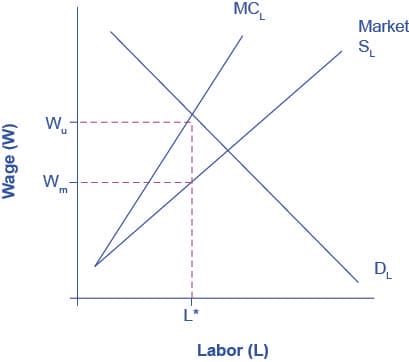
Bilateral Monopoly | OS Microeconomics 2e View original
Is this image relevant?
Labor Market Power by Employees | Public Economics View original
Is this image relevant?
The Labor Relations Process | OpenStax Intro to Business View original
Is this image relevant?
Bilateral Monopoly | OS Microeconomics 2e View original
Is this image relevant?
Monopsony, Union, and Bilateral Monopoly
A monopsony is a labor market with a single buyer of labor. Because the employer is the only game in town, it faces an upward-sloping labor supply curve. That means it can set wages below the competitive level since workers don't have other options nearby. Think of a coal mining town with one major employer: if you want to work, you accept what they offer.
A union is an organization that represents workers collectively. By bargaining as a group (and threatening to strike if necessary), a union can push wages above what any individual worker could negotiate alone. The United Auto Workers union is a classic example.
A bilateral monopoly forms when these two forces collide in the same market: one dominant employer facing one powerful union. Professional sports leagues illustrate this well, where a league acts as the sole employer for top-level athletes and a players' association represents all the athletes.
In this structure:
- The monopsony employer aims to minimize labor costs and would prefer to pay the monopsony wage (below competitive level).
- The union aims to maximize wages for its members and pushes toward a wage above the competitive level.
- The actual negotiated wage lands somewhere between these two positions, depending on each side's bargaining power.
Employment is then determined by where the negotiated wage intersects the employer's labor demand curve. A higher negotiated wage generally means the employer hires fewer workers, while a lower negotiated wage means more hiring.

Impact on Wages and Employment
The key result of bilateral monopoly is that the outcome wage falls in a range between the monopsony wage (the employer's preferred low wage) and the union wage (the union's preferred high wage). The competitive wage typically sits somewhere inside this range too.
Where the wage actually lands depends entirely on bargaining. There's no single equilibrium the way there is in a competitive market. This is what makes bilateral monopoly distinctive and somewhat unpredictable.
Impact on wages:
- The floor is the monopsony wage (what the employer would pay with no union).
- The ceiling is the union wage (what the union would demand facing a competitive employer).
- The negotiated wage falls between these, closer to whichever side has stronger bargaining power.
Impact on employment:
- Employment is typically lower than in a perfectly competitive market, creating deadweight loss.
- Once a wage is agreed upon, the employer decides how many workers to hire by moving along its labor demand curve. Higher negotiated wages mean fewer jobs; lower negotiated wages mean more.
Consider the healthcare industry: a dominant hospital system facing a strong nurses' union. The hospital wants to keep nursing salaries low to control costs, while the union pushes for higher pay. The resulting salary reflects their relative leverage, and the number of nurses hired follows from that negotiated rate.

Factors Influencing Bargaining Power
Since the outcome hinges on bargaining power, it's worth understanding what strengthens each side's position.
What strengthens the union:
- High membership rates and worker solidarity (a united workforce is harder to ignore)
- A credible strike threat, especially in industries where production halts completely without workers
- Few available substitute workers or replacement options for the employer
- Public sympathy and political influence (teachers' unions, for instance, often benefit from public support for education)
What strengthens the employer:
- High labor market concentration (fewer alternative employers means workers have limited outside options)
- Inelastic labor supply (workers can't easily leave the area or switch industries)
- Deep financial resources to withstand a strike or slowdown
- Access to substitute labor, automation, or outsourcing (tech giants in Silicon Valley, for example, can recruit globally)
External factors that shift the balance:
- Economic conditions: During recessions, unions lose leverage because jobs are scarce. During booms, workers gain power because employers compete for talent.
- Government policy: Minimum wage laws, right-to-work legislation, and labor regulations can tilt the balance toward one side.
- Technological change: Automation and platforms like gig economy apps can weaken union power by creating alternative labor arrangements that bypass traditional collective bargaining.
The relative strength of these factors determines whether the negotiated wage ends up closer to the union's target or the employer's, and how many workers ultimately get hired.
See Fiveable more often in Google
Mark Fiveable as a preferred source and Google is more likely to show you our guides in Top Stories, with a "preferred" badge in AI Mode and AI Overviews.