9.1 How Monopolies Form: Barriers to Entry

💸Principles of Economics Unit 9 Review
9.1 How Monopolies Form: Barriers to Entry
💸 Principles of Economics
Monopoly Formation and Barriers to Entry
A monopoly exists when a single firm dominates a market so thoroughly that it effectively is the market. Understanding how monopolies form helps you see why some markets lack competition and why prices, output, and efficiency look so different compared to competitive markets. The key concept here: monopolies don't just happen randomly. They persist because barriers to entry prevent other firms from entering and competing.

Top images from around the web for Natural vs legal monopolies
Regulating Natural Monopolies | Microeconomics View original
Is this image relevant?
Monopoly in Public Policy | Boundless Economics View original
Is this image relevant?
Reading: How Monopolies Form: Barriers to Entry | Microeconomics View original
Is this image relevant?
Regulating Natural Monopolies | Microeconomics View original
Is this image relevant?
Monopoly in Public Policy | Boundless Economics View original
Is this image relevant?
Natural vs. Legal Monopolies
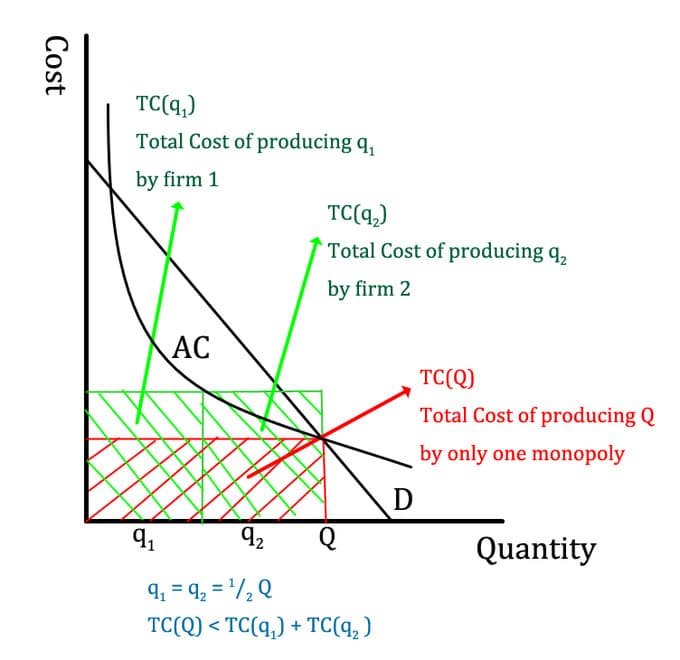
Natural monopolies emerge when the economics of an industry make it most efficient for a single firm to serve the entire market. This typically happens when fixed costs are extremely high relative to variable costs, so a firm's long-run average total cost keeps falling as it produces more output. In that situation, one large firm can supply the whole market at a lower cost per unit than two or more firms could.
- Utilities like electricity and water are classic examples. Building a second set of power lines or water pipes to serve the same neighborhood would be wasteful and more expensive for everyone.
- Telecommunications infrastructure (landline networks) and transportation networks (railways) follow the same logic.
The defining feature: economies of scale are so large relative to market demand that there's only room for one efficient producer.
Legal monopolies are created through government action that grants exclusive rights to a single firm. The government does this for specific policy reasons, such as protecting intellectual property, ensuring quality standards, or managing strategic resources.
- Patents, copyrights, and government-granted franchises (like the U.S. Postal Service's monopoly on first-class mail) all fall into this category.
- These monopolies exist by law, not because of cost structures.

Causes of Monopoly Formation
Several forces can give rise to monopoly power, often working together:
Economies of scale allow large firms to produce at lower average costs than smaller competitors. As output increases, long-run average total cost decreases. An established firm operating at high volume has a significant cost advantage, and a new entrant starting small would face much higher per-unit costs. This cost gap discourages entry.
Control of critical resources can block competitors entirely. If one firm owns or controls an essential input, rivals simply can't produce.
- De Beers historically controlled roughly 80-85% of the world's rough diamond supply, which gave it enormous monopoly power in that market.
- Exclusive access to rare earth elements, strategic locations (like a key port), or essential distribution infrastructure can have the same effect.
Vertical integration occurs when a firm controls multiple stages of production or distribution. A company that owns its suppliers and its retail outlets can make it very difficult for a new competitor to find suppliers willing to sell to them or stores willing to carry their product.

Intellectual Property and Market Dominance
Intellectual property (IP) rights are government-created legal protections that can generate significant market power.
Patents grant inventors exclusive rights to make, use, or sell an invention for a limited period (typically 20 years in the U.S.). During that window, no competitor can legally produce the same product.
- Pharmaceutical companies depend heavily on patents. Developing a new drug can cost over $1 billion, and without patent protection, generic manufacturers could copy the formula immediately, making it impossible to recoup R&D costs.
- This creates a temporary monopoly by design: society trades short-term higher prices for the long-term benefit of incentivizing innovation.
Trademarks protect brand names, logos, and other distinguishing features. They don't create monopolies on their own, but strong trademarks build brand loyalty, which acts as a barrier to entry. When consumers strongly prefer an established brand, new firms struggle to attract customers even if their product is comparable.
Copyrights protect original creative works (books, music, software code) and function similarly to patents in granting exclusive rights.
Together, IP rights can create lasting market dominance. Microsoft's Windows operating system benefited from both copyright protection on its software and the network effects that came with widespread adoption. During the late 1990s and 2000s, Windows held over 90% of the desktop OS market.
Predatory Pricing as an Entry Barrier
Predatory pricing is a strategy where a dominant firm deliberately sets prices below its own costs to drive competitors out of the market. The logic works in two stages:
- The dominant firm cuts prices to unsustainably low levels. It absorbs short-term losses because it has deeper financial reserves than its rivals.
- Smaller competitors, unable to match these prices, eventually exit the market.
- Once rivals are gone, the dominant firm raises prices above competitive levels to recoup its losses and earn monopoly profits.
The Standard Oil Company in the late 19th century is the textbook example. It would slash prices in specific regional markets to bankrupt local competitors, then raise prices after achieving dominance.
Even the threat of predatory pricing can deter entry. If a firm has a reputation for aggressive price wars, potential entrants may decide the risk isn't worth it.
Predatory pricing is illegal under U.S. antitrust law, but it's notoriously hard to prove. Courts generally require evidence that the firm priced below its own average variable cost, not just that it priced lower than competitors. A related (and legal) strategy is limit pricing, where a firm sets prices low enough to make entry unprofitable for rivals but not so low that the firm itself takes losses.
Additional Factors Influencing Monopoly Formation
A few other forces can reinforce or create monopoly power:
- Network effects increase a product's value as more people use it. Social media platforms are a clear example: Facebook became dominant partly because that's where everyone else already was. This creates a self-reinforcing cycle that's very hard for new entrants to break.
- Sunk costs are upfront investments that can't be recovered if a firm exits the market. Industries requiring massive sunk costs (building a factory, laying cable infrastructure) discourage entry because the financial risk of failure is enormous.
- Regulatory capture happens when the firms being regulated gain undue influence over the regulators themselves. This can lead to rules that protect incumbents and raise barriers for newcomers, even when that wasn't the regulation's original intent.
See Fiveable more often in Google
Mark Fiveable as a preferred source and Google is more likely to show you our guides in Top Stories, with a "preferred" badge in AI Mode and AI Overviews.