34.5 The Tradeoffs of Trade Policy

💸Principles of Economics Unit 34 Review
34.5 The Tradeoffs of Trade Policy
💸 Principles of Economics
34.1
Protectionism: An Indirect Subsidy from Consumers to Producers
34.2
International Trade and Its Effects on Jobs, Wages, and Working Conditions
34.3
Arguments in Support of Restricting Imports
34.4
How Governments Enact Trade Policy: Globally, Regionally, and Nationally
34.5
The Tradeoffs of Trade Policy
International Trade and Policy Responses
International trade creates real tradeoffs: consumers benefit from lower prices and more choices, but some workers and industries bear significant costs. Trade policy is about deciding how to distribute those gains and losses. This section covers the effects of trade, how technological disruption reshapes markets, and the policy tools governments use to respond.

Top images from around the web for Effects of International Trade
Gains from Trade | Boundless Economics View original
Is this image relevant?
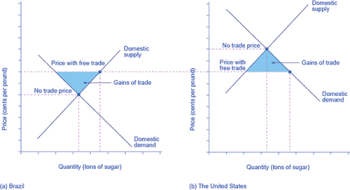
Reading: Demand and Supply Analysis of International Trade | Microeconomics View original
Is this image relevant?
Macroeconomic Effects of Exchange Rates | Microeconomics View original
Is this image relevant?
Gains from Trade | Boundless Economics View original
Is this image relevant?
Reading: Demand and Supply Analysis of International Trade | Microeconomics View original
Is this image relevant?
Effects of International Trade
Benefits of international trade:
- Lower prices and more variety for consumers. When foreign producers compete with domestic ones, prices tend to fall and the range of available goods expands. Think about how many different smartphone brands you can buy today compared to twenty years ago.
- Access to new markets. Domestic firms can sell to customers abroad, increasing their revenue beyond what the home market alone could support.
- Cheaper inputs. Firms can source raw materials and components from lower-cost suppliers around the world, which reduces their production costs.
Challenges posed by international trade:
- Increased competition from imports. Domestic firms that can't match foreign prices or quality may lose market share.
- Job losses and business closures. Industries that face heavy import competition sometimes shrink, leading to layoffs and even bankruptcies. The decline of U.S. textile manufacturing as production shifted overseas is a classic example.
- Structural unemployment. Workers displaced by trade often can't simply move to a new job in a new industry overnight. They may need retraining, relocation, or extended job searches, and some never fully recover their previous earnings.
Trade balance and exchange rates:
- A trade deficit means a country imports more than it exports (negative net exports). A trade surplus is the opposite.
- Exchange rates influence trade flows directly. When a country's currency appreciates (gains value), its exports become more expensive to foreign buyers and imports become cheaper for domestic consumers. Depreciation has the reverse effect, making exports more competitive abroad.

Technological Innovation and Market Disruptions
Technology doesn't just improve existing industries; it sometimes replaces them entirely. These disruptions interact with globalization in important ways.
Disruptive technologies are innovations that fundamentally change how industries operate or create new markets altogether. E-commerce (Amazon replacing many brick-and-mortar retailers), ride-sharing (Uber challenging traditional taxi companies), and streaming (Netflix displacing video rental stores like Blockbuster) are well-known examples.
Impact on established firms: Companies built around older business models can lose market share rapidly. Kodak, once dominant in film photography, filed for bankruptcy after failing to adapt to digital cameras. The pattern is consistent: firms that don't innovate get left behind.
Opportunities for new entrants: Disruptive technologies often lower barriers to entry. A startup with a good app and modest funding can now compete with established corporations. This is especially significant for developing countries, which can "leapfrog" older technologies entirely. Kenya's M-Pesa mobile banking system, for instance, brought financial services to millions of people who never had traditional bank accounts.
Globalization accelerates this process. Innovations spread across borders through trade, foreign investment, and knowledge transfer, meaning disruptions in one country quickly ripple worldwide.

Policy Responses to Globalization
Governments have several tools to manage the tradeoffs that come with open trade. The challenge is using them without undermining the benefits trade provides.
Trade agreements and regulations:
- Multilateral agreements (like those through the WTO) and bilateral deals (like USMCA, formerly NAFTA) set rules for fair competition and reduce trade barriers.
- Regulations on labor standards, environmental protection, and intellectual property help prevent a "race to the bottom" where countries compete by weakening protections. Examples include minimum wage laws, emissions standards, and patent enforcement.
Targeted assistance for affected workers and industries:
- Subsidies and tax incentives can help domestic firms invest in research and development to stay competitive, rather than simply shielding them from foreign competition.
- Retraining programs and job search assistance support displaced workers. The U.S. Trade Adjustment Assistance (TAA) program, for example, provides extended unemployment benefits and vocational training for workers who lose jobs due to imports.
Investments in education and infrastructure:
- Strengthening education, particularly in technical and STEM fields, helps workers adapt as job requirements shift.
- Infrastructure investments like modernizing ports, highways, and broadband networks reduce trade costs and make domestic firms more competitive globally.
Balancing trade openness with domestic priorities:
Policymakers face a genuine tension. Free trade maximizes overall economic efficiency, but the gains aren't distributed evenly. Some industries and communities absorb most of the costs. Strategic trade policies try to navigate this by protecting industries that are still developing (infant industry protection) or promoting exports in sectors where a country has growth potential. The key tradeoff is always the same: protection helps specific groups in the short run but can raise prices and reduce efficiency for everyone in the long run.
See Fiveable more often in Google
Mark Fiveable as a preferred source and Google is more likely to show you our guides in Top Stories, with a "preferred" badge in AI Mode and AI Overviews.