2.1 How Individuals Make Choices Based on Their Budget Constraint

💸Principles of Economics Unit 2 Review
2.1 How Individuals Make Choices Based on Their Budget Constraint
💸 Principles of Economics
Consumer Choice and Budget Constraints

Top images from around the web for Budget constraints and consumer choices
Reading: Income Changes and Consumption Choices | Microeconomics View original
Is this image relevant?
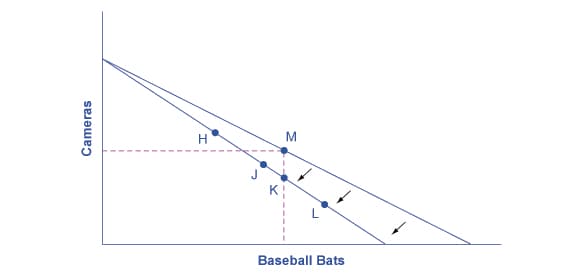
Income Changes and Consumption Choices | Microeconomics View original
Is this image relevant?
How Changes in Income and Prices Affect Consumption Choices | OS Microeconomics 2e View original
Is this image relevant?
Reading: Income Changes and Consumption Choices | Microeconomics View original
Is this image relevant?
Income Changes and Consumption Choices | Microeconomics View original
Is this image relevant?
Budget constraints and consumer choices
A budget constraint represents all the combinations of two goods a consumer can afford given their income and the prices of those goods. It's the starting point for understanding consumer choice because it defines what's actually possible before preferences even enter the picture.
- Graphically, the budget constraint is a straight line with one good on each axis (e.g., food on the x-axis, clothing on the y-axis)
- The slope of the budget line equals , which tells you the opportunity cost of one good in terms of the other. If food costs $2 and clothing costs $4, the slope is , meaning you give up half a unit of clothing for each unit of food
- Any point on or below the line is affordable. Any point above it is not.
The budget line shifts when income or prices change:
- Outward shift (right): income increases or prices drop, so you can afford more of both goods
- Inward shift (left): income decreases or prices rise, reducing your purchasing power
A consumer's optimal choice is the point on the budget line that maximizes their satisfaction (utility). In more advanced terms, this occurs where the budget line is tangent to the highest attainable indifference curve. For this intro-level course, the key idea is simpler: you want to spend your money in the way that gives you the most total satisfaction.

Opportunity costs in decision-making
Opportunity cost is the value of the next-best alternative you give up when you make a choice. Every time you spend $50 on a new shirt, the opportunity cost is whatever else you would have done with that $50, like putting it toward concert tickets.
- Scarcity forces these trade-offs. Because your income is limited, choosing more of one good means less of another.
- On the budget line itself, this trade-off is built into the slope. Moving along the line toward more food means giving up some clothing, at a rate determined by their relative prices.
The marginal rate of transformation (MRT) is a related concept that shows up on the production possibilities frontier (PPF). It represents the opportunity cost of producing one more unit of a good in terms of the other good an economy must sacrifice. The MRT is reflected in the slope of the PPF.

Diminishing marginal utility
Utility measures the satisfaction you get from consuming a good or service. Marginal utility is the additional satisfaction from consuming one more unit.
The law of diminishing marginal utility says that as you consume more of a good, each additional unit gives you less extra satisfaction than the one before. Your first slice of pizza might feel amazing. The second is still good. By the fourth or fifth, you're barely enjoying it.
This matters for two reasons:
- It helps explain the downward-sloping demand curve. Since each additional unit brings less satisfaction, you're only willing to pay less for it.
- It drives how you split your budget across goods. If your fifth slice of pizza barely satisfies you but a first soda would bring a lot of enjoyment, you're better off buying the soda.
Consumer equilibrium occurs when the marginal utility per dollar spent is equal across all goods you're buying. At that point, there's no way to rearrange your spending and get more total satisfaction. If you're paying $2 for pizza and $1 for soda, equilibrium means:
Marginal analysis for optimal choices
Marginal analysis means comparing the additional benefit of a decision to its additional cost. It's how economists think about almost every choice: not "all or nothing," but "one more or one less."
The equimarginal principle gives you a step-by-step rule for optimizing:
- Compare the marginal utility per dollar () across all goods you could buy.
- If one good has a higher than another, shift some spending toward that good.
- Keep reallocating until is equal across all goods. At that point, you've maximized your total utility.
Two effects explain how consumers respond to changes in income and prices:
- Income effect: When your income changes, the quantity you demand changes too. For normal goods, higher income means you buy more (e.g., more fresh produce after a raise). For inferior goods, higher income means you buy less (e.g., switching from instant noodles to restaurant meals).
- Substitution effect: When the price of a good rises, you tend to substitute toward cheaper alternatives, holding your overall satisfaction constant. If beef prices jump, you might buy more chicken instead.
These two effects work together to determine how your purchasing behavior shifts when conditions change.
Economic theories and consumer behavior
Rational choice theory assumes consumers make logical decisions to maximize utility given their preferences and budget constraints. It's the foundation of most models you'll encounter in this course.
Behavioral economics pushes back on this assumption. Research shows that people don't always act rationally. Cognitive biases (like overvaluing things you already own) and social influences (like peer pressure) can lead to choices that don't maximize utility in the traditional sense. For an intro course, just know that the rational model is a useful simplification, but real human behavior is messier.
See Fiveable more often in Google
Mark Fiveable as a preferred source and Google is more likely to show you our guides in Top Stories, with a "preferred" badge in AI Mode and AI Overviews.